Two performers rush down the stairs and sweep through the audience, their designer outfits splaying out as they speed elegantly around the gallery and disappear as quickly as they came. Thus begins a series of performances that are an intriguing mix of flamboyant narcissism and minimalist restraint.
Borrowing from various dance and performance traditions that seem at odds with one another, Trajal Harrell creates hybrid forms that are exhilarating, strange, beautiful and uplifting. On the one hand, there’s postmodern dance developed in New York by the Judson Dance Theater group, who replaced technique with everyday movements such as walking, running and standing. Summing up their approach is Yvonne Rainer’s 1965 No Manifesto which stipulates “NO to spectacle NO to virtuosity NO to glamour and transcendency NO to trash imagery NO to camp NO to seduction”.
 At the other extreme are the Voguing contests that originated in Harlem dance balls in the late 1960s, went viral in the 1980s and swept into the mainstream with Madonna’s 1990 song and music video Vogue. Imitating the walk and poses of fashion models, participants compete for attention with role paying, exotic costumes and complex moves. The mix of extravagant spectacle, trashy glamour and camp self-regard is the polar opposite of Rainer’s ambition to democratise and demystify dance, yet Harrell creates a fusion between these diverse languages.
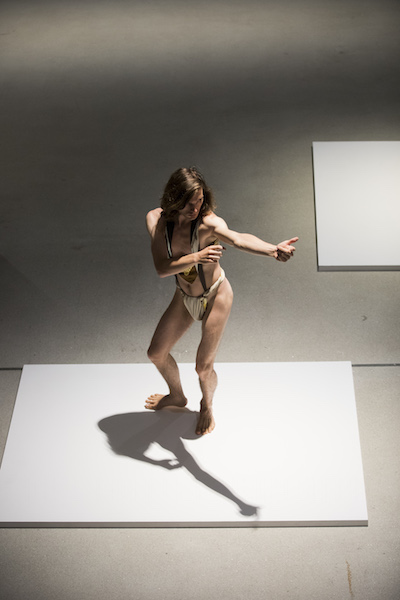
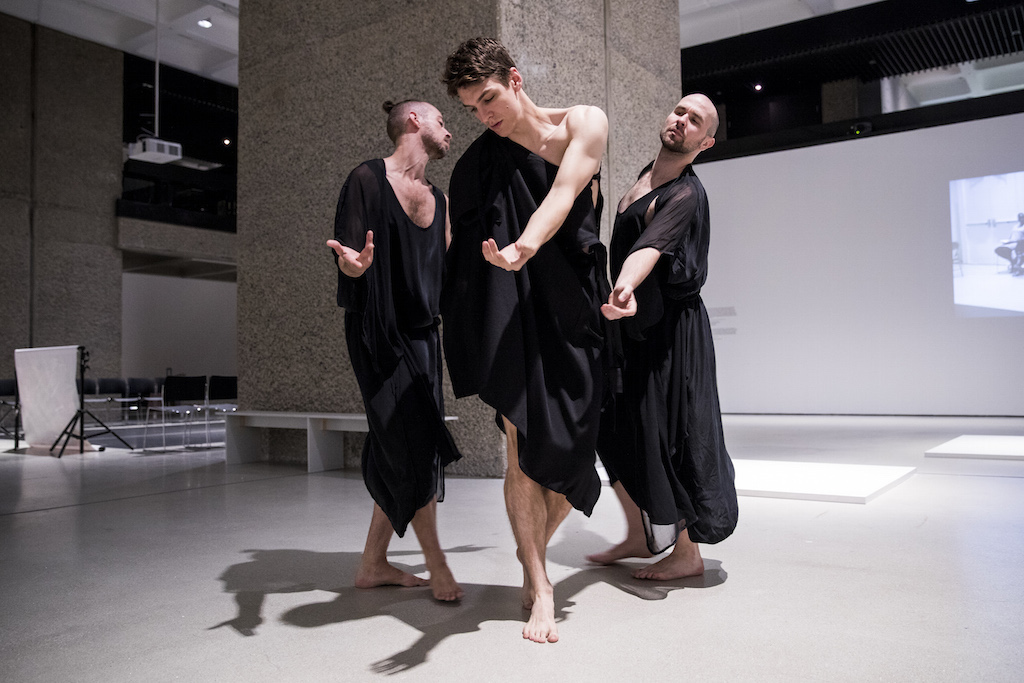
“What if you made Voguing minimal?” he asks. “I made this little piece to the song of Ode to Boy by YAZ. I just walked, posed and gazed.” As well as performing, he choreographs for other dancers. In Wall Dance two performers parade back and forth as though on a catwalk before developing more elaborate and idiosyncratic moves. Clad only in knotted silk scarves, in Creon’s Solo (pictured above right) a dancer gyrates under a spotlight so that his sinuous movements throw expressive shadows. Decked in flowing designer threads, the dancers in Ghost Trio (pictured below) remind me of Rodin’s sculpture The Burghers of Calais; the bronze figures seem to have come to life to enact a solemn ritual in anticipation of their martyrdom. With its gentle interweaving, the choreography is simple, but the effect is surprisingly moving.
Harrell does not just strut and sashay; he also reads and theorises. He knows his history and freely borrows ideas and samples different traditions. Two performers read in French and English The Conspiracy of Art, written in 2005 by French philosopher Jean Baudrillard. By replacing the word “art” with “performance”, Harrell adapts the essay into a critique of performance.
This approach, which is situated, he says, “between history and the imagination”, results in wonderfully rich spectacles. Footage of a catwalk display shows performers decked in a flamboyant array of aprons, skirts, bustles, hoods, scarves, tassles and fringes; it's as though some of the characters from classical Greek theatre have been updated for introduction to a voguing contest.
 During a residency at New York’s Museum of Modern Art, Harrell studied Tatsumi Hijikata, one of the founders of butoh. In The Return of La Argentina (main picture) he revisits a famous solo directed by Hijikata and performed by Kazuo Ohno, the other founder of butoh. To the rhythmic scraping and tapping of a spoon inside a bowl, he enters a trance-like state with eyes rolled back and mouth fixed in an ecstatic grin. Donning a blouse and skirt, he spins, stamps and yells while his face is transformed by a series of exaggerated expressions into a mask-like imitation of emotional extremes. This fusion of Eastern “no mind” – removal of self – and Western narcissism – self-regard – is strangely captivating. Unlike anything I’ve seen before, it offers endless potential for further exploration.
- Trajal Harrell: Hoochie Koochie at the Barbican untll 13 August
- Read more Visual Arts reviews on theartsdesk