It’s been a long time since an exhibition made me feel physically sick. The Hayward Gallery is currently hosting a retrospective of the Japanese artist Yoshitomo Nara and the combination of turquoise walls and oversized paintings of cute kids turned my stomach over. Kitsch has that kind of power.
It can also command high prices on the international market and Nara’s pictures sell for vast sums. In 2019 Knife Behind Back, a slick rendition of a grumpy girl in a red dress, sold at auction for £20 million. Since then, his prices have shrunk to a mere £9 million – still not bad for a product that, with minor variations, is repeated endlessly.
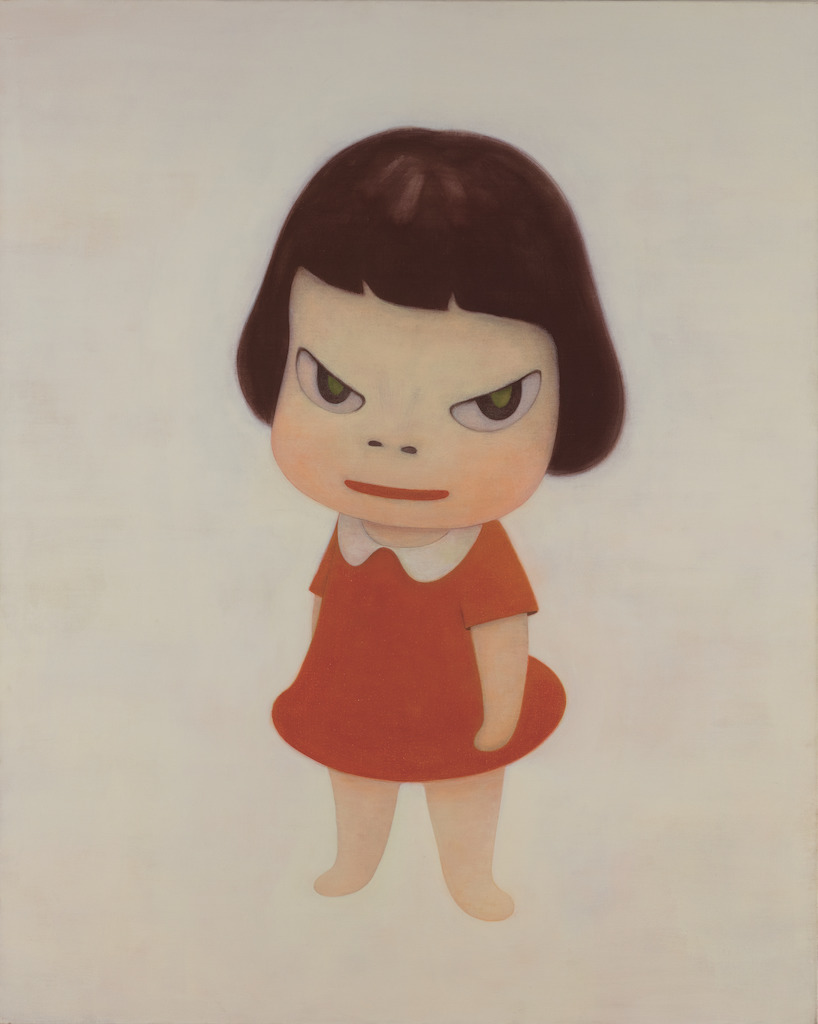 You can spot a Nara anywhere; whether smiling or angry, the little girl’s face consists of a single line for a mouth, a button nose, ambiguously shaped eyes – somewhere between oriental and western – that are set too far apart and often glisten with tears (pictured right: Missing in Action, 1999). These doll-like creatures supposedly portray a range of emotions, but whether smug, sad or defiant, all are designed to be disarmingly cute.
Under the Hazy Sky, 2012, was painted in response to the Fukushima Daiichi nuclear power plant accident in 2011, when the power plant was engulfed by a disastrous tsunami. The painting shows a depressed girl in a red dress against a yellow ground supposedly indicative of toxic smog. In her outstretched, spaghetti-like arms, she holds two seedlings representing peace and hope.
Such vapid sentimentality continues in the main gallery upstairs (pictured below) which is like a shrine to superficiality. Dominating the space is one of the worst sculptures I’ve ever seen. Miss Forest, A Pedestal, 2023, is a mountain of globules made of white FRP (fibre-reinforced polymer) that resembles a jelly that has plopped prematurely out of its mould. Her closed eyes, clown nose and puffy cheeks are crowned by a profusion of bulbous curls sliced off at the apex to create a platform for a pack of identical cartoon dogs. The figure is a “moriko” or “forest child” and I acknowledge that cultural differences make her meaning opaque to me but that for a Japanese person the sculpture might have some significance.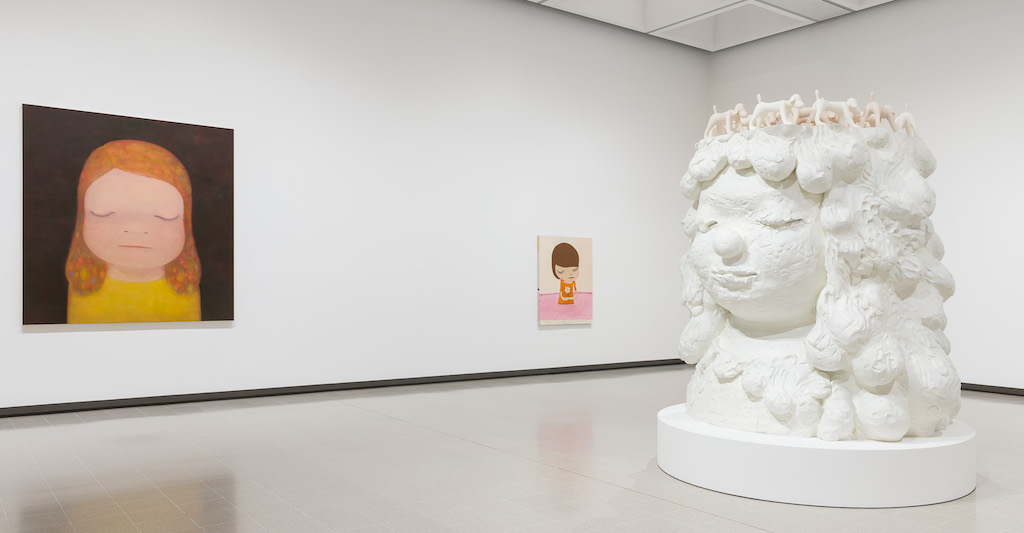 I can spot a cliché a mile off, though. Fountain of Life, 2001/14, (main picture) consists of a column of spherical kids’ heads crying tears into a giant teacup. For me, the piece does not convey “endlessly flowing melancholy” as claimed in the caption so much as pseudo, nursery rhyme sentiment. Ugh !