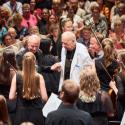
A motley crowd at Cadogan Hall on Saturday afternoon: new music aficionados and interested parties; general music lovers; some passing trade; tourists; one dad with a young boy of six or seven. Heaven knows what the latter made of the dissonances, dislocations and heated laments summoned forth by the intrepid performers in this invigorating concert, dominated by the creations of some of the more challenging composers among contemporary Brits.
It could be that the lad had a whale of a time, for a child’s sensibility might well respond to the exuberant anarchy of Michael Finnissy’s Piano Concerto No 2. Premiered in France in 1977, the work has taken 35 years to cross the Channel. Not that it’s aged a day. A permanent iconoclast, Finnissy uses a traditional title simply to smash conventions: the piece is basically a piano solo with muted contributions from strings and two alto flutes.
Judging by his music, Elias spends all day on his knees, mourning
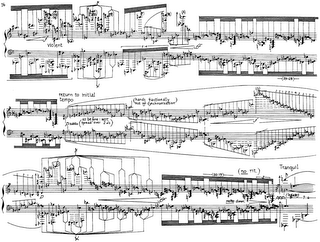
Three movements could, I suppose, just about be discerned; but you couldn’t spot Brahms or Chopin in the full-tilt cascades of notes, the scary intervals and growling reverberations, scattered with sudden pools of quiet, spidery counterpoint, or passing biffs from one of the pianist’s arms (a sample Finnissy piano score pictured below right). Saturday’s soloist Nicolas Hodges is known for his extraordinary skills in conquering the unconquerable, but even he exceeded himself by navigating this belligerently crazy score from faint and murky photocopied pages. You might as well climb Everest blindfolded.
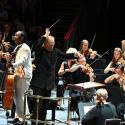
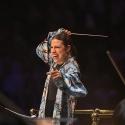
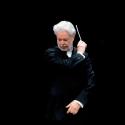
Out of the spotlight in the Finnissy, members of the Britten Sinfonia and Saturday's unflappable conductor, Clark Rundell, showed more of their stuff in Brian Ferneyhough’s Prometheus of 1967 for wind sextet. Ferneyhough’s music usually has all the charm of a ball of barbed wire, but following Finnissy’s assault and battery the brittle, fragmentary exchanges in this early piece almost resembled the lyrical colour permutations of Webern.
 No time for an interval and a comforting ice cream; instead, the concert pressed on with Nicolas Hodges back at the ivories with a more legible score, and one also more easily swallowed.
Dedicated to Hodges, Harrison Birtwistle’s 12-minute Gigue Machine from 2011 (this was its British premiere) never overtly suggests a baroque dance, though I heard the machine of the title, hard and energetic, rattling out staccato material while more linear and legato fingerings sometimes swept through at a different speed. This wouldn’t be the first Birtwistle piece which the ear walks around as if sizing up a sculpture or gnarled rock. I’d be happy to walk round it again, especially if Hodges is playing.
I’d equally be happy to pay another visit to Brian Elias’s 17-minute vocal scena, Electra Mourns, which received a convincing world premiere performance from Rundell and the Sinfonia, mezzo-soprano Susan Bickley, and Nicholas Daniel on the cor anglais. Judging by his music, Elias spends all day on his knees, mourning. He regularly sets lamenting, death-haunted texts, preferably in Russian, though the grief embedded in Sophocles’ play Electra was obviously too juicy to pass over. Here the concert’s music audibly echoed past traditions, and achieved something otherwise scarce: direct emotional expression.
Ever ardent, Bickley’s mezzo admirably suited Sophocles’ lines featuring Electra in full flight, raging before the urn supposedly containing her brother Orestes’ ashes. Elias doubled her eloquence by mirroring her phrases with Daniel’s plangent cor anglais, backed by the Sinfonia’s sorrowing strings. Bickley was singing in ancient Greek, though we needed no translation to understand those breast-beating syllables oimoi moi. Nor did we need any signpost to grasp Sophocles’ and Elias’s double intention: acknowledging Electra’s loving feelings, while suggesting that the love has curdled into a vicious instrument of revenge. Just the bracing lesson needed for a sunny Saturday afternoon.