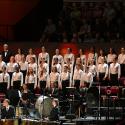
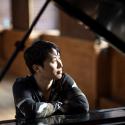
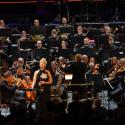
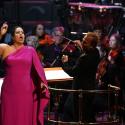
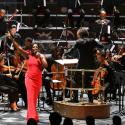
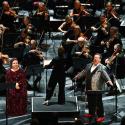
Had a dastardly dirty bomb gone off in the Wigmore Hall last night and turned us all to dust, the contemporary British classical music scene would, in one fell swoop, have been wiped off the map. No more Peter Maxwell Davies, Alexander Goehr, George Benjamin, Julian Anderson, Simon Bainbridge or Oliver Knussen, all of whom were gathered for the inaugural concert of the year-long residency at the hall of rising compositional star Luke Bedford (above) .
This was a fascinating programme, delivered without fault by the Birmingham Contemporary Music Group and Knussen. Most fascinating was hearing quite how much the aesthetic gap has widened between young and old. I hadn't realised how indifferent the younger generation of composers are now to the works of the predominant British compositional school of the preceding generation, the Manchester Group of Birtwistle, Maxwell Davies and Goehr.
The relatively easy, breezy compositions of Helen Grime (28) and Luke Bedford (31) stood poles apart from those complex crags by the modernist old-timers. The young bore the marks of the buzzy American minimalists, while the rocky compositions from the Manchester Group had the scars of the European winds that had battered these musical shores after the Second World War.
First up was a fantastic bit of Birtwistle, The World is Discovered (1960-1), which alternated spare, telling duets (between guitar and, respectively, flute, clarinet and oboe) with darkly coloured choruses. Particularly atmospheric was the second, which led out with a flute and bassoon duet, the bassoon line sagging guiltily as if recalling a bad memory and ended with two horns exploding onto the picture sonorously and conclusively like two phoenixes.
Helen Grime's A Cold Spring (2009), which starts with a clarinet and strings boogie-woogie, didn't hold its own against the sonic explorations of the Birtwistle. Grime was offering us little beyond what Louis Andriessen has already put to paper. In fact, with the start of Alexander Goehr's carefully coloured The Deluge (1957-8) for soprano, contralto and chamber orchestra, a pattern was emerging. The works from the 1960s constantly engaged the ear, giving it new and interesting (and, arguably, too much) sonic information. The Grime meanwhile concerned itself with forward-motion, the scenery on the journey being less important than the quality of the vehicle travelled in. So, while Goehr's picture-painting of Leonardo di Vinci's jottings on the subject of The Flood (translated by film-maker Sergei Eisenstein) was at times very striking indeed, his formal wanderings were harder to discern. And, while the Grime was easy enough to follow, a variety in touch and taste was lacking.
Just right in almost every way was Maxwell Davies's Leopardi Fragments (1961). This slow-moving but intensely saturated polyphonous piece (written in the manner of the great Worldes Bliss of 1969) is as much a horizontal, as a vertical, joy; by which I mean that each individual moment was as pleasurable as the whole. The work's soft melismatic motion periodically erupts. A harp bucks up like a young steed over a bassoon. The Third Section of the work has a duet of intense and enticing variety and concision, the two singers, soprano Claire Booth and contralto Hilary Summers, both performing out of their skins.
To play out the evening came the London premiere of Luke Bedford's Good Dream She Has (2008), with the biggest ensemble so far, including percussion and double bass. It started well. Very well. With a handsome, timeless and engaging chorus that developed effortlessly (though some might say too easily). It was making sense of the poem, too - a edited slice of Milton's Paradise Lost from Glyn Maxwell - with the harmonic world of the tonic disintegrating as Adam and Eve ruminate, ever more wildly, on their existence.
The initial musical idea, however, gives way to another half way through that starts to play with much more obviously open, uncomplicated intervals, upon which a main climax is built. (Summers, by the way, handled these intervals with a pole vaulter's precision.) With this new idea, a work that started refreshingly simple and neat ended up running close to being bland and cliched. There are purple Hollywood sweeps, harps mimicking the run of water and a beat from a wood block (later, I think, taken over by the harp) that had the whiff of Turandot.
The Bedford should have been the climactic headline act of this concert, but, next to the Maxwell Davies, it seemed deficient. The Grime looked similarly overshadowed. Having divested themselves of the complexities of modernism, the younger generation seem to have lost something of modernism's edge. An edge that the greatest works of the Manchester Group have no sign of losing.