Never envy a relatively new voice in music his or her place in a concert shared with Sibelius. Invariably the economical Finnish master will triumph with his ideas and how he streams them in a forward-moving adventure. You sit staring at all the percussion Sibelius never needs, and wonder whether the newcomer will engage it more imaginatively than most of his peers. Which fortunately turned out to be the case with Detlev Glanert's 15-year-old Music for Violin and Orchestra, fearlessly taken on by one of the BBC Symphony Orchestra's two world-class leaders, Stephen Bryant. But given Principal Guest Conductor David Robertson's urgent, sensuous way with Sibelius, the German's flickering homage to the Orpheus of Rilke's sonnets still hovered in the shadows.
Why the great Rainer Maria? The programme note didn't quite clarify, though I hazard a guess that the way the violinist begins with a rising not-quite-scale has to do with Rilke's opening sonnet: "A tree rose up... Now Orpheus sings, all hearing's tallest tree". And his final ecstasies, shining in the highest register, chimed well for me, at least, with the "ringing, shattered glass" of Orpheus ascending in song among the shades. These, and the central cadenza - "'Spiramen" ("Breath", but why?) - compel, and vividly so in Bryant's intonation-perfect focus.
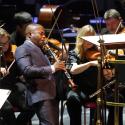
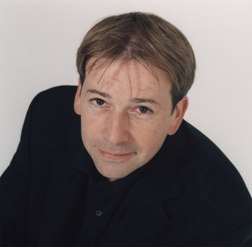
For the rest, it's a tall order to match in music such high and distinctive poetic diction. Glanert seems to follow the usual hope that if you take care of the sounds, which he does with an especially precise ear for the orchestral burblings as well as the discreet use of thundersheet, tom toms and gongs, the sense will take care of itself. It's not quite enough to admire the concertante dialogues between the orchestra and a player it knows so well (Bryant pictured below right), though there were enough shifts of timbre to hold the attention throughout. And Glanert's faith in his soloist was thoroughly justified; Bryant deserved his time in the sun every inch as much as the other leader, Andrew Haveron, who played the Korngold Concerto equally distinctively last season (this, though, is surely the first time the two violinists have been seen onstage together at a BBCSO concert).
 What this not-quite-concerto surely needs is a truly memorable shape to themes and gestures, the kind that seem to strip several layers of skin from us in Sibelius's last major tone poem before the silence of his last 30 or so years. Tapiola is ostensibly a dark hymn to the god of the Finnish forests, giants dwarfing Glanert's jungle, but like the symphonies, it's surely also testament to the state of the composer's soul at a specific phase of life. That seemed last night to bore through ours with the penetrating woodwind unisons following Robertson's whiplash start. Bass lines were strange and mobile; divided cellos and violins answered each other in melancholy heartache at the still centre of this otherwise restless fantasia. There were few of the usual half-lights, but a compensating urgency combined with the current, sensual form of the BBC Symphony strings to bring some of Debussy's Atlantic storms pouring into what's usually an austere northern landscape. No doubt about it, though, the one Sibelius whips up just before the final surprise benediction of a rich major chord - less transcendant than usual here - is the most terrifying in the entire repertoire.
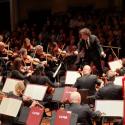
A muscular directness was also Robertson's chief virtue in the hard-won triumphs of the Fifth Symphony. The top interpreters always make you feel that the climactic wave at the centre of the revised first movement crashes over us with absolute inevitability (though it's fascinating to compare the end results with the sudden dead end of the original version). I seem to be in a minority which finds that supposed high priest of Sibelius Osmo Vänskä wanting here; but Robertson was not, pulling the right stops from his splendid trumpets just as he knew how to veil them on the last leg of the finale. This was a scrupulous hero's life which progressed without rush and bluster, but also without pausing for more than half a second between movements: I've never encountered before quite this effect of serene breath issuing forth in the aftermath of the scherzo's welter. The orchestra rode on blazing saddles throughout, boding well for the Sibelius cycle that's just been announced as carved up among distinguished interpreters throughout the BBCSO's next season.
- Listen to the BBC Radio 3 broadcast of this concert on 22 February, and for the following seven days on the BBC iPlayer
- Check out what's on in the BBCSO's 2011-12 Barbican season, including its Sibelius cycles