I’ve just spent five weeks in the company of a very austere and sometimes frightening masterpiece, Sibelius’s Fourth Symphony, hearing a great many recordings of it for Building a Library, the abiding gem of Radio 3’s CD Review in which the critic takes the listener through the piece and chooses a front runner.
Now that I’ve reached the finishing post, having scripted the three-quarters-of-an-hour slot with all the snippets from the best and worst of the various recordings - the middle-grounders rather lose out - people are inclined to ask, “ain’t you sick of it?”. Far from it. The wonderful thing about this (hopefully) unassailable format is that you get to know the work as well as you do its interpretations, so that by the end of it you have an ideal of the piece in mind and could conduct that version, were you able (and I know from a couple of conducting lessons with Martyn Brabbins up in Orkney that I couldn’t, yet if ever).
In my experience, after 30 such library-building exercises, the most sheerly pleasurable have been the lightest – Delibes’s Coppélia and Bizet’s L’Arlesienne. The longest and potentially most daunting work, Wagner’s Parsifal, also turned out to be no heavy burden, at least in terms of listening, thanks to its incredible clarity of intent – though whittling down examples from the five-hour work into 45 minutes was the toughest thing I’ve done on the programme. It also furnished a clear, if surprising, library choice, a recording by Rafael Kubelik with the best cast which should have been released on the Deutsche Grammophon label had the odious Karajan not put the kibosh on it, and is now to be found on the specialist Arts Archives label.
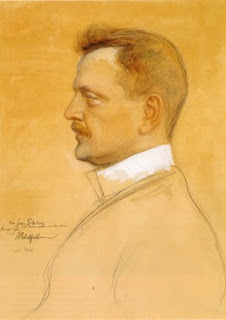 Sibelius’s Fourth has a similar strength of purpose and a rigour which stops it getting you down (the other thing that people have said to me is, “how depressing”). It’s the ultimate distillation of the enigma which lies at the heart of Sibelius’s genius (the composer pictured right by Albert Edelfelt in 1905): how much is depiction of Finnish nature, how much inner landscapes and internal weather? The complications here are due to the fact that he started sketches for it in 1909 after a life-changing trip to Mount Koli in north-eastern Karelia, proposing the work as "La montagne", and carried on struggling with it through the early months of 1911, when he was prone to bouts of depression and found himself, in the wake of an operation on a throat tumour several years earlier, having to function without whisky and cigars. That changed the style of his music, as he was well aware.
Sibelius’s private thoughts-book reveals he knew he was a genius who’d written a masterpiece, a work which one perceptive critic at the time of the April 1911 premiere described as “a synthesis of classicism, romanticism and modernism, which might well serve as the ideal for the music of the future”. In fact the Fourth Symphony remains timeless, many of its sonorities still as fresh as the time when they were written down. It’s struck me time and again, whenever I’ve heard Sibelius in a concert context which also includes a generic new work, how much more “modern” his ideas sound than those – if there are any – in the derivative newcomer.
 The Fourth is too rigorous and focused to be genuinely “depressing”, a term used far too loosely in any case. Sibelius (his hat and stick at the house-museum Ainola pictured left by the author) wrote that it was the only work of his from which he could not remove or add a single note. I wondered if I’d wobble after four or five recordings, but then along came versions which emphasized the granite-like surface rather than the “dark recesses of the soul” (another phrase of Sibelius’s). Later specimens highlighted the sheer tonal beauty explicit in the spare orchestration: any great symphony has to serve the orchestra and its players as much as the composer’s psychological needs.
It’s a strange feeling, letting the work go (at least until the recording next week). I learned from Erik Tawastsjerna’s magnificent study of the work in the second volume of his biography as translated into English, of still more interpretations I’d like to hear and have to restrain the urge to go and search them out. But I’m not bereft. Now that I’ve reached the pitch where I can even go around humming the extraordinary atonal passage for unaccompanied violins at the heart of the first movement, this is surely a long-term companion, one with the courage – as, again, Sibelius himself put it – to “look life straight in the eye”. As for who’s the best and who doesn’t cut mustard, you’ll have to wait until the broadcast of the Fourth on the fourth of the fourth.
- Building a Library on Sibelius's Fourth Symphony will be broadcast on BBC Radio 3's CD Review on 4 April. A podcast will also be available
- David Nice's blog, I'll Think of Something Later, on Donald Runnicles's Sibelius 7 in Inverness