Brahms: Trio Op. 114, Robert & Clara Schumann: Romances. Joachim: Hebrew Melodies Tabea Zimmermann (viola), Javier Perianes (piano) Jean-Guihen Queyras (cello) (Harmonia Mundi)
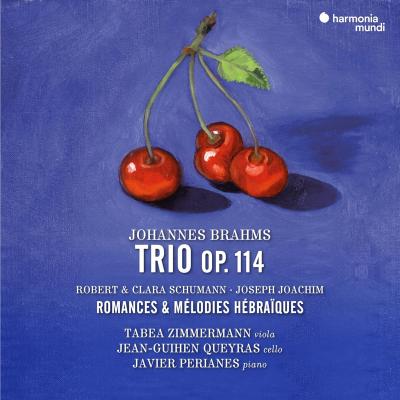
That sound! The glorious resonant tone which Tabea Zimmermann finds way down in the lower reaches of the viola is absolutely irresistible. The first taste of it that we get is when she takes the plunge into the central section of the second of Robert Schumann’s Op. 94 Romances – she takes her time with it these days, relishing it far more than in the more impetuous 2004 recording with Hartmut Höll. Later in the programme, we get the full low-down, a deep and unbelievably soulful reading of Joseph Joachim’s “Hebräische Melodien” after Byron. Her playing of the start of the C minor grave movement is unforgettable. The viola part keeps on being irresistibly drawn all the way down to the tonic, the open C string. I can’t imagine it being played with more presence or pathos than here.
Zimmermann’s instrument – we it hear throughout the album - is a modern viola from 2019. She commissioned it from the Newark-trained and Loire-based luthier Patrick Robin, who sadly died just last year at the age of 69. The recording was made in September 2025, just four months after Robin died. It’s sad not to find any mention of that anywhere in the booklet; an album as good as this might be the most fitting tribute that an instrument maker could ever have.
Of course it’s not just about the instrument. It can’t be. Zimmermann is in her astonishing prime, she phrases and paces everything with authority and forethought, and she and Perianes go deep into this repertoire metaphorically as well as literally. Their collection of mostly Spanish works issued in 2019 makes an interesting contrast, with much more of a tendency to lightness. Zimmermann has also done her own arrangements of about half of this new album – in fact, everything apart from the three Joachim pieces and the Brahms Trio carries the annotation “Arr. Zimmermann”.
The recording, from Schloss Britz in Berlin, is superb and beautifully balanced. As no fewer than three separately commissioned liner note essays testify (in French, English and Spanish - the German is a translation of the English), the interconnections and the lifelong friendships between the Schumanns, Brahms and Joachim are a fascinating topic. And the programme duly culminates in a masterpiece, the viola version of the Brahms A minor trio with cellist Jean-Guihen Queyras joining the Zimmermann/Perianes duo. It is a superbly collaborative performance, with many moments to melt the heart. Of these I will draw attention to the clarity, beauty and passion of Zimmermann’s first statement of the theme of the ‘adagio’ movement. It is just one of many delights of a treasurable album. Sebastian Scotney
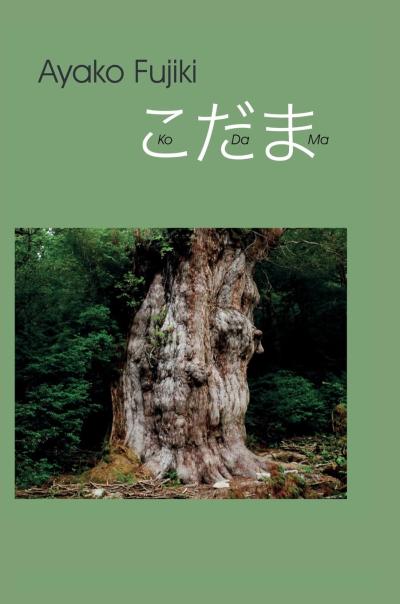
Ayako Fujiki: Ko-da-ma (Temps Record)
Consuming Ko-da-ma at home is akin to turning your sitting room into a multimedia performance space, pianist and composer Ayako Fujiki’s eight-track album accompanied by a hardback poetry book illustrated with some spectacular photographs, the texts written “not as an explanation, but a companion.” Digesting the poems whilst listening to the music is an agreeable experience, even if it’s occasionally difficult to make connections between what we’re reading and what we’re hearing, especially when there’s little information about how the album was created. What came first: poems or piano music? A cedar found on Japan’s Yakushima Island feature in the title track, the tree standing “not as a monument/but as a presence/choosing simply to be”. Fujiki’s music is unexpectedly formal but immediately appealing, the version for piano trio more so.
“Miyajima Sketch” portrays an iconic torii gate, “embracing the rough waves”, a constant in the landscape as the tide rises and falls. A depiction of snow is unexpectedly weighty, a reminder that “one crystal/becomes many/becomes mass/becomes momentum.” “Tetra” is more unsettled, the music’s restlessness ideally matched with a photograph of Tokyo’s NHK tower at night, surveying “the space between order and chaos”. The closer, “Hisho -Ascension”, is a euphonious meditation on the death of a loved one.
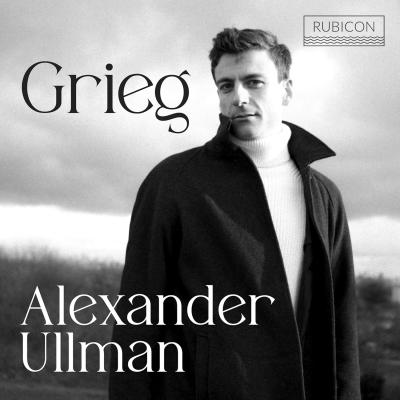
Grieg Alexander Ullman (piano) (Rubicon)
Here’s a winning compilation of Grieg’s solo piano music, its diverse contents presumably the reason for the one-word title. I’d never heard this composer’s Stemninger (Moods) before, the last complete work published before the composer’s death in 1907. Grieg was disparaging about this sequence of seven miniatures, describing them to a friend as “a couple of old Norwegian pieces that I am pleased with, but otherwise my heart was not in them”. As performed here by Alexander Ullman, they’re a delight, the best of them as good as any of the Lyric Pieces. Try the tiny “Folk Tune”, or the catchy “Mountaineer’s Song”, Ullman’s flexibility suggesting that he himself is doing the climbing. Comparing them to the last set of Lyric Pieces, published in 1901, is interesting; Grieg’s musical language is more adventurous here, a depiction of a “small troll’ looking ahead to Bartok and Prokofiev. It’s superbly played here, and Ullman nails the subdued tone of the final piece, Grieg wistfully looking back at the little “Arietta” which opened Book 1, published 40 years previously.
Ullman’s own transcription of the first Peer Gynt Suite is colourful and idiomatic, with a stark, austere take on “The Death of Åse” and a frenzied “In the Hall of the Mountain King” that’s as witty as it is terrifying. And we get Grieg’s Op. 41 as an opener, seven irresistible song transcriptions. Especially appealing is the tiny fourth song, “My Love She Was So Pure”, a bittersweet remembrance of a lost love. Warmly recorded and well-annotated, this is a very enjoyable anthology.
Messiaen: Quatuor pour la fin du temps Anzû Quartet (Cantaloupe Music)
The best recorded versions of Messiaen’s iconic Quatuor pour la fin du temps come from groups whose members actually have a history of playing together. Like this one: New York’s Anzû Quartet first got together in 2020 and regularly commission new works featuring the same cello/violin/clarinet/piano instrumentation, a combination dictated by the musicians available to Messiaen during his internment in a German prisoner-of-war camp in the early 1940s. The Anzû’s reading is bold, intense and full of colour, the first movement’s blackbird and nightingale calls brilliantly projected by clarinettist Ken Thomson and violinist Olivia de Prato. And listen to Messiaen’s “sweet cascades of blue-orange chords” in the “Vocalise, pour l'Ange qui annonce la fin du temps”, pianist Karl Larson seductive and stentorian by turns. Thomson is superb in the “Abîme des oiseaux”, barely audible at some points, and the scherzo-like “Intermède” is delicious here.
The “Louange à l'Éternité de Jésus” is very well sustained, Larson and cellist Ashley Bathgate daringly expansive but possessing enough charisma to pull it off. A close recording balance makes this “Danse de la fureur” frighteningly intense, the last two movements more uplifting as a consequence. De Prato’s “slow ascent to the acutely extreme” in the closing minutes is terrific, and very moving, nicely supported by Larson. This could be my new reference recording of the work. Sound and documentation are impressive, and there’s a fascinating reminiscence from veteran cellist Fred Sherry about his recording the quartet in the presence of the composer in the late 1970s.
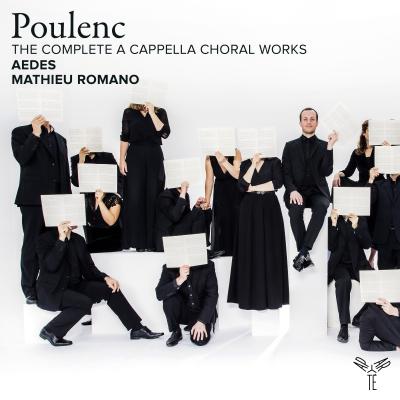
Poulenc: The Complete A Cappella Choral Works Ensemble Aedes/Mathieu Romano (Aparté)
Here is a generous double album of Poulenc’s works for unaccompanied choir, pieces broadly on a more humble scale than the triumphant Gloria and Stabat Mater, with their orchestra and soloists. Here the tracks are mostly between one and three minutes long but, apart from a couple of standalone numbers, are mostly grouped into sets. Excepting a single early piece – a fun squib written for the Harvard Glee Club – Poulenc didn’t start writing choral music till his mid-30s, coinciding with his discovery of religion following the sudden death of a close friend. His engagement with the French Christian tradition is fascinating to trace, but the choral music is not entirely sacred.
There are a couple of sets in a folky, naïve language, the Petites Voix and Huit chansons françaises, charming but not especially characteristic, the latter at its best channelling Stravinsky’s Les Noces, which Aedes have also recorded. The most substantial – and best-known – is Figure humaine, written in 1943. Here the choir really hit their straps, exploring Poulenc’s wartime struggle, occasional moments of revelation and peace amid the tension. Ensemble Aedes are particularly effective in the cantata’s edgy second movement, which dissolves into a hymn of touching simplicity. It’s a lovely performance of an important piece.
But perhaps my favourite was the revelatory Sept Chansons, which have a real robustness and edge to the harmony, and a rhythmic bite. Ensemble Aedes give a nuanced account, ready to sacrifice beauty of sound to serve the music. No. 4, ‘Tous les droits’ has a strikingly bold two-part counterpoint, taken even further in the unison opening of no. 5, and the dramatic and ascetic last of the set – all need the commitment Aedes showed.
Of the sacred works, there is a poised Ave Verum Corpus, a somewhat pedestrian Salve Regina and an Exsulatate Deo dressed in archaic garb, but the real meat is in the Mass in G major. I hear echoes of Vaughan Williams’s mass in the same key, although I have no idea if Poulenc knew it, and the “Gloria” has clear echoes of Poulenc’s much later Gloria. But I liked best the Quatre motets pour un temp de pénitence, at once extremely French in their exquisite harmony, but also coloured with Renaissance false relations.
This terrific survey finds room for Poulenc’s lush, but strangely fragile, harmony, but, compared with his piano and chamber music, we have little of the perky neoclassicism. This is a Poulenc moved by grief and piety to find a new means of expression. The recordings, released in the 20th year of Ensemble Aedes, were made, according to the booklet “over a period of many years” with an evolving group of singers, but there is a clear unity across the album. It is a very French choral sound – who better in this most French of composers? – complemented by beautiful presentation and a generous bilingual booklet. Bernard Hughes
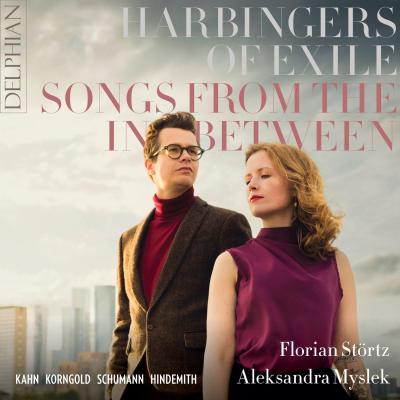
Harbingers of Exile: Songs from the In-Between Florian Störtz (bass-baritone), Aleksandra Myslek (piano) (Delphian)
Days of These Days: The British Isles Reflected in Song Tristan Hambleton (bass-baritone), Simon Lepper (piano) (Delphian)
These two make an obvious pairing for a combined review: a pair of recital albums, both on the terrific Delphian label, of bass-baritones (one German, one British) with piano, in carefully curated sequences showing a sensitivity to programming as well as vocal excellence. Florian Störtz’s Harbingers of Exile uses mainly older repertoire from the German musical tradition – Schumann, alongside Robert Kahn and Erich Korngold – to explore ideas of liminality, while Tristan Hambleton offers a 20th and 21st century selection, including 10 premiere recordings out of 22 songs, exploring aspects of the British Isles and British literary history.
Nineteenth-century art song is not my happy place, and I don’t think I’d previously even heard anything by Robert Kahn (1865-1951) – indeed, this is the first substantial recording of his songs by a baritone. The same age as Richard Strauss, and only a few years older than Schoenberg, Kahn’s conservative musical language is firmly rooted in Schumann and Brahms, a tradition of deeply felt responses to text. These are matched by Florian Störtz’s earnest and sincere delivery of the long melodic lines, and Aleksandra Myslek’s contemplative and luxuriant accompaniments. The exile of the album’s title comes from Kahn’s fleeing from Nazi Germany (he was Jewish), although the 19 songs presented here are on a range of subjects. I can’t imagine them being given a more sympathetic interpretation, even if the musical style is never going to strike an especial chord with me. Kahn’s songs are heard alongside some Schumann (the opening track "Stille Tränen" is sublime) plus fellow exiles Hindemith (whose bracing harmonic vocabulary is a world away from Kahn’s) and Korngold (the closing track "Unvergänglichkeit" has a yearning intensity.)
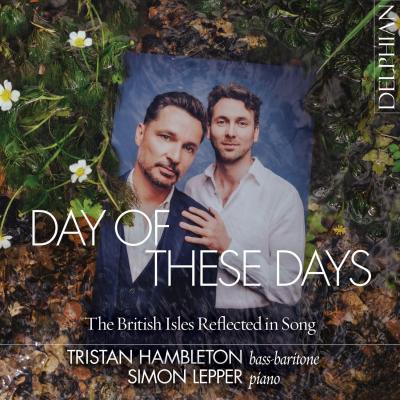
Day of These Days is rather more in my wheelhouse: songs by 20th and 21st-century British composers reflecting “particular moments of lived experience, capturing that fleeting, introspective British light.” (Can I forgive that “lived experience”? Let’s give it a pass.) The poetic texts are wide-ranging, and this is reflected in very varied musical responses. There is a dark tone to lots of the songs – the booklet explains that several were transposed lower to fit Tristan Hambleton’s range – and this has implications for the tessitura of the piano too. Britten is always unimpeachable, and his short sequence This Way to the Tomb, written during the composition of Peter Grimes, is a perfect opener, crisp but always teetering on the brink of melancholy. Sally Beamish’s song gives the album its name, has an admirable pared-back simplicity, as is Judith Weir’s more declamatory setting of Shakespeare’s Sonnet 116. Thomas Adès’s arrangement of Purcell’s By beauteous softness is both beauteous and soft, while Tarik O’Regan’s settings of Andrew Motion are more troubled, both in the hesitant vocals and peripatetic piano parts. Huw Watkins’ three songs look up to the moon and explore some of the higher reaches of Hambleton’s register, while Stuart MacRae’s "I know not how it is with you" is a little gem, tentative and aching.
Both these discs are recommended in their different ways – both have the usual Delphian high standard of recording (the Hambleton more intimate, the Störtz more conventionally captured) and excellent quality CD booklet, with introductory essay and full texts and translations. My only doubts were about the slightly eggy lifestyle-magazine-like cover photos. Bernard Hughes