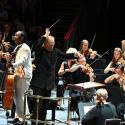
Sir Mark Elder was back on the scene of past triumphs last night as he returned to the Hallé at the Bridgewater Hall – and he has not lost his taste for the slightly unexpected.
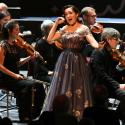
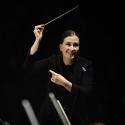
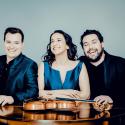
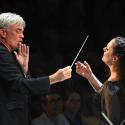
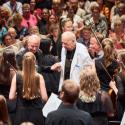
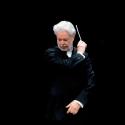
This was a bill that featured both a knight (himself) and a dame – Imogen Cooper as concerto soloist (pictured below) – and its first outing pulled a gratifyingly large crowd for a programme that was in two respects somewhat off the beaten track. Sibelius’s Scènes historiques Suite no. 2 isn’t heard particularly frequently, and Dvořák’s Symphony no. 5 does not hold the place of his last two in popular esteem. Elder’s Conductor Emeritus role, in his two concerts this season 2025-26 season, is, it seems, to lead listeners gently into vistas some may not have experienced before, with the assurance that they have a trusted guide (main picture: Sir Mark Elder). But Mozart’s final piano concerto, no. 27, is no stranger, and the charm of this performance lay in the sound balance and clarity created by a string band of very modest size and the imaginative abilities of the keyboard soloist.
In the Sibelius suite, some of today’s Hallé Orchestra may have been familiarising themselves with music they hadn’t played often, if at all, before (though long-serving members would remember it from 12 years ago). It’s made up of three characteristic pieces published in 1912 – though the original references of the titles seem to be obscure, apart from a note in the score that the “Love Song” for Sibelius reflected his feelings for his wife, Aino. The first, “La Chasse”, is something of a test for an orchestra to surmount from cold, with demanding horn writing at the start, and a very lively passage for exposed violas, then first and second violins, to follow. With Julian Mottram, Hallé leader Emily Davis and Caroline Pether to set them on their way, they rose to that challenge pretty well, and the piece was brought to a splendid climax and a grandiloquent coda which in Elder’s hands was near-Elgarian. The “Love Song” was an opportunity for principal horn Laurence Rogers to make his magic and also for the flutes and oboes to shine, along with principal cello Rachel Helleur-Simcock – a showpiece in its own sentimental way – and the wind players all made their mark in “At the Drawbridge”, too, the bounding finale which had something of the infectious momentum of the equivalent in the Karelia Suite.
Mozart’s last piano concerto has a valedictory quality few can avoid seizing on – not so much because of any premonitions of his death (though we know now that it wasn’t far away) but because it reflects an awareness that the Viennese fashion wheel was turning and the genre itself had lost its popularity. Elder’s string players were 29 in total, effectively a chamber orchestra yet providing a lean and lively fullness of tone to match the modern woodwind and the Steinway grand – Imogen Cooper’s playing was never less than aristocratically stylish, even though the piano’s tone at times seemed almost too big for the wistfully elegant quality of the opening movement and the exploration of melancholy that emerges as it proceeds. There was real delicacy, though, allowing the pizzicato string accompaniments near the end to make their mark without obtruding on the flow of the music. The slow movement became a picture of innocence and purity conceding place to a new era, and the finale’s main theme was plaintive, both sad and cheerful – but at last fiercely contrasted by the soloist in the two flamboyant cadenzas Mozart provided as a kind of farewell fling. It was an affecting experience.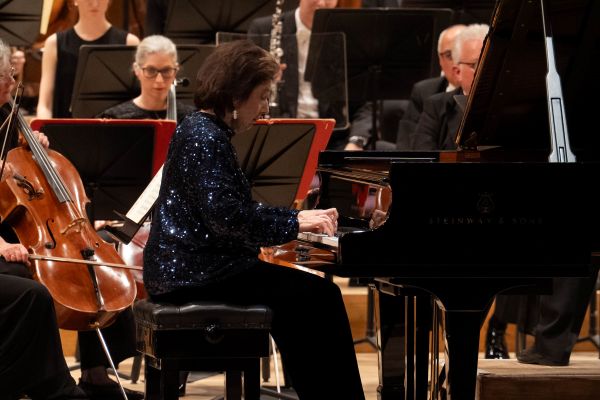 The Dvořák symphony is, on one level, music of the open air and bucolic charm, with a fair bit of drama and rich orchestral colours thrown in – but at the same time quite boldly experimental in its structural and key-relationship innovations. There are melodies, of course, and despite the frequent possibility of their repetitions beginning to pall from the second movement onwards, Sir Mark Elder worked hard to bring out the varieties of textures and articulations Dvořák uses to dress them, and shaped the sometimes strange junctions in the road with care. The third movement showed the Hallé cellos in fine and confident voice and the full brass – at last unleashed to full effect – sounding magnificent. The finale was both urgent and at times gently meditative (with Sergio Castelló-López’s clarinet eloquent) or mildly mysterious, but came home with a fine big finish, to satisfy all expectations.
- To be repeated on Sunday 9th November
- More classical reviews on theartsdesk