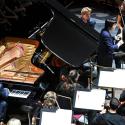
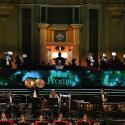
Their bicentennial years may have been and gone, but even Mazeppa’s wild horse wouldn’t be able to stop the world’s top pianists playing Chopin and Liszt almost every month. Last night Maurizio Pollini and his aristocratic art returned to the Royal Festival Hall for a recital featuring both composers, each on either side of the interval. Pollini also brought his Steinway-Fabbrini touring piano – a Steinway from the Hamburg factory, titivated inside with extra refinements by the piano technician Angelo Fabbrini. People clustered round it in the interval snapping photos, as if they’d spotted a particularly exotic animal on safari.
Pollini himself, 70 last month, collected rousing applause: deserved to a degree, though slightly in excess I thought of the performances he actually delivered. If all the programme had scaled the peak of his interpretation of Chopin’s Scherzo no 1, a B minor whirlpool of stormy notes, hosannas of praise would certainly be deserved. Here we heard the Steinway-Fabbrini’s enhanced subtleties at their clearest in the tone’s general purity, the wealth of colouring in complex textures, and the heightened contrasts between pianissimo and fortissimo.
He delayed his entries into the auditorium, building anticipation as if he were Judy Garland
But even the queen of pianos is nothing without a pianist, and the mastery of the piece’s emotional graph – rising in swirls and slashing dissonant chords, subsiding into the middle section’s dreamy repose, surging back into fury, the kind of graph Beethoven draws – was Pollini’s alone. There was no sign here of the veil of ice that sometimes descends over his playing. This was Pollini close to his best, selflessly entering deep into the soul of a composer who’s been a constant in his life ever since he won the 1960 International Chopin Piano Competition in Warsaw.
The recital also gave us a glimpse of Pollini the modernist, the man who loves taking Boulez and Stockhausen’s piano works on the chin, and wants us to do the same. Not for him Liszt’s pretty fripperies; instead Pollini opened the second half with a linked chain of adventurous mysteries from Liszt’s last decade – Nuages gris, Unstern!, and two desolate responses to Wagner’s death: music where tonality is audibly crumbling, along with a sense of direction. Schoenberg seems just around the corner. Passing from one to the other with scarcely a breath between only added to the avant-garde mood; it also allowed for the music’s unsettling expressive power to build throughout the set. Nuages gris couldn’t have sounded more penetratingly grey, more quizzically unstable; the Wagner tribute La lugubre gondola was another highlight, a sad barcarolle rocking in murky waters.
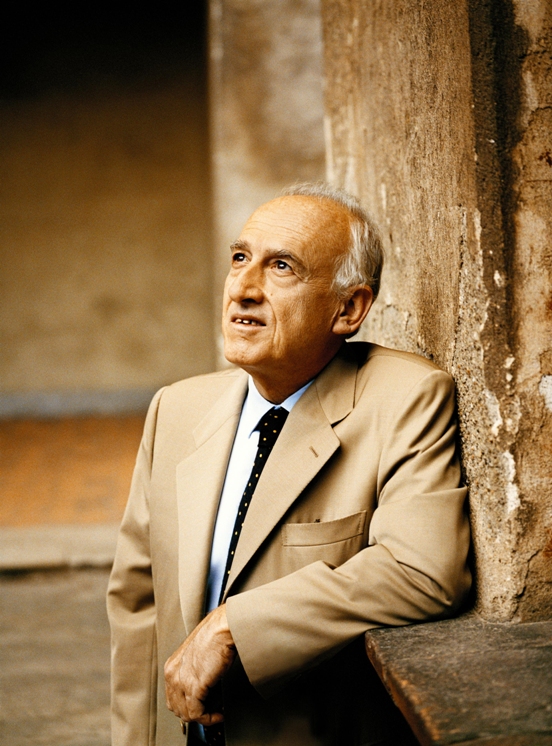 Elsewhere in the night, Pollini’s gold standard slipped a bit. There was an ordinary touch about his first Chopin pieces, until his powerful Polonaise-Fantasie. And all his brain and finger power couldn’t take away my feeling that Liszt’s Sonata in B minor, so structurally masterful, contains too much grandiose posturing. Maybe I heard it too much during Liszt’s bicentennial year. Maybe Pollini yawned inside too, for in its vigorous segments he did run into some technical issues – patches of muddy voicing in complex textures, some splashes of piano clatter. The slow section returned him closest to full strength: poetic without being choked in sentiment, the music’s ethereal threads caressed while still seeming part of the sonata’s argument.
But, drier patches and little slips acknowledged, Pollini remains a piano star. He gave us three meaty encores, two of them tempestuous (Liszt’s 10th Transcendental Study, Chopin’s Revolutionary Étude), the third gratefully calming (Chopin’s Berceuse, where the notes cascaded with the beauty of jewelled dewdrops). He delayed his entries into the auditorium, building anticipation as if he were Judy Garland. And he signed CDs in the foyer afterwards. Perhaps he’s there doing it still.
Pollini performs Chopin