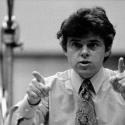
“My goal was to take the Messiah as if it had been written yesterday,” the conductor and eminent French harpsichordist Christophe Rousset told Tom Service on Radio 3 on Saturday. “[It would be] as if we had received the score for the first time… [and were thinking] wow, how amazing this piece is and how fresh it can be.”
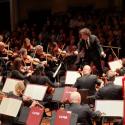
“Wow” was certainly a word that came to mind as the English Baroque Soloists launched into the Messiah’s French-style overture with nimble ebullience, emphasising the beats in bold stripes of tonal colour. It was as if Rousset, one of our most stylish and subversive interpreters of Baroque music, was delivering a spark of electricity with each movement of his hands. This was the version of the Messiah that was performed at Covent Garden in 1752, the year in which the 67-year-old Handel went blind and started to experience other health setbacks. Yet the Handel reincarnated before us in this performance was the vigorous young man who was the darling of the European continent, happily combining Italian, German and English influences to create a piece that would resonate profoundly centuries later.
Quite how profoundly was amplified by the “surprise visitor” to the concert, who turned out to be King Charles. As a frisson went through the pews at St Martin’s it seemed pleasantly apt that, 400 years after Handel was the toast of the Hanoverian household, a 21st century monarch was still seeking him out as a pre-Christmas cultural treat.
If that makes it all sound very establishment, then think again. After the galvanic opening, the tenor Andrew Staples stepped forward to deliver "Comfort Ye" in tones as warm and rich as butterscotch. But the drama and tempo picked up quickly when the music modulated from E major briefly to B major for “saith your God,” and the urgency intensified as the keys shifted through A major and C-sharp minor. "Ev’ry Valley" was executed supply and briskly, with a real sense of adrenaline at the message of salvation the words contained.
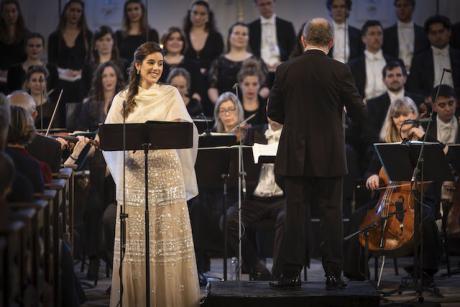
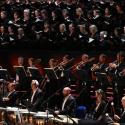
For all its enjoyable vigour, there were points in the first part of the evening when the speed of Rousset’s Messiah was frankly eyebrow raising. Yet while in lesser hands this could have led to stumbling and loss of clarity, the tightness and discipline and the sheer overall joy was such that the best course of action for the listener was to cast aside inhibitions and enjoy the wild ride. That discipline was never better on display than with the Monteverdi Choir, who had to leap up from their seats with the suppleness of gymnasts in order to be ready for their entrances. The ecstatic soaring-to-the-ceiling elegance of the first chorus, And the glory of the Lord, was heightened and given gravitas by the emphatic delivery of the first beat of each bar.
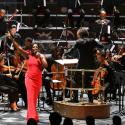
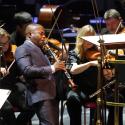
The 1752 version of the Messiah is the only time a soprano, contralto, tenor and bass were used as soloists for the work. For this performance, alongside Staples, we had Ana Vieira Leite (pictured above) as the soprano, Dame Sarah Connolly as mezzo soprano, and William Thomas as bass. Thomas’s resonant voice, the timbre of polished mahogany, was one of the evening’s many highlights, particularly when he sang "The People That Walked in Darkness".
Two years ago, this thoughtful musician made headlines after John Eliot Gardiner slapped him for apparently entering the stage on the wrong side during a semi-staged opera. On the basis of his performance here, filled with nuance and shifting light, that should soon just be a tiny footnote for what promises to be a long and fascinating career.
Connolly’s mezzo-soprano delivery was as melodious as it was supple, distinguished by quiet empathy and graceful as a weeping willow. Her air, "But Who May Abide The Day of His Coming", was suffused with intimate disquiet, before flaring into life for the more vigorous assertion, “For he is like a refiner’s fire”. Leite’s soprano was as bright and full of vivid colour as a stained-glass window. When she sang “He shall feed His flock like a shepherd,” she held the entire audience spellbound.
Yet for this first part of the evening it was the chorus that really stood out, with crescendos that sent a whoosh up the spine and a daring emphasis of words for maximum impact. In For Unto Us A Child Is Born, for instance, the words “Wonderful, Counsellor” leapt out so crisply, and clearly you could almost see them hanging in the air before dissolving in a shower of silver light.

A somewhat more stately pace was introduced for the second part, as the narrative turned to Christ’s betrayal and passion. Sarah Connolly’s performance of "He Was Despised and Rejected" was stunningly imbued with bitter pathos. The chorus "All We Like Sheep" began with gambolling lightness, but – in one of the many striking tonal contrasts that marked the evening – swiftly took on a darker, more cutting aspect as it progressed to “the iniquity of us all”. Thomas’s interpretation of "Why Do the Nations?" was filled with magnificent fury, not least in the final notes which resonated like a bell tolling.
The Hallelujah Chorus – which fantastically counterintuitively, started with feather-like delicacy before crescendoing exuberantly – brought a rousing end to the second part. Then we were into the reflectiveness of the third. The duet between Connolly and Staples, "O Death Where Is Thy Sting?", was marked by subtle poignancy before the beatific radiance of Leite’s "If God Be For Us". Then it was over to the chorus to deliver the dynamic finale, culminating in an exhilarating tsunami of Amens.
As Rousset turned to the audience he looked triumphant, as he well deserved to be. This thrilling, alternatively mischievous and lyrical interpretation felt – as he intended – as fresh as if it had been written yesterday.