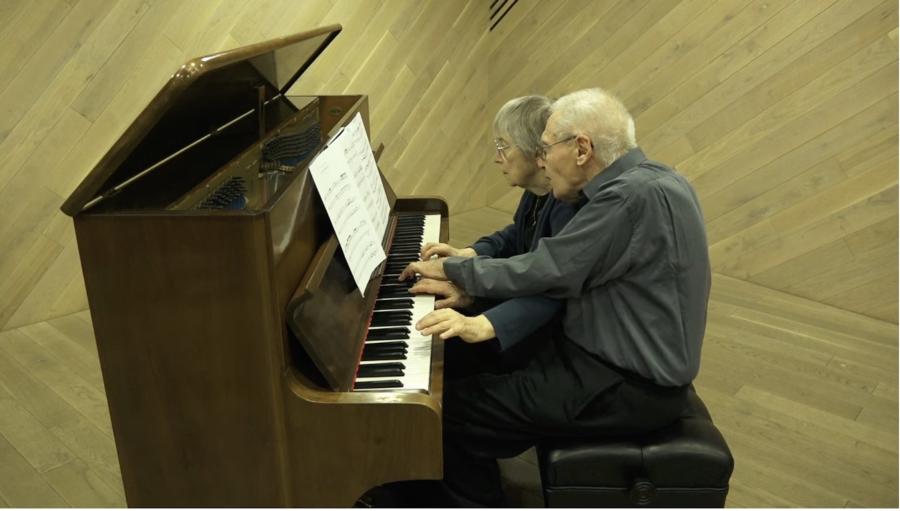
I still retain a vivid memory of a concert in London’s Queen Elizabeth Hall in December 2013 at which Hungarian composer György Kurtág and his wife Márta sat at an upright piano with their backs to the audience and played excerpts from his Játékok collection of progressive teaching pieces, interspersed with arrangements of Bach chorale preludes for piano duet (Pictured below). The audience might have been eavesdropping on an afternoon of private music-making. But what in fact took place was the distillation of the essence of music – its directness and detached spirituality – into a performance stripped of superficial theatre and ostentation.
At Thursday’s BCMG/CBSO concert anticipating Kurtág’s 100th birthday next week, Paul Griffiths told how the 30-year-old composer – nursing a creative block – visited a Paris psychiatrist and was instructed by her to “find your truth.” His first truth, emerging from her surgery, was a tree. Perhaps you have to know Kurtág to understand the sheer authenticity of this rather childish anecdote. But this concert’s cunning arrangement of the tiny musical images that for him are both the foundation and the starting point of everything he has written was as convincing a practical demonstration as could readily be imagined.
The core of the programme was, again, an assortment of Játekok (games or toys, play objects, variously for solo piano and strings) together with a selection from another open-ended series of pieces for strings called "Signs, Games and Messages" (Jelek, játékok és üzenetek). Everything in Kurtág is lapidary. A sign is a gesture is an inscription is a message carved in stone. He has never really done structure but deals with elements. But these elements have the intensity and absoluteness of profoundly considered concepts engaged, it may be, in a constant battle with the natural tendency of music to extend over time. A "játek" may be little more than a scale, or an oscillating chord, or a flourish of some kind. A "jel" (sign) may be a distorted fragment of folksong or a vestigial violin cadenza.
It’s hard to pinpoint the significance that the isolation of these ingredients lends them; like Kurtág’s tree, they simply are. One is listening, in effect, to material that, if it were part of a conventional musical discourse, one would probably disregard. The concert used the same Bach connection to make this point very wittily. His E major two-part invention teased the preceding játek for its trivialising of the up-and-down scale; his A minor Prelude and Fugue (from Book Two of the 48) ticked off the chromatics of Kurtág’s Kromatikus feleselös (Saucy Chromatics) for not taking these sombre elements seriously.
Bach was and is there, of course, because he is Kurtág’s hero. He is the goal and essence. But the ironic humour of these mostly tiny pieces comes from somewhere else: perhaps partly from a post-Soviet disillusion with conventional musical continuities and a coming to terms with the consequent vacuum. His music is full of quotations or allusive hints; full of homages to musicians, writers and artists great and small, including some who, one suspects, he does not rate highly. They are a catalogue of responses from the potting shed to the garden of possibilities. His 100 years bear amazing and amazed witness to the most bewildering epoch in the history of western music.
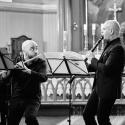
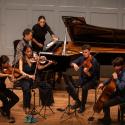
It was a marvellous, intensely moving concert, neatly compered by Griffiths. Four string players (Colette Overdijk, Georgia Hannant, Chris Yates and Arthur Boutillier) gathered on the platform or vanished into distant galleries, dialogued antiphonally or cadenza-ed perhaps tongue-in-cheek or perhaps not, while John Reid played Bach coolly on the grand piano and straight-backed on a slightly muffled upright.
At the end they combined in scattered ensemble in the beautiful Ligatura – an allusion, I suppose, to Kurtág’s compatriot Ligeti, but with a nice suggestion of Ives in its subtitle, “The answered – unanswered question:” Ligeti’s textures answered by richly voiced string dissonances at the start, Ives’s trumpet by the faintest chords on a celesta up in the clouds at the end.