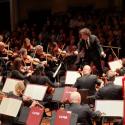
The BBC NOW called this concert Echoes of France, which was both an understatement and a partial misnomer. Cardiff’s St David’s Hall being currently out of action, the orchestra is playing its regular concerts in the much smaller Hoddinott Hall, but with no concession to the acoustical trivia of decibels, balance and blend. Misnomer? We heard Ravel and Chausson - French certainly - but Sibelius’s Pelleas and Melisande incidental music is French only in the language of the play, which is by the Belgian Maeterlinck.
It’s strange how that play captivated composers on either side of the year 1900, and even stranger how differently they understood it. Just compare the mysterious opening of Debussy’s opera with the ceremonious first piece of Sibelius’s suite, “At the Castle Gate”, well-known to aficionados of the BBC’s “Sky at Night”. Not a great deal of Sibelius’s music seems to echo the play’s slightly weird setting and atmosphere, at least until the beautiful ending which presumably accompanied Melisande’s death.
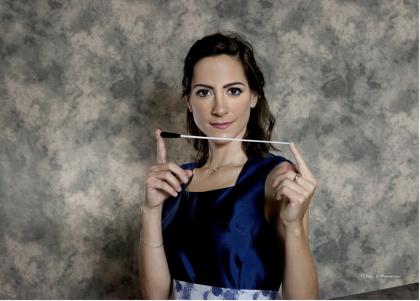
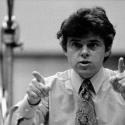
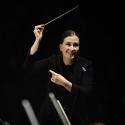
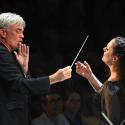
The suite is nevertheless charming in its mildly bucolic way and was very well played under the young Italian conductor, Clelia Cafiero (pictured left by Ciro Simeone), who makes up for her modest stature with clear and authoritative gesture. Sibelius, though himself a violinist, had a sharp ear for woodwind sonority, and the wind scoring is a feature of this suite, ringing out almost too distinctly in these surroundings, but always superbly played. Would he have had, in his Swedish Theatre orchestra in 1905, 26 violins and half a dozen double basses? Doubtful, and not even necessary (the score specifies ten and three respectively). But they were all there for Ravel and Chausson so why not use them? Hmm!
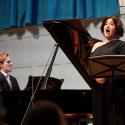
The Ravel was the left-hand Piano Concerto played, as many times recently, by Nicholas McCarthy, who was, alas, literally to the manner born. His command of the piece is extraordinary, with a kind of throw-away facility that two-handed pianists - anxious perhaps to make sure the difficulties are apparent - don’t often attempt or manage. But the result can seem overblown, with Ravel’s self-consciously spectacular orchestration responding, so to speak, to the pianist’s flying left arm. In this hall it was at times too much, though it would be hard to argue for a reduced orchestra in this case, since triple wind and six percussionists are prescribed.
As they are - the wind at any rate - in Chausson’s one and only symphony, his masterpiece, as the BBC announcer somewhat naïvely suggested. Poor Chausson, a wealthy Parisian whose father had made a fortune as a building contractor in Haussmann’s redevelopment of Paris, had little incentive to finish large works, and his greatest contribution to music was probably his support of Debussy, who had nothing much except incentive. The symphony, composed in 1889, is effective, grandiose, Wagnerian in gesture, rather square in phrasing, harmonically somewhat stereotyped, resoundingly orchestrated - mostly qualities that Debussy (who paid Chausson back with musical advice) will have detested.
Under Cafiero’s baton, however, the symphony came across as a well-made piece, certainly worth this showing, if preferably in a much bigger space. This is still a very fine orchestra. Let’s hope the BBC doesn’t take that, in Arts Council fashion, as a provocation and reduce it to the chamber proportions that actually would fit into the Hoddinott Hall.