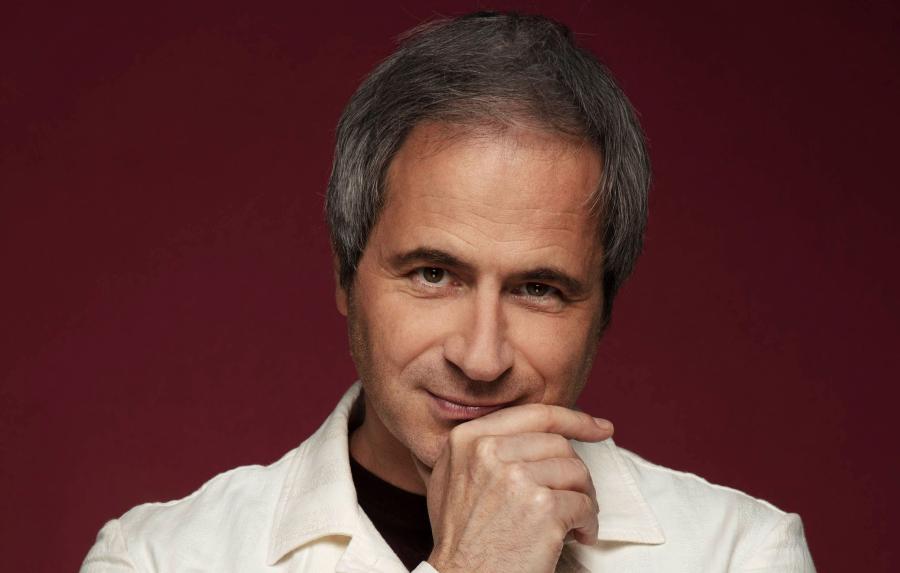
Almost everything about Piotr Anderszewski's Wigmore Hall recital pleased, intrigued and even thrilled – except, perhaps, the order of the works. The Polish-born pianist opened with his selection of a dozen of Brahms’s late solo pieces, from the Op. 116 to 119 sets, and returned after the interval with the thunderous heavy cavalry of Beethoven’s final sonata, Op. 111. Compare, and contrast, the supreme leave-takings of both poets of the piano.
Now, Anderszewski’s arrangement and performance of the Brahms works – several of them far from “miniatures” – lends them a dramatic and architectural shape of striking emotional depth and pianistic complexity. He brings out weight and brilliance, not just fragile dreaminess. At the same time, his far from retiring – indeed, often spectacular – approach to Beethoven’s late marvel did, for me, have the effect of a partial eclipse for the twilit accents and colours of what had gone before. The original programme for this concert advertised Schubert’s D858 sonata. Might that have been a neater fit?
At any rate, Anderszewski makes an unanswerable case for the Brahms set as far more than a charming succession of valedictory fugitive pieces. These works have scarcely lacked for distinguished advocates in recent years – foremost among them, Stephen Hough’s irresistible account. Anderszewski, famously a technical perfectionist but also a penetrating thinker, places his chosen items in an order that creates its own internal logic and drama. He doesn’t aim for completeness, nor even-crowd pleasing: he declined to give us the beloved Scottish folk-tune of 117 no. 1.
At the keyboard he cuts a slightly austere, even severe, figure, with few splashy gestures – or listen-to-me rubato flourishes. He seldom hurried, even when the music might have encouraged a brisker pace. But that controlled sternness makes his dives into wild energy or skittish playfulness all the more effective.
He began, limpid, measured but wistful, with 119 no. 1 – for Clara Schumann, a “grey pearl”. With a couple of exceptions, he avoided conspicuous breaks between pieces, adding to the impression of a single drama unfolding scene by scene. That drama could encompass the clear, bright, firm line of vigour and dash in 118 no. 1, but equally the mysterious slow dance of 116 no. 2. The cumulative effect of his juxtapositions reshaped these works almost as a succession of linked preludes. But if Chopin came to mind, it was for the subtle shades and half-tones of Anderszewski’s playing, not any corny heroics or grandstanding exaggeration.
Contrast, however, we had in abundance: and here Schumann, and the notion of the character piece, seemed to colour the interpretation. As the bounce and thrust of the main theme in the Rhapsody, 119 no. 4, gave way to its mercurial melodic counterpart, the sound-world of Schumann’s extrovert Florestan and dreamy Eusebius sounded not so far away. However, programme-hunting felt irrelevant given the dappled, elusive beauty of touch in a piece such as the waltz-lullaby of 118 no. 2. And the closing statement of 118 no. 6 moved seamlessly between secret, inward quest and anthemic march built on its Dies Irae motif: not a mere Intermezzo, in these hands, so much as a grand finale.
Anderszewski finds such range and variety in late Brahms that the Beethoven felt like – not an anticlimax (how could the C minor sonata ever sound like that?), but a rather more familiar journey into the abyss and back again. In tempi, phrasing and expression, Anderszewski scrupulously avoids melodrama, but the harmonic and melodic clashes of the work emerge, organically, with undimmed force. In the Maestoso, his left hand lent the bass a sinister and volcanic power: the ogre in the depths always threatened to overcome the angel trying to sing above. Emphatic and strenuous, Anderszewski does nothing to prettify or mollify the dark passions of this movement; in fact, sometimes he seemed to be playing for a much bigger hall than this.
In the five variations of the Arietta, that tough muscularity yielded sometimes to a light-touch tenderness that enhanced the veiled mysteries of the music. Anderszewski commanded Beethoven’s quicksilver, ever-shifting rhythms – which can baffle the listening ear, never mind the pianist – with nerveless authority. And he made the famous “boogie-woogie” variation that erupts halfway through as mesmerically strange and exciting as I have ever heard it.
Florestan and Eusebius came to mind again: contrasting selves at war but striving too for the reconciliation that, in 111, Anderszewski located in the gentle heavenly calls of the final Arietta variation. Even if I had doubts about the logic of his scheduling, the celestial trills in C of Beethoven’s farewell – beautifully executed – seemed to forge a ghostly bond with the sad, serene descending bells of the B minor Intermezzo with which we began. A circle, gloriously, closed.