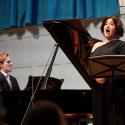
Several years ago, after a Queen’s Hall song morning, a fellow reviewer told me it was time we rethought the song recital, and that the old format of someone standing still while singing songs in German to an uncomprehending audience was way past its sell-by date. He should have been at this one, because Beth Taylor and Hamish Brown’s recital managed to turn the conventional song recital into a gripping piece of drama.
Much of that, of course, was down to Taylor’s transfixingly unique voice. I’m always surprised that she is described as a mezzo-soprano, because the depth and richness of her voice brings her as close to a contralto as any singer I’ve heard. There is such gorgeous fullness to her tone, anchored in low notes as sensual as you’ll hear anywhere, that makes it impossible to take your attention away while she is singing, and which makes the top notes completely thrilling because they emerge from such a base of strength. Brown, her regular pianist – they have an album coming out later this year – is a perfect partner, finding every expressive nuance in the music and using it to complement Taylor’s voice while deepening the drama.
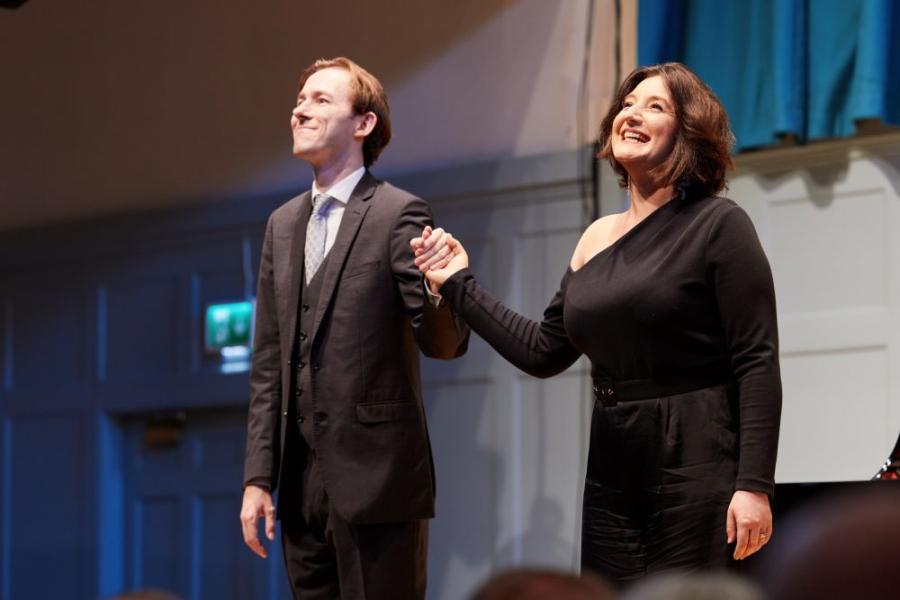
And such drama there was here. Much of it is to do with Taylor’s identification with the text, as in two songs by Augusta Holmès that ran from passionate love to the annihilation brought by sensuality, and Taylor found similar passion in songs by Fanny Hensel and Clara Schumann. In contrast, there was wilting beauty in Lily Boulanger’s “Reflet”, and in a cycle by Germaine Tailleferre she was by turns waspish and sensual. An old Orkney song, arranged gorgeously by Cameron Biles-Liddell, showcased Taylor’s voice as the perfect instrument for something as directly communicative as a folk song.
However, the highlight came at the end in the premiere of Stuart MacRae’s Medusa, a sympathy-for-the-devil song cycle which sees the myth from the perspective of Medusa as the victim. Taylor hurled herself into the music with impassioned intensity, bringing thrilling, hall-filling grandeur to the voice while Brown accompanied with expressionist vigour, transfiguring the piano part into something unexpectedly beautiful at the end. This was a quasi-operatic monodrama in the line of, say, Britten’s Phaedra, and MacRae can’t have wished for a more sympathetic pair of interpreters.
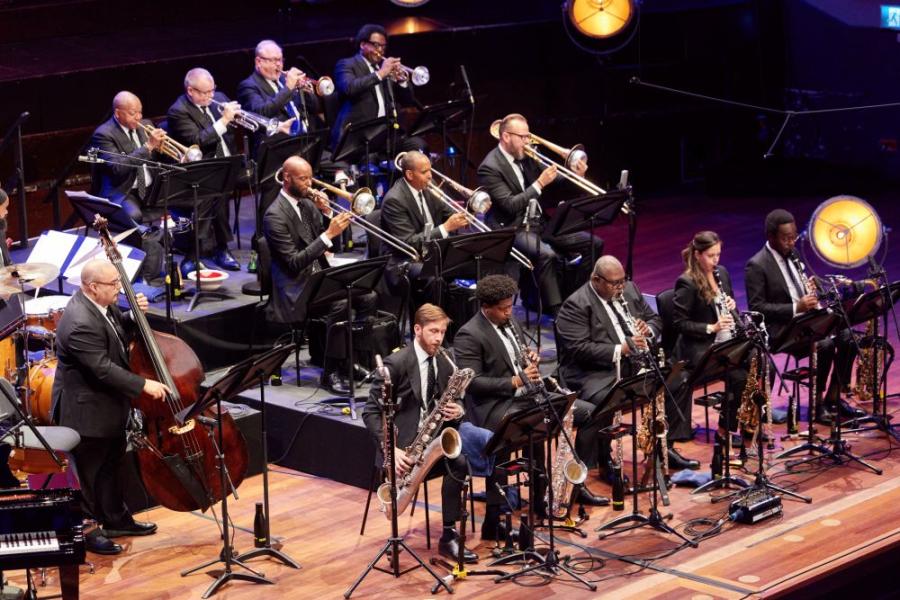
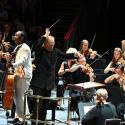
The following evening contained plenty of drama, too, albeit of an altogether more laid-back variety. Concluding their EIF residency, the 15 players of the Jazz at Lincoln Center Orchestra were on stage to play their own arrangements of American jazz classics, directed from his place in the back row by their trumpeter and boss Wynton Marsalis. So far so excellent, and we got treated to not only a gloriously rich sound but also some outstanding solo blasts, as well as, in the music of Ernesto Lecuona, the finest Cuban rhythms north of Havana.
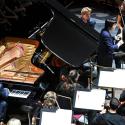
There was a 16th player on the stage: none other than classical piano virtuoso Yuja Wang. Her name could pack out any hall on the reputation of her Rachmaninov, Ravel or Shostakovich – the EIF laid on two iterations of this concert in the same evening to cope with the demand – but hearing her in jazz is a treat rare indeed.
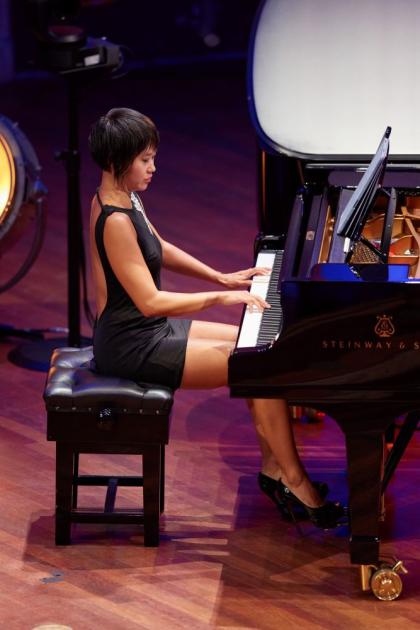
She was both an excellent complement to the JLCO players and, all the more so, a draw in her own right. In the opening tutti sections of each number, she played unobtrusively at the piano, while nonetheless seeming to exude the dynamic energy you expect from her when she’s pounding her way up the keyboard in a concerto; but in the improvisatory sections she really took flight.
Wang turned Oscar Peterson’s “L’Impossible” into a dazzling showcase, while her concluding take on Joseph Kosma’s “Autumn Leaves” brought the house down in its showstopping brilliance. She also stormed her way through Art Tatum’s “Tiger Rag” like it was a walk in the park. The loveliest thing about it was that, for all her virtuosity, she had such easy-going sway to her that she seemed to be having an absolute blast. You can be sure the audience was having one too.