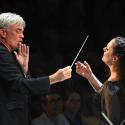
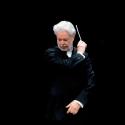
Best laid plans and all that … this concert was originally to have been conducted by the late Oliver Knussen, and of course things had to change after his death. In the end the more recently advertised Ryan Wigglesworth was unable to conduct either, and Moritz Gnann stepped in: he first appeared with the BBC Philharmonic in 2017 and last visited in November. The programme had already begun to change – the original choice of Borodin’s Second Symphony had been changed to Nielsen’s Fourth, the "Inextinguishable", and in the end we heard Dvořák’s Ninth, the "New World".
Knussen’s own Flourish with Fireworks was kept as the four-minute opener, as was Henze’s Ariosi, but the premiere of a new piece by Martin Suckling fell by the wayside. Claire Booth was also unable to appear as soloist, and Christiane Oelze sang in the Henze, while Allison Oakes appeared in Berg’s Three Fragments from Wozzeck: considering her reputation and track record as a major dramatic soprano in Germany, Budapest and New York, this was something of a revelation for us, as she made her UK debut only last October (with the Bournemouth Symphony Orchestra). Of the original line-up, only Clio Gould, as violin soloist in the Henze, remained.
Gnann is a man of many sympathies, and he presented Knussen’s work – itself a kind of tribute to Stravinsky – with swagger, a sense of the exotic and an impressive build-up of rhythmic power. It was a tribute in its way to the memory of Oliver Knussen, whose father was a Hallé double bassist at one point and who was himself a familiar figure on the podium in Manchester.
Henze’s piece – whose five sections include three settings of poems by Torquato Tasso – is also quite a virtuoso work for large orchestra, and Gnann’s control of its wide sonic canvas, allied to the contributions of the soloists (both Christiane Oelze’s and Clio Gould’s, and eloquent ones from within the orchestra), was masterly. There was palpable anguish in the lamenting, finally peaceful, second movement, and a real outburst in the fourth, as Midori Sugiyama led the orchestra. And while Oelze’s singing was at its most passionate in the short central poem, it was the despair and agony expressed in the accompaniment of the final sonnet that hung in the air.
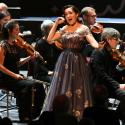
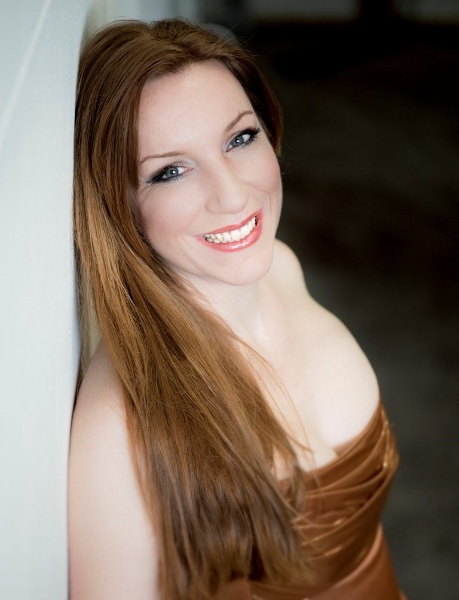 Berg’s Fragments gave Allison Oakes (pictured right) the chance to use her skills as an actress as well as a singer: she was in character from the start, as the new mum Marie sings to her baby and watches for soldiers marching by. Oakes has taken the role in the complete opera, so she knows what Marie is thinking in this extracted scena, and her portrayal came to life in concert, while the rich power of her voice was evident by the climax of it, too. Gnann obtained eloquent playing from the orchestra in the final section.
The Dvořák symphony was a different task for all concerned – it’s a repertoire work, familiar to the players and many, one would think, of the audience. Here Moritz Gnann had fresh ideas to offer. He found drama in its opening (very slow indeed) and then hurled us into a brashly American allegro first subject, itself contrasting nicely with a charmingly nuanced Bohemian second. He likes to let everyone hear the counterpoints in the scoring wherever possible: that can be great fun, but there were times when the brass playing became a bit overly competitive.
His reading of the slow movement gave its middle section much more passion and impact than is often the case – and its final bars were beautiful and thoughtful (and earned some spontaneous applause for the movement in its own right).
The scherzo opened and closed at a fine lick, easing in the lilting trio, and the finale brought committed playing from start to finish, with exemplary clarity in the textures. It was a demonstration of what a conductor on top of his game can do with a warhorse – incidentally the same symphony that was conducted by Gianandrea Noseda the first time he appeared with the Philharmonic… and look what that debut led to.