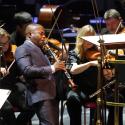
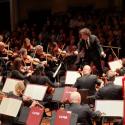
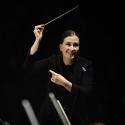
Legends, myths, and Nietzsche’s Superman - which for the purposes of this London Philharmonic Prom was none other than Vladimir Jurowski himself. His extraordinary ear, his nurturing and layering of texture, was a constant source of intrigue and delight and at least one performance - that of Sibelius’ tone poem Pohjola’s Daughter - was revelatory in its musical insights. That began distinctively with a strange little serenade for cello (Kristina Blaumane) and took us to wild and wonderful places in the hinterland of Sibelius’s imagination.
But on a blind listening who might we have supposed had written the first piece on the programme? It, too, opened with a string solo (violin this time - leader Peter Schoeman - it was a good night for string soloists) coaxing woodwinds out of hiding until the same tentative phrase in response turns into a transporting melody. Light, airy, and balletic, with chattering woodwinds on pointe so suggestive of Tchaikovsky but only fleetingly. On account of its brevity and transparency one might have been more inclined to guess at Liadov instead of thinking closer to home. But Granville Bantock’s The Witch of Atlas (receiving its first performance at the Proms) is in some respects more Russian than the Russians and since he chooses to home in on one aspect of Shelley’s epic poem above all - the witch’s bewitching beauty - the seductiveness of Bantock’s orchestration is all in its iridescence. Top-heavy, you might say, as opposed to Sibelius whose music comes up through seismic bass lines.
Prokofiev, the seductive romantic, was in safe hands but the quirkier, more abrasive, side of his nature was nowhere
Pohjola’s Daughter was, then, the flip side of the Bantock in the second half of the concert, dark and windswept where the Englishman’s fancy was all lightness and shimmer. Jurowski, who has a wonderful way of clarifying even the most obtuse and complex of musical scenarios, reconciled Sibelius’s structural tautness with an epic reach. As so often with Jurowski, the familiar was completely surprising.
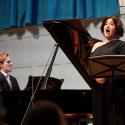
In between came a Proms debut for the Serbian pianist Anika Vavic. She played Prokofiev’s Third Piano Concerto with warmth and self-evident affection but with a disconcertingly muted approach to rhythm and articulation. I know the Albert Hall is difficult (some would say impossible) to manage and that the image of its Steinway can seem woolly and diminished depending upon where you are sitting - but I was close and well enough situated to know that this was a very one-sided performance. Prokofiev, the seductive romantic, was in safe hands but the quirkier, more abrasive, side of his nature was nowhere.
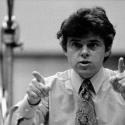
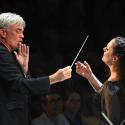
 Vavic (pictured right) seemed to be in her own little world, visible interaction with Jurowski and the orchestra was at a premium, and in the work’s many brilliant up-tempo flights things felt far from secure with momentary lapses in co-ordination leading one to think that soloist and orchestra were about to part company. Indeed, it was the orchestra that drove this performance and the piccolo that lent brilliance and dazzle to the finale and not the under-projected keyboard.
But if the Albert Hall is not the pianist’s best friend its mighty organ is welcoming and then some to Strauss’s Also sprach Zarathustra. We got slightly more than we bargained for from organist Catherine Edwards who had a “cipher” event (like a cosmic fart) in one of the quietest moments of longing very early in the piece. It somewhat undermined the memory of the great sunrise - which was very Stanley Kubrick - but didn’t for long affect the composure and lushness of the performance. Some of this piece - not least the slow fugue which so effectively parodies dry academia - does still feel a little too theoretical (the ubiquitous three-note nature motif of the opening does rather gnaw into our souls) but Jurowski rejoices in its ingenuity and ebullient spirit and the orchestra (with exciting horns and bullseye first trumpet) really reached apotheosis of the dance even if the fabled “Midnight Bell” didn’t quite rise to the occasion. Tubular doesn’t do it, I’m afraid, not in this hall. It’s something akin to Notre Dame that is required, or bust.