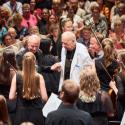
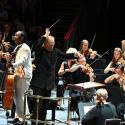
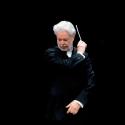
This was a Romantic behemoth of a concert: dripping with over-the-topness and oozing slush, the sort that is guaranteed to sell out the Albert Hall and is equally likely to send you home feeling like you’ve just eaten a rather too heavy six-course dinner with a couple of ports at the end. Could even Vasily Petrenko’s expected clinical touch turn Rachmaninov’s Second Piano Concerto, Schumann’s Manfred Overture (re-orchestrated by Mahler here) and Tchaikovsky’s frankly outrageous Manfred Symphony into a manageable banquet?
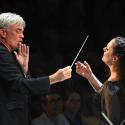
The answer was a resounding yes. Schumann’s overture was neat, incisive and intense. A short, sharp (Mahlerian) cymbal gave us a hint of the dramas ahead before alert, questioning string lines set the mood, probing like a snake in the grass. Petrenko is a master at showing the detail without losing the overall picture and the constant dissonances reared their heads with an impressive clarity that created a vividly colourful orchestral palette, with particularly effective dabs of paint coming from a generous bass section and sweeping lines of violas and cellos. Petrenko kept tight hold of the reins – the Romantic hero was kept under a firm leash – but it was a splendid portrayal of the unstable Manfred: difficult to contain, twisting and turning, and straining to escape at every opportunity.
The Rachmaninov actually provided a bit of light relief between all this long-haired Romantic head tossing, and Simon Trpčeski, who recently recorded this and No 3 with the RLPO, and who obviously has a good relationship with them, kept things light in his piano playing. In fact, in volume the piano sounded rather underpowered throughout, and didn’t always manage to cut through the generous orchestral accompaniment. Perhaps a more brightly prepared piano would remedy this – and surely it would only serve to enhance an already sparkling performance.
It is the glittering moments where Trpčeski really shines: the cascades of semiquavers and those flowing, boiling-water moments at the beginning of the first movement. It all feels very natural and incredibly easy, so you can forget about the fact that there’s a pianist there and concentrate on wallowing in whatever it is this piece makes you feel. Petrenko, as expected, didn’t hang about, but far from being humdrum this made the most subtle of holding backs infinitely more effective. As in the Schumann, with Petrenko’s RLPO you become so aware of all variety of elements in Rachmaninov’s scoring that you never realised before – a hint of oboe melody here, a surge of violas there – that the work seems splendidly fresh.
The second movement was the least satisfying of the three, for the reason that where Trpčeski glides through the fast passages, in the slow, drawn-out melodies he seems rather less able to create a truly effortless sense of line. Petrenko matched the pianist here, with some of the accompanying orchestral phrases sounding rather too clipped, too divided. The result wasn’t entirely satisfying – the odd jolt in the piano line tended to get in the way of those beautiful melodies. The third movement was much more suited to both Petrenko and Trpčeski’s style, however, and was utterly thrilling.
And so back to Manfred. For all its precision this playing out of High Romanticism was as dramatic as one could hope for. A gutsy, dirty, portamento-laden string introduction became an electrifying – and at times terrifying – queue of tragedies just waiting to happen. The contrasting second theme, that of the irresistible and unobtainable Astarte, was slender and lovely. The second movement, which can be a nightmare to keep both together and exciting, excelled on both counts. Clear, clean and fresh but with a definite edge to them, the melodies buzzed about with a waspish sense of mischief. After a breather in the third movement we were back to turmoil in the fourth with pseudo-Symphonie fantastique figurations played with an assuredness and virtuosity that was gripping. Swirling, skirling winds and strings and rude brass played out a black-sky (and possibly black-magic) drama, before that ridiculous organ entry gave poor old Manfred some sense of redemption at the end. Hats off gentlemen, and toss your Romantic locks for what was a thoroughly enjoyable evening’s entertainment.
- Read theartsdesk's recommendations for the 2010 BBC Proms
- Follow the RLPO in Liverpool with the next concert in their Russian Masters series: Rimsky Korsakov, Shchedrin and Shostakovich on 25 November
- Listen to the Radio 3 broadcast of this concert on the BBC iPlayer for the next week