“O stay and hear,” sings Twelfth Night’s jester Feste in his song “O mistress mine”, “your true love’s coming,/ That can sing both high and low.” And loud and soft, earthbound and airborne, Heldentenor-grave and night-club frivolous: Nicky Spence’s wide vocal span and stylistic versatility made him the ideal soloist for this cheerful post-Christmas canter through several centuries of Shakespeare songs.
Roger Quilter’s urbane yet melancholy take on “O mistress mine” (one of a trio of items from the composer) represented just one stop on a musical journey that began with William Byrd and ended with John Dankworth.
Dylan Perez was the accomplished style-shifting pianist (and occasional partner in banter and byplay), while actor Miranda Richardson – for once filling a non-Blackadder Elizabethan role – supplied what Spence called the “connective tissue” to the evening in her brief readings from the plays and sonnets. We even enjoyed an audience singalong: a rare bird in the Wigmore's hallowed halls.
Pitched both as a festive cabaret (Spence branded the programme as a pre-Twelfth Night gig) and recital showcase for a multi-faceted star tenor, the concert had to tread the fine, if wavy, line that separates jollity and artistry. The fun bits mostly worked well, with Spence as MC and occasional stand-up, though pianistic in-jokes (Steinway vs Bechstein) can swiftly fall flat. In the first half, the main dampener came from Richardson’s rather whispery delivery, as if she were performing in a TV studio while, in contrast, every one of Spence’s sung or spoken words bounced bell-like off the back wall. Post-interval, her volume rose and projection improved, which meant that her sonnet readings (for instance of 138, “When my love swears that she is made of truth”) landed with the force and grace that they deserved. 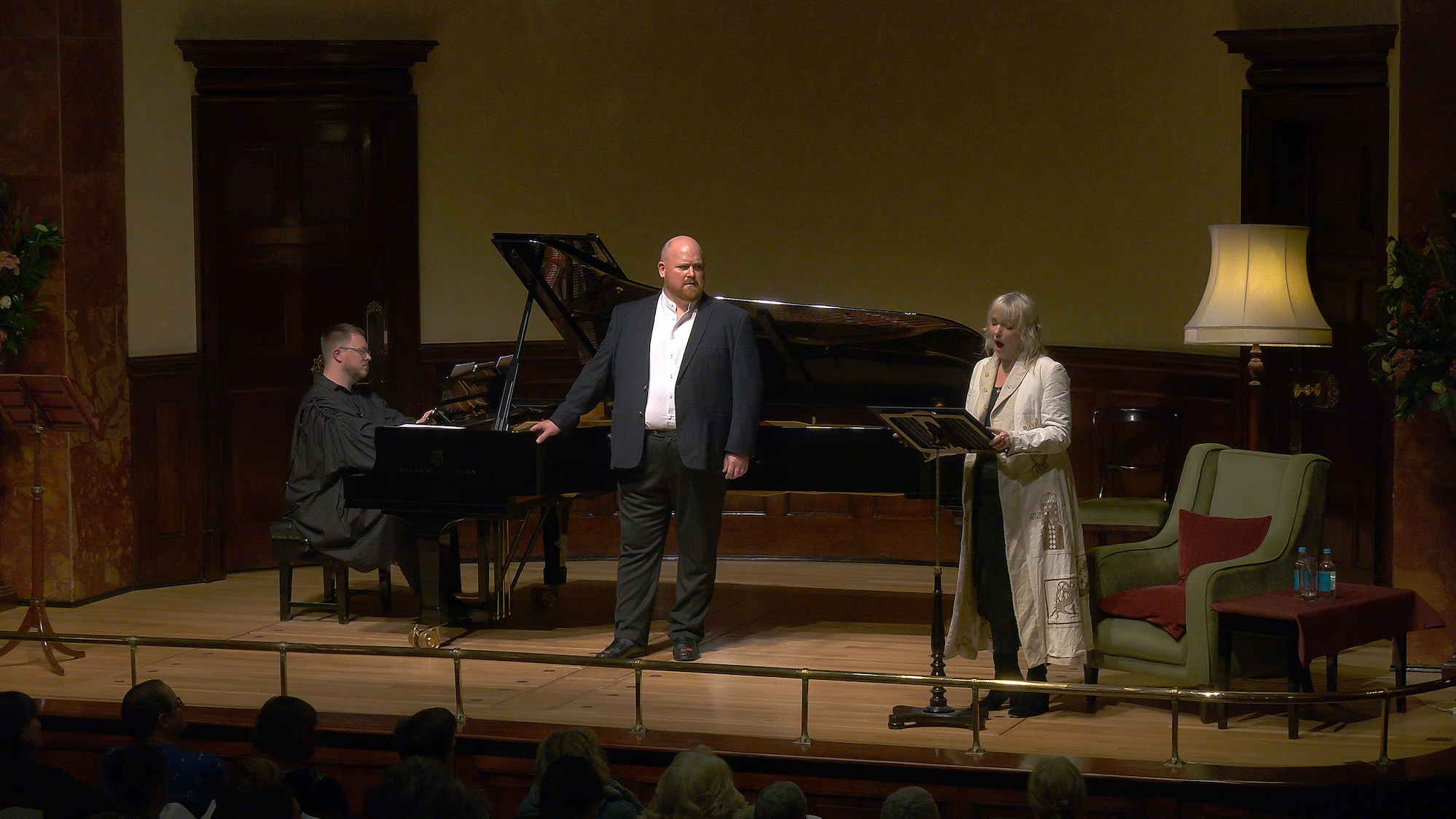 As for the musical buffet, Spence strode over four centuries of Shakespeare settings from Tudor airs to Sixties jazz. At the earlier end of this historical arc, Byrd’s “Caleno custure me” (the occasion for our mass karaoke) doesn’t quite set a play text but adapts a popular number – with a refrain that looks like joke Latin, but is apparently mangled Irish – that’s also referred to in Henry V. At the other, Dankworth’s sinuously cool match of sound and sense for sonnet 18 (“Shall I compare thee to a summer’s day?”) might have been written for the inimitable voice of Cleo Laine, but Spence managed to avoid pointless mimicry while showing just how deftly the music’s shape fits the words.
Schubert topped and tailed the menu: a sturdy, muscular “An Silvia” (which originates in the little-seen Two Gentlemen of Verona) at the start, and a farewell “Hark, hark the lark” (from Cymbeline) capped by a clever blues version of the same number by Peter Dickinson. Along the way, Spence delivered a fairly light-hearted masterclass not only in the tenor range of tone and colour – from sounding brass to tinkling cymbal – but in the expressive word-painting that all these composers try to evoke. Tippett abundantly calls on (and received) that craft in his Ariel songs from The Tempest, with “Full fathom five thy father lies” plunging us into a harmonically mysterious submarine swirl.
Yet Spence showed too how character-rich performance can add irony or distance to the words, as in his sarcastic rendition of “Thrice happy loves” from Purcell’s The Fairy Queen, with his savage shredding of the final “chaste”. In Tippett and Walter Bergmann’s arrangement, Purcell’s “If Music be the food of love” prompted some of the evening’s most beautifully nuanced and sculpted lines. And a tenderly haunting “She never told her love” – with Perez’s piano eloquently filling the grief-filled gaps in the words from Twelfth Night – made you regret that Haydn never wrote any more Shakespeare settings.
On occasions, the sequence of words and music lacked clarity and continuity: sometimes, but confusingly not always, Richardson’s play extracts related to the songs. Not every number touched the heights of Purcell and Haydn, though I was glad to discover Ned Rorem’s quietly ardent response to sonnet 60 (“Like as the waves make towards the pebbled shore”). But on such a night nobody would have wanted to nitpick or fault-find: Spence’s agile and full-flavoured vocal art put the infinite variety of musical Shakespeares – which here also embraced settings by Britten, Poulenc and Hugo Wolf – into bold relief. As The Merchant of Venice tells us, “The man that hath no music in himself... Is fit for treasons, stratagems and spoils”. Spence, Perez and Richardson pushed us genially towards 2025 newly armed against those ills.