Siglo de Oro are a vocal ensemble who specialise in older music – and especially neglected older music – but they have also always programmed new music, and the centrepiece of this recital at the Wigmore Hall was a large-scale commission by composer Ben Rowarth, to words by Sophia Carr-Gomm. And a successful work it was, maintaining interest through its 45-minute span through its strong musical conception, the excellent playing and singing of Siglo de Oro and violinist Amy Tress, and the extra dimension of the live electronics provided by Joe Bates.
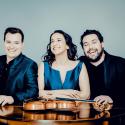
The first half, though, was more familiar Siglo de Oro territory, starting with some trademark Hildegard, sung from the back of the hall, the unison line passed between solo voices and small groups, from downstairs to up in the gallery. This was followed by a Bach violin solo movement, beautifully played by Amy Tress (pictured below), with poise and a wonderful line.
The Palestrina Lamentations of 1588 are – to my modern ears – too serene and perfect to fully depict the misery of Jeremiah, but Jonathan Harvey had a solution, in his re-working of Palestrina’s Stabat Mater (2004). Here the original Palestrina, sung from the stage, is combined with a pre-recorded version in another key and live manipulations of the voices on stage. This certainly adds a piquancy to the basic Palestrina, with polytonal scrunches souring the consonance, and the resonance of the electronics putting us temporarily into a larger space. But I wondered whether, however well sung, this gilding of the lily got caught between being on the one hand too faithful (there are no compositional additions or alterations of the original) and too far from Palestrina’s own world. I also suffered from being too close to a speaker, so got an unbalanced sound, something I was glad to put right by moving a few rows for the second half. And here Ben Rowarth’s The Fall achieved a real sense of lament and an emotional drawing-in that I found more affecting than the Harvey/Palestrina. It is a telling of the story of the Trojan War through the eyes of Cassandra, but the fragmented text and the deliberately oblique word-make it possible to enjoy the piece without really knowing what it was about. For me, its pleasures lay in the subtle textures, the 12 voices whispering, muttering, chanting, droning, interacting with the live violin, and the electronically distorted pre-recorded violin.
The text is jittery in its repetitions and mantras and Rowarth has responded to Gomm-Carr’s eminently settable words with a seriousness of intent, and the skill to sustain a large-scale conception. The singers are mostly quiet, making the occasional outbursts hit home all the more effectively. It is a proper ensemble piece, with only one solo spot, for the alto Rebekah Nießer-Jones, a folky meditation gradually overwhelmed by other sounds. Meanwhile, the still centre of everything was Amy Tress, her violin keening and sliding, or inexorably plucking, dancing around the choir. And credit for the whole ambitious project must go to conductor and artistic director Patrick Allies, who led a most committed and intense performance.