Jef Costello, the lone contract killer in Le Samouraï (Jean-Pierre Melville, 1967), carries out the murder of the boss of a night club. We see how meticulously he has prepared for it, including the construction of an airtight alibi involving precise times – which others will corroborate – for his arrivals and departures at locations other than the scene of the crime. In spite of that, he is rounded up on the same night, identity-paraded the following morning, and once he is released by the police, he still remains their main suspect. And then finds he is also being pursued by his criminal bosses...
This is the Paris of over 50 years ago. In the dialogue-less opening he steals a grey Citroën DS (there is a lot of grey). The police investigation inevitably involves lines of questioning involving the temperature of bed-sheets. People familiar with the Paris Metro will notice Costello vaulting off the tapis roulant (travolator) at Châtelet, and see the police doggedly tracking their suspect using a customised version of the PILI (Plan Indicateur Lumineux d'Itinéraires), once such an everyday sight in stations all over Paris.
But the plot and the setting are really just a pretext. As Melville explains in one of the interviews accompanying this Criterion release – with extras such as documentaries, interviews and a 2005 essay by David Thompson – for him, gangster movies are a vehicle to explore themes that really interest him: individual freedom and trust, friendship and betrayal (just about always between men, it was the Sixties...).
And then there is the inescapable fact that the main protagonist of Le Samouraï is the impossibly handsome Alain Delon in his early thirties, in the first of three films he made with Melville. We watch as Delon does other kinds of meticulous preparation for his crimes. The putting on of the hat in front of a mirror, or the donning of white gloves are done with great care and thoroughness, as if they are a “hieratic ritual” in the words of Volker Schlöndorff who worked with Melville as an assistant.
In Italy the film was titled Faccia d’Angelo (Face of an Angel) and it is indeed Delon’s seraphic face which dominates and almost never leaves the screen. Throughout the film Delon is being hunted down, and the viewer is magnetised by the clues his facial expression gives or doesn’t give. He is seldom seen without trenchcoat and fedora. Melville was one of the most diligent film-viewers ever, and he is deliberately alluding here to earlier American role models, such as Alan Ladd in This Gun for Hire (1942), or possibly Bogart in Casablanca.
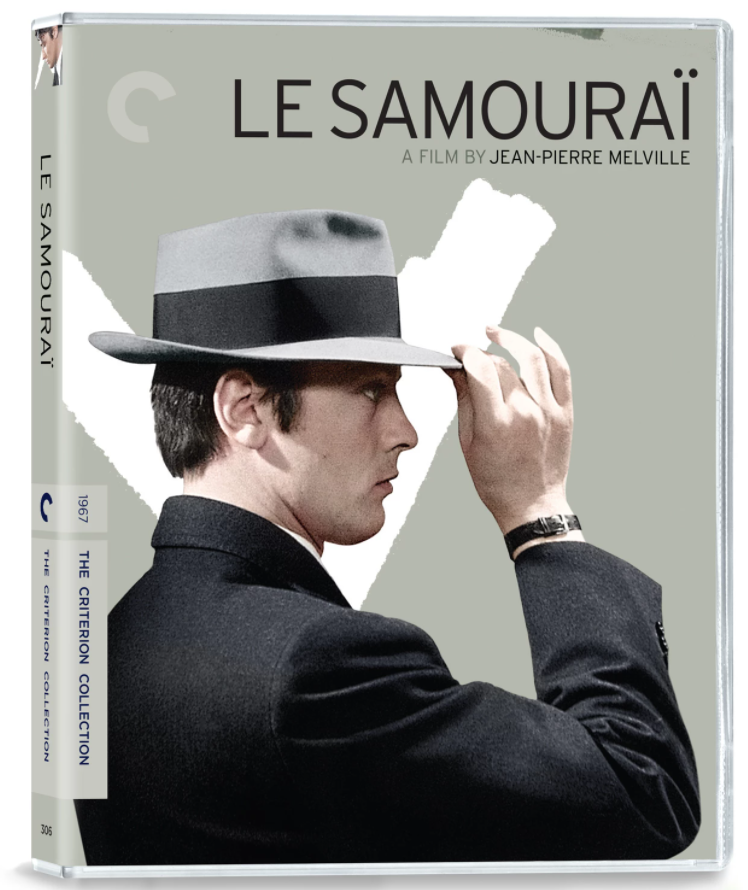 Melville explains how he sees the role of the director in an interview accompanying this high-definition digital restoration: “A film-maker is a shadow puppeteer. He works in in the dark. He uses tricks to create.” He also had frequent collaborator Henri Decaë whose wizardry working with natural light is the stuff of legend.
Melville sees the police and the criminals as opposing armies and more or less interchangeable. In Le Samouraï that ubiquitous gravelly-voiced French actor François Périer is the main cop. In the next Melville/Delon movie Le Cercle Rouge (1970), he pops up as a criminal. And in the last of the three, Le Flic (1972), Delon himself has switched sides and become a cop.
The real theme, and also the film’s title are elucidated in one of the opening shots with this quote across the screen: “There is no greater solitude than that of a samurai, unless it is that of the tiger in the jungle... perhaps...” – Bushido (Book of the Samurai).
One reviewer of Melville: The Essential Collection (2017), which left out Le Samouraï, has said that Melville's achievement was to "make existentialism thrilling”. In Le Samouraï he also gave Delon a classic and unforgettable role.