Anyone who’s ever been to a movie set can’t help but struggle to reconcile the utter dismembered chaos of these workplaces with the smooth joined-up pseudo reality of the finished screen product. This jaunty, knowing third feature from Jane Schoenbrun – in which the teen slasher genre more or less eats itself – half-wants us to believe that the tortured film production process flows backwards. That is, the movie comes first. Then it sets out to assemble itself in the real world, torturing everyone all the more.
It tells of a 29-year-old cultish filmmaker called Kris (Hannah Einbinder) with a fear of sex and a fascination with the brand of old-school slasher movies that fetishised that fear. She’s the kind of young person who loves DVDs (N.B. an old mode of recording for home cinema) and can’t encounter a spool on a film projector without caressing it.
She wants to reboot a 35-year-old Friday the 13th-type franchise called Camp Miasma (horny teens slaughtered at a sleepaway resort) and tracks down the heroine of the original to see if she’ll do a reprieve of her turn, like Neve Campbell in Scream or Jamie Lee Curtis in Halloween.
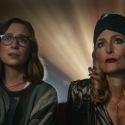
This is Billy Presley, played by Gillian Anderson, who was dropped years ago from the franchise after she “aged out”, in the glorious Hollywood phrase, and now lives in the very same Pacific Northwest resort where the original film was shot. This alone might tell us that Schoenbrun’s saga might be seeking a tasty snack in the form of its own tail. And the persona of Billy herself further suggests that Kris’s head may not be as well screwed-on as we think and disappearing into a fantasy vortex of her own making.
Anderson gives us an addled witchy southern belle of no determinate century, mixing elements of Norma Desmond, Blanche DuBois and Dolly Parton. A scene in which Kris and Billy try to bridge the culture and generation gulf, as Kris talks about intersections of queerness and bestiality in slasher films, and Billy rejects all this mumbo-jumbo, is a great encounter for our times. This is Schoenbrun, not for the last time, in self-parody. Billy, meanwhile, is playing a little dumb and knows more about this stuff than she’s letting on.
Kris and Billy eventually bond over re-watching Camp Miasma itself in all its – well – camp glory. Limbs fly off and corpuscles cascade in a Monty Python or Saturday Night Live fashion. The killer (Jack Haven), who is called Little Death and comes from a hole at the bottom of a lake, is a once-bullied trans teen with a PA speaker on his head, Darth Vader breathing and a metal spike that’s like Carl Boehm’s murder device in Peeping Tom (1960).
Sex and death coming together in an orgasm kill is also the nub of things here as our two leads intently study the deflowering of Billy’s young character (Amanda Fix) in Camp Miasma. Inspired, Kris and Billy launch into coupling of their own to feed Kris’s victim fantasies and release her hang-ups – all the more appetising because Little Death is back and looming over them.
The Letterboxd website describes Teenage Sex and Death at Camp Miasma as a “generational text”, though it’s not clear which generation this might be. Schoenbrun seems interested in a few stopping-off points – whether the anti-repression era of the 1960s, the exploitation movies of the 1980s or the metafictions of the post-modern 1990s. Basically, it’s a Tarantino-esque veneration of popular culture for all “adultescents” born since about 1955. If anything, its seminar room call-outs are a bit old-fashioned.
Schoenbrun is aware of wading into misogynistic and anti-queer waters in glorifying the spouting and spurting of slasher films, but for the director the genre’s euphoric traumas seem to bounce into a trans person’s journey – as was the case when people were swallowed by an online game in We’re All Going to the World’s Fair (2021) or by the small screen in I Saw the TV Glow (2024).
This new work is more about sex therapy and film-studies fun than horror. To the fore are the acts and parlances of sex itself, calling to mind, say, Jane Campion’s The Piano (1993) or early Pedro Almodóvar films. After all, as Billy points out, slasher pics are primarily about “flesh and fluids”.
There’s also more comedy than in Schoenbrun’s Gothy earlier efforts, notably in a scene where Kris wigs out on a Zoom call in front of some Hollywood stiffs. Schoenbrun is well served by cinematographer Eric K. Yue and composer Alex G, while “A Long December” by Counting Crows is a good needle drop over an extended bloodletting. The director delights in very direct steals from the cinema of others, whether Georges Méliès in TV Glow or Michael Powell and David Croenenberg here (close-up eyeballs and a sticky, fleshy VHS slot in the form of… you work it out).
All in all, Schoenbrun’s liminal and libidinal phantasmagoria is never going to concede that sometimes a movie is just a movie. Both movies and killers come from holes at the bottom of a lake. And an unyielding credo of the half-mad tribe of movie people has always been: Reality is what I say it is.