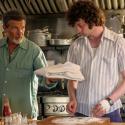
The strongest element in Tony is the performance that Antonio Banderas gives as ‘Chef’, the owner of a seafood restaurant in the holiday resort of Provincetown in the late ‘70s. It’s a subtle, nuanced delivery despite a script which doesn't give the actor much to work with. He could have just drifted into playing a saintly mentor, but somehow Banderas finds complexity in the role.
If only the same could be said of Dominic Sessa, who repurposes his debut performance as a surly youth, a cocktail of ego and insecurity, from The Holdovers. It’s easy to see why Sessa would be cast as the young Anthony Bourdain, the chef/ writer/TV presenter who was in the vanguard of foodie influencers. Sessa shares Bourdain’s dark curly hair and tall, lean physique but what’s missing here is the writer’s charm and wit.
Tony is Bourdain’s origin story, loosely adapted from the opening chapters of his memoir, which saw him stumble in his late teens into a summer job washing up in a series of restaurants and gradually learning to cook. He fell in love with the swagger, cameraderie and fireworks of a restaurant full of testosterone-fuelled staff and then made a career in the hospitality business in New York. Bourdain first wrote an essay for The New Yorker that gave the lowdown on what really goes on in restaurant kitchens; it was a hit and he found a publisher swiftly and the resulting book Kitchen Confidential (published in 2000) has had a cult following ever since.
The handsome chef turned writer became a media star with his TV travelogues searching out local cooking in restaurants around the world. But Tony the film is about Bourdain's life before fame and that may not appeal unless you enjoy spending 106 minutes with a boastful young fantasist set on winning a girl's heart. I found the skimpy script in this coming-of-age feature frustrating and Sessa’s wolfish glare didn't convince me that he'd evolve into a charmer.
There’s plenty of rough housing and verbal insults flying in the kitchen of The Flagship, a down-at-heel seafood restaurant . Fans of The Bear and Gordon Ramsay’s output may well enjoy these scenes. But the action is often repetitive and predictable; Tony has no money for rent, so Chef let’s him sleep on a hammock on the deck of his beachhouse. Every morning, the hungover dishwasher is woken by Chef throwing a bucket of water over him. It's hard to keep finding that funny the fourth or fifth time.
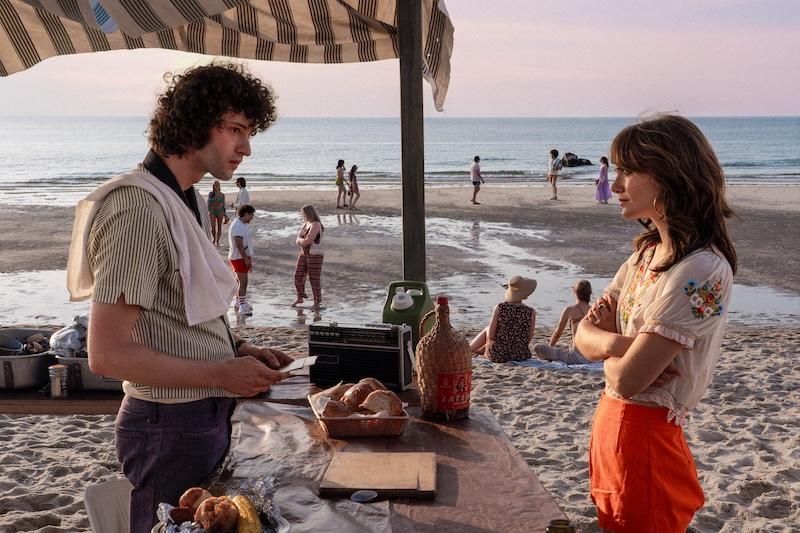
Leo Woodall (so good in Tuner where he gave a performance that really showed his range) is allowed here to phone it in. He plays Sal, a sexy bad boy cook who digs notches of wood from the doorframes of the girls he’s bedded, when he’s not introducing Tony to a panoply of hard drugs. We get no back story, no insight into his character; at one point toward the end of the film we see Sal/Woodall in the middle distance shrug his shoulders a couple of times, as if to indicate he didn't have enough lines to work with.
Even more underused is Emilia Jones (above right), who was excellent in Coda. She plays Nancy, a student and aspiring photographer who is spending the summer working at a pizzeria and partying along the Provincetown strip. Tony, nursing a crush on her since high school, has pursued her to Cape Cod but pretends it's a coincidence that they meet. She's sceptical, but is slowly worn down by his dogged determination. And so the film settles in to well-worn rom-com rhythms.
Shot all too often in tight close-ups and reverses, Tony looks like it would play comfortably on TV. It’s hard to believe that the cinematographer Michael Bauman, who filmed the visually extraordinary One Battle After Another is behind the lens here. It’s all handsome enough, there’s a nostalgic glow to the saturated summertime scenes, but Canadian Matt Johnson's direction is conventional and his music choices unengaging. Why have a poster of the New York Dolls on the wall, and sport the Stooges on a t-shirt (Bourdain was a big Iggy Pop fan), and not use their songs?
Even more questionable in terms of directorial taste is the foreshadowing of Bourdain’s own fate, hinted at in a convoluted story Chef retells from Escoffier, about how the pressures of the kitchen can lead to suicide. Ultimately Tony is a disappointment to admirers of Bourdain's writing and TV work. But there’s plenty of the real Bourdain to be seen on streamers where his considered forays into the food cultures not just of America, but of high-risk destinations such as Libya, Gaza, Congo and Myanmar made him far more than just a foodie influencer looking for followers.