Vicky Krieps is a guarantor of female integrity, whose characters rail against or ride roughshod over gender restrictions. Star turns from Phantom Thread’s steely ingenue to Corsage’s empress fighting to breathe share a searching, nonconformist intelligence and sensual warmth sometimes sheathed for survival. Love Me Tender’s Clémence seems a defining role. Fighting for custody of her child and expression of her queer, artistic identity when society expects more conservative motherhood, she’s a warrior in an unwinnable war.
Director Anna Cazenave Cambet’s adaptation of Constance Debré’s autofiction opens with Clémence swimming with athletic rigour in her local pool, then having sex in a cubicle. Cycles of discipline and release, austerity and sensuality flicker like a shuttering camera, as Clémence’s complete life slowly develops. She is an ex-lawyer and fledgling author, separated but still married to husband of 20 years Laurent (Antoine Reinartz) and amicably sharing custody of 12-year-old Paul (Viggo Ferreira-Redler, pictured below right with Krieps), who remains with Laurent in the marital home. Her new queer-leaning bohemian life is an idyll of communal cafes and bars, energising friends, hedonistic clubbing and casual hook-ups. Lunch with her friendly ex- seems part of this benign world, her admission that she’s seeing women hardly phasing him. “I just want you to be happy,” he says.

Days later, Clémence is accused of paedophilia and incest, the stunning first blow in Laurent’s claim for full custody. He retains possession of Paul, leaving Clémence in bureaucratic purgatory, where maternal intimacy is supervised and time is measured in “indicative periods” as, astonishingly then undeniably, her sexuality is punished. Incremental legal victories prove pyrrhic when Laurent ignores their rulings, lost time loosens Paul’s ties and the father annexes the son’s heart.
Krieps is long, lean and rigorously self-contained. Cambet angles her camera to emphasise the actress’s height, and whether in white shirts borrowed from Laurent or functional tank-tops, she’s androgynous in the sense of stripping away feminine adornment for an unencumbered, functional life. Whether this is a matter of survival, burying indulgence out of devotion to Paul, or an inbuilt essence, Krieps embodies Clémence.
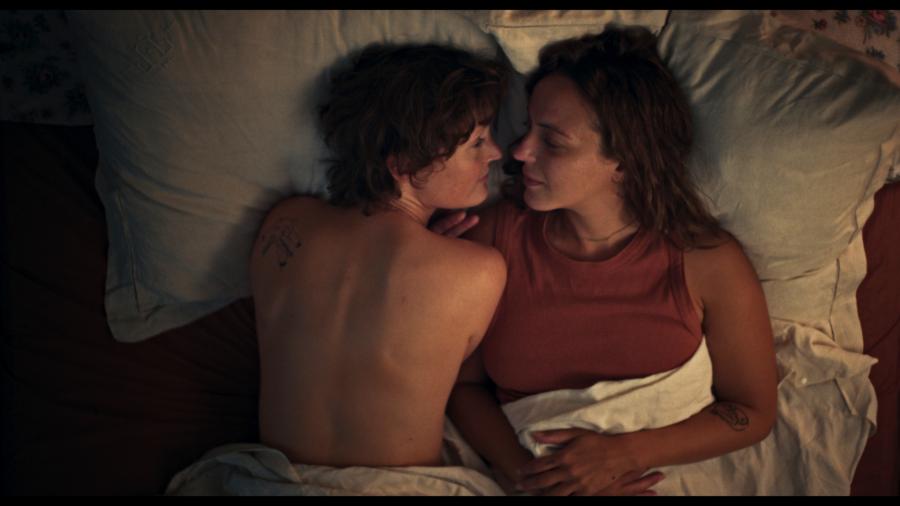
Her Belleville neighbourhood’s high-rises and municipal buildings pierce the optimistic blue sky of an endless summer. Like the coach-house at the foot of the former family mansion where her ageing dad lives his own medically supervised life and the bucolic Southwest landscape where she escapes with her most determined lover, Sarah (Monia Chokri, pictured below right with Krieps), this unfamiliar France is refreshing.
Clémence’s writing provides an authorial voiceover, the law’s visceral injustice competing with literary alienation from “womanish absurdity, the obscenity of mothers”. Diligently meeting each unreasonable legal hurdle for little reward, society’s claim on her weakens. Brief, heated affairs begin to suggest a contrasting, post-maternal queer heaven. Shaving her head, she could be cancerously ill, or liberated.
Cambet similarly splices an emotionally searing family film a la Kramer vs. Kramer with a procedural exposé of bureaucratic crimes comparable to workplace dramas such as Stéphane Brizé’s The Measure of a Man. Universally moving protest film and thesis of a possible feminine future, Love Me Tender is a radical heartbreaker befitting Krieps’ quietly iconic performance.