

Rebecca Lenkiewicz’s Hot Milk, adapted from Deborah Levy’s 2016 Man Booker shortlistee, has been described as a "psychological drama". Strictly speaking, it's a psychoanalytic one – a clue-sprinkled case study, involving talk therapy, of a woman whose repressed trauma has confined her to a wheelchair for 20 years.
She’s so querulous and demanding that whether she gets up and walks at the end matters less to the viewer than her frustrated caregiver daughter’s ability to free herself from Mum’s mind-forged manacles. The world belongs to the young, after all.
Former librarian Rose (Fiona Shaw), 64, has dragged the long-suffering Sofia (Emma Mackey) from London to Almeria, where she hopes €25,000 will buy her a cure from the shaman-like shrink Dr. Gomez (Vince Perez) at his clinic. Sofia is sceptical, inured as she is to the possibility that Rose’s psychosomatic illness was self-willed to facilitate her tactical withdrawal from the hateful world. (Pictured below: Fiona Shaw and Emma Mackey)
 To minister to Rose, Sofia has postponed completion of her PhD in anthropology and taken a coffee shop job. Beaching solo in Spain brings her no relief. She can't even get a smile from the handsome medic who, treating her for a jellyfish sting, ignores the sight of her bikini top slipping and her coy apology.
No matter. When Sofia is next sunbathing, up rides insouciant Ingrid (Vicky Krieps) and gazes down on her. The moment strongly recalls the meet cute of prostrate daydreamer Mona (Natalie Press) and mounted Tamsin (Emily Blunt) in My Summer of Love (2004), directed by Paweł Pawlikowski (with whom Lenkiewicz co-wrote 2013’s Ida). Like that mismatched teenage pair, Sofia and Ingrid start an affair. Ingrid proves as elusive and unreliable as Tamsin.
Enhancing her femme fatale credentials, she confesses to Sofia that she has killed someone. She is not a vacationing murderess, though, but another tormented intimate for whom Sofia must bear witness. That Ingrid’s trauma correlates with Rose’s feels contrived, but this doesn’t impair Sofia’s all-important evolution as a woman chasing liberation.
Rose denounces Sofia’s plan to visit her Greek father, who abandoned her and Rose years before and has a new family. She makes it anyway. The trip prompts her to help Gomez discover the maternal source of Rose’s woes, which were socially induced in the 1950s Ireland where she grew up.
A powerful dramatist and screenwriter – Disobedience (2017), Colette (2018), She Said (2022) – Lenkiewicz links Hot Milk intertextually with her Sligo-set Chekhovian play The Night Season (2004). Rose, born a Kennedy, is seemingly an amalgam of two of the play’s three Kennedy sisters, one also named Rose and another a librarian; their student sister must be Lenkiewicz’s (if not Levy’s) prototype for Sofia.
As a first-time director, Lenkiewicz has made a deceptively sunlit anti-idyll that's dense – almost too dense – with symbolism and references. It's as overdetermined as a dream.
Sofia identifies with a trapped dog and with the therapeutic art of Louise Bourgeois, who was psychosexually traumatised in childhood by her father’s affair with her nanny. The jellyfish equates with Bourgeois’s spider scuptures, which represented the artist's protective-predatory tapestry-weaving mother.
The snake that makes Sofia start outside the shack that Ingrid shares with her male lover? A bit obvious. We’re deep into Electra Complex territory here, as explored in Aeschylus’s matricidally themed The Libation Bearers. A shot of Sofia and Rose lying together en plain air quotes the realist painter Gustave Courbet's 1857 Salon shocker Young Ladies on the Banks of the Seine (Summer). (Pictured below: Emma Mackey and Vicky Krieps)
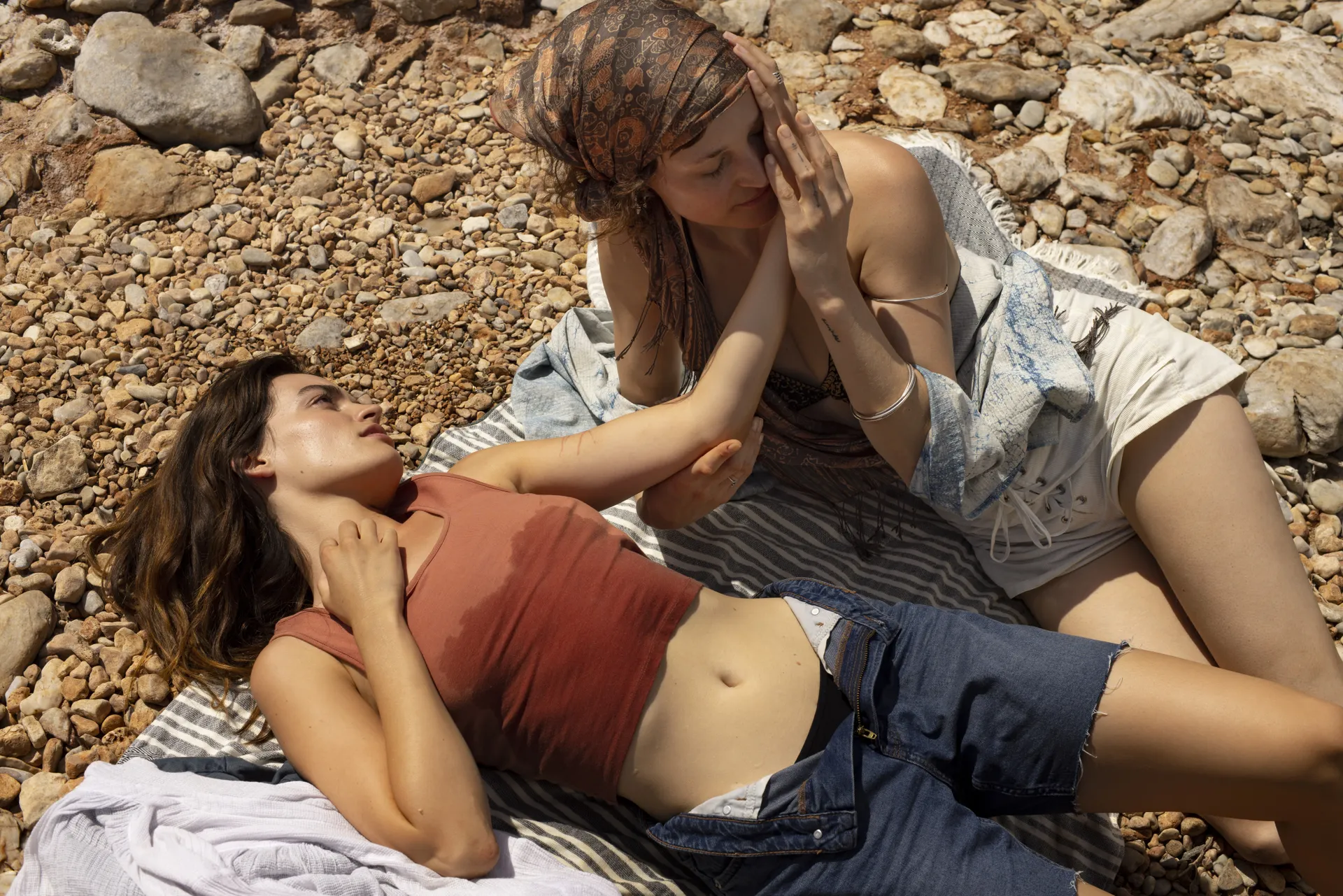 Since Sofia has been studying Margaret Mead, Lenkiewicz interpolates images from Mead and her fellow anthropologist Gregory Bateson’s 1937 film of a Balinese trance dance. It presents the story of a witch so enraged by the king's refusal of her daughter that she instructs her pre-adolescent female acolytes to spread a plague; they end up stabbing (but not wounding) themselves. Rose’s masochistic wrath has done greater damage to her and Sofia. Her failed parenting and her repression recall that of the Olivia Colman character’s in Maggie Gyllenhaal’s like-minded The Lost Daughter (2021).
Like John Wayne, say, Mackey is a great reactor, as she showed portraying the cruelly wuthered title character in the Brontë sister biopic Emily (2022). She perfected her world-class glower and combat boot stomp as "scary" Maeve in Sex Education (2019-23), herself burdened with a checked-out mother, and she uses them effectively in Hot Milk, surly Sofia's foot-pounding scorning Rose’s lameness. Pushed to the limits, forced into a dual detective role she doesn’t want, Sofia sometimes explodes, though Mackey internalises throughout the effect on her of pell-mell emotions and revelations.
Shaw brings perverse wit to her portrayal of the self-lacerating Rose. Krieps’s turn as the exasperatingly mercurial Ingrid is consciously self-conscious. Together, the three weave a dark tangled web that’s hard to brush off.


