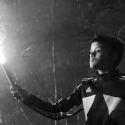
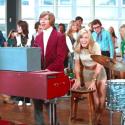
Joan Littlewood’s stage production of Oh! What a Lovely War was a huge success when premiered at Stratford East in 1963. Loosely based on a documentary-style BBC radio musical, it showed the key events of World War I portrayed by a commedia dell'arte troupe taking on multiple roles, the score based on popular songs of the time. A film adaptation seemed inevitable, though Richard Attenborough’s 1969 widescreen epic (his debut as a director) was made without any input from Littlewood, understandably worried about how her pithy, low-budget creation would survive its transition to celluloid.
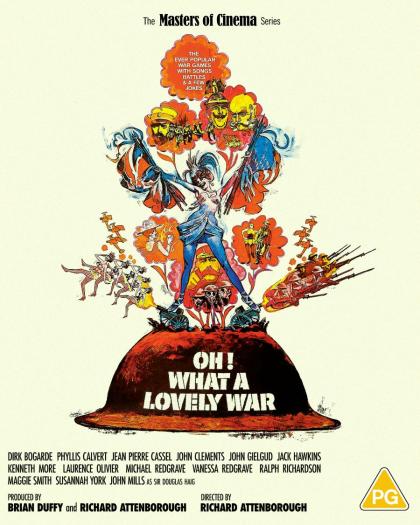
Attenborough’s adaptation used a screenplay by an uncredited Len Deighton, one of the film’s co-producers, the striking opening titles created by regular Deighton collaborator Raymond Hawkey. Instead of the original’s small ensemble, the film features an extravagantly starry cast, Dirk Bogarde, John Gielgud, John Mills, Maggie Smith and Laurence Olivier among those taking part. Brighton’s now defunct West Pier plays a vital supporting role, the events leading up to the assassination of Franz Ferdinand acted out in the pierhead pavilion. Europe’s great and good remind one another that war is unthinkable and that staying calm is the best course of action. Alas, World War One is soon emblazoned in lights at the pier entrance and the masses are encouraged to enter and enlist.
Stylised artificiality and grit coexist throughout the film, Attenborough’s chronologically ordered vignettes typically beginning on the pier, pantomime style, before abruptly cutting to earthy realism. We see this early on as the everyman Smith clan sign up, firing toy rifles at a fairground shooting gallery which quickly becomes the real thing. The pressure to sign up is nicely expressed in a scene where an alluring Maggie Smith sings, brilliantly, “I’ll Make a Man of You” to a music hall audience, a parade of bewitched men queuing to do their bit. “From now on, your lives won’t be worth living,” snaps David Lodge’s recruiting officer.
While the Smith family are mostly played by younger unknown actors (Corin Redgrave and Angela Thorne notable exceptions), the big names play the incompetent elites. Olivier gives us a pompous, loathsome Field Marshall French, and Mills’s General Haig is totally out of his depth, blithely ordering his troops to their deaths (“one more push should do it!”) from the top of a wooden helter-skelter. A cricket scoreboard shows the tally of dead on both sides, the numbers still shocking today. Great use is made of Sussex locations, Brighton Station and the South Downs prominent.
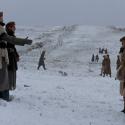
Attenborough’s direction in the big numbers is bold and confident, the pace slowing for the scenes which are played straight. The Christmas Day truce of 1914 is poignantly staged, German and British foot soldiers sharing cigarettes and schnapps for a few hours. And the film’s close, a rewritten version of Jerome Kern’s “And When They Ask Us” playing out over a hillside covered with thousands of white crosses, is terrific. So, a potent mixture of messiness and magnificence then, but an important British film which looks and sounds wonderful in this new HD print. Eureka provide good extras, notably film historian Simon Brown’s overview on depictions of World War I in British cinema. And a vintage making-of documentary includes a twinkly Attenborough on sparky form, especially entertaining when recalling how Larry, Ralphie and Johnny were brought on board.