We get the big city views of Chicago, the bright lights and the skyscrapers, a few times in Kim Longinotto’s Dreamcatcher, but for the most part we’re planted firmly down at street level, in areas of town probably you wouldn’t want to go to, a fair amount of the time at night. That’s where we first meet the film’s protagonist Brenda Myers-Powell (though I don’t think we ever actually hear her addressed by her surname), who’s cruising the streets, handing out condoms to any prostitute she can find. What she’s really offering, though, is advice – the advice of one who has herself managed to escape half a lifetime of drug addiction, working the streets, and all levels of abuse.
She’s come out the other side, and now she’s trying do something for those who remain trapped in the world she’s left behind. “You’re not a criminal, you’re a survivor!” is the salute Brenda offers to a group of prostitutes she meets on a prison visit after one of them has just recounted her own life story. Brenda’s message is that, even under the harshest circumstances – and some of the circumstances recounted in Longinotto’s film are as harsh as they get – there’s always a chance to turn a life around. It’s a message delivered with an empathy born out of experience – “Because I’m you!” – and without a hint of judgment. Help is there whenever the individual is ready, because it’s a decision that can only come from inside; the relapses, when they come, are never condemned.
The damages of early childhood are carried over into broken teenage years
For almost four decades British documentarist Kim Longinotto has been following women’s stories all over the world; her compendium documentary released earlier this year, Love Is All, an assemblage of British archive material which brought her back to the filmic landscapes of her native country, was a definite exception. Part of the remarkable immediacy of her work reflects the fact that she always works as her own cinematographer. Her more recent work has told stories from the developing world (after an early fascination with Japan), making Dreamcatcher’s American setting another turn away from the director's familiar territory.
We never learn how Longinotto first encountered Brenda and the rescue foundation that gives the film its title that she set up with a friend. But the degree of trust evident here is complete, less of a surprise with Brenda herself – who’s a presence whose empathy and energy is almost engulfing – but with some of the very damaged women who come into her orbit. Looking back over some of the director’s earlier films, like her remarkable Divorce Iranian Style (1998) or Sisters in Law (2005), those works seem somehow poised: by contrast, Dreamcatcher is as raw as it comes.
 It’s an accumulation of a few women’s stories, in which the damages of early childhood are carried over into broken teenage years. Even managing to stay in school at all is a major achievement when life forces you towards the streets. One of Longinotto’s most remarkable scenes shows Brenda visiting the local Paul Robeson High School to hold an after-school club with teenage girls. The frankness of their testimonies is as shocking as the almost neutral tone in which they’re told, as the girls relate their experiences of being raped (“recycled” being another word). It’s like a macabre countdown of the ages at which they were first violated: from 14, to 11, to nine, to eight, while one of them struggles to protect a four-year-old sister. And in almost every case, if they told anyone about what was happening they weren’t believed, left instead with a sense that it was their fault.
Brenda herself is an inspirational figure: her ability to convey the message of choice and the possibility of a better future is conveyed with an almost preacher-like mantra, “Courage, strength, hope”. When caught “off-duty” she's very funny too, and Longinotto was let in to witness all. “I don’t know where my hair is,” was her voluble reaction to one moment of confusion: Brenda rotates between a variety of extravagant wigs.
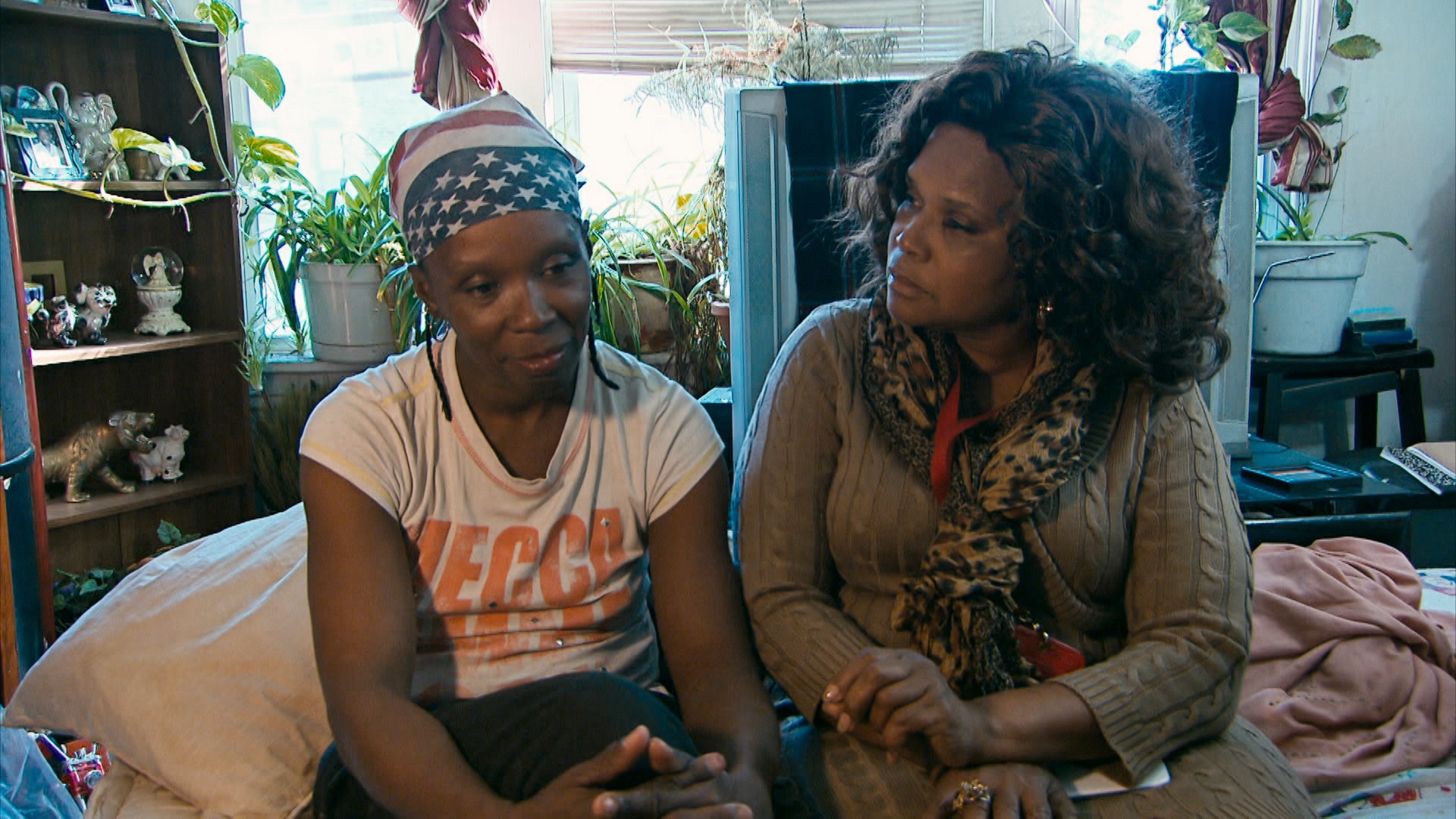
Of these surrounding dysfunctional families and friends, Brenda’s own circle received no less attention. She’s on good terms with one of her former pimps, Homer, who comes along to address her meetings to tell his own story, allowing Brenda the rarely laconic remark, reversing their previous relationship, “Homer works for me”. Immediate family issues were as demanding as those found elsewhere, with Brenda's sister-in-law Melody a troubled presence, as a powerful later scene between the two showed (pictured, above): Brenda and her husband have adopted Melody’s young son.
Longinotto has made a lacerating film, and with her longtime editor Ollie Huddleston balances moments of urgent communication and witness with those when silences and faces speak more strongly. We don’t really learn where the Dreamcatcher Foundation gets its outside support from, but can only hope it’s a reliable source. Dreamcatcher immerses us in an ocean of pain, from which some do manage, somehow, to force their way to a shore of hope. How many more, we can't help wondering, are left drowning.
Overleaf: watch the trailer for Dreamcatcher