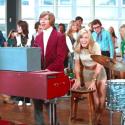
The Ealing-like comedy heist caper Two to One is Natja Brunckhorst’s second feature as a director, after the 2002 short film La Mer, but most people will remember her for an extraordinary performance as a 13-year-old actor in Uli Edel’s 1981 cult film Christiane F. The following year, she had an equally memorable walk-on in Rainer Werner Fassbinder’s last film Querelle.
Edel’s movie controversially depicted the empty lives of teenage drug addicts in West Berlin a decade before the collapse of East German communism and the fall of the Wall. In Two to One, Brunckhorst fast-forwards, as it were, the intervening decade and also crosses the divide. “Defence is weak,” says a GDR army guard, 20 minutes into the movie, but he’s talking about the quarter-final of the 1990 World Cup between West Germany and Czechoslovakia, rather than the Warsaw Pact, and is too busy watching the match on TV to spot a break-in at the underground compound he is supposed to be guarding.
As a result, the film’s trio of bank-robbers (Sandra Hüller, Max Riemelt and Ronald Zehrfeld), a kind of Halberstadt Hill Mob, get away with tons of abandoned and soon-to-be-worthless ostmarks before cunningly exchanging them for Deutschmarks at the derisory rate of two to one.
The premise of the film, which Brunckhorst also wrote, is clever and a lot of fun, juxtaposing historical events shortly before German reunification with an amusingly farfetched Mission Impossible-style – or perhaps Trabant-style – plot.
Those East German cars and the unique beauty of post-war socialist architecture give the film a meticulous, authentic feel for the Erich Honecker era. And the first half of the movie is full of some killer lines. “We have a right to see what the state is hiding,” unemployed factory worker Robert (Riemelt) tells his disaffected uncle Markowski (Peter Kurth). “Isn’t it a bit late to be revolutionaries?” replies the uncle, who actually works for the East German security services and is therefore able to sneak them into the underground base.
Unfortunately, the second half of the movie goes off the rails, with too many sub-plots clinging to its undercarriage, like fugitives, and a tedious love triangle involving Robert’s wife Maren (Hüller) and old friend, Volker (Zehrfeld), who returns to Berlin from exile in Hungary. “I didn’t feel at home there,” he tells Maren. “I belong here.”
The fall of the Iron Curtain is often viewed as a triumph for the rest of us, but for many people in East Germany, it ushered in hard times that eventually sowed seeds for Alternative für Deutschland (AfD), the neo-Nazi party that doubled its Bundestag seat share in February’s general election. Like many an Ossi (or East German), the banknote robbers in the movie fall victim, one way or another, to the transitions of the long hot summer of 1990, between the collapse of East German institutions and the rise of unemployment and the cost of living. “Everything I was told to believe for 40 years is doing a 180-degree turn again,” complains an elderly neighbour.
Hüller must have liked the script and perhaps just wanted to lend her bankable name to the project in order to get it made. Otherwise, it’s hard to understand why she took on the role of Maren, who is given almost nothing to do except count cash and act the femme fatale, like Jeanne Moreau in a DEFA remake of Jules et Jim. “Maren was always more than we could handle,” Volker tells Robert, “like a butterfly with clipped wings.” The same applies to the movie itself, which looks great but never quite manages to fly, even if the charm of Kurth, whenever he’s on-screen, almost brushes the dust off its wings.