“All over the world, young people between the ages of 14 and 20 gradually spend more and more of their time away from the good influences of their homes and schools. What sort of people are they growing up to be?” Although the stuffed-shirt narrator cannot bring himself to say the word “teenager” of the film’s subjects, it’s a question asked in the 1954 Government-sponsored Central Office of Information short film Youth Club (1954) included as a crazy extra on a new package of Expresso Bongo (1959). The main feature and the same year’s Beat Girl answer it. But not in a way the squares behind Youth Club would want.
The double-handed release of Expresso Bongo and Beat Girl brings a fine chance to entertainingly look at how low-budget British cinema dealt with the burgeoning threat posed by unruly teenagers. Each places a lot of its action in seedy Soho and its iniquitous coffee bars. Both feature highly racy sequences with strippers: almost bare breasts and the odd bottom are seen. This, then, is exploitation cinema.
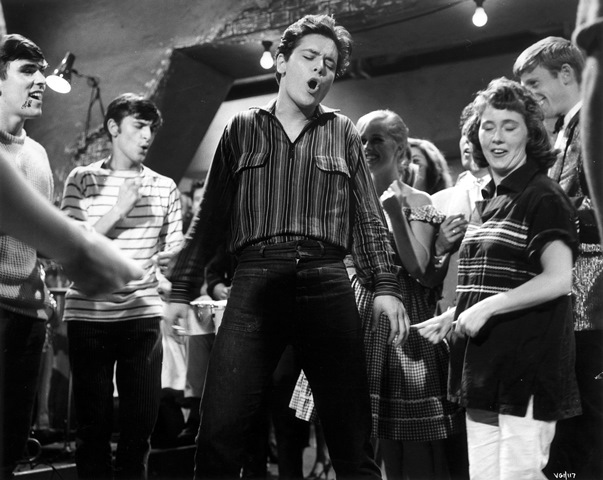 Expresso Bongo is the just about more serious of the two films as it adapts a 1958 Wolf Mankowitz stage satire about Tommy Steele, Britain’s first popular rock ‘n’ roller. Its director is the reliably great Val Guest. In short, it is the British Kwik Save take on Sweet Smell of Success and stars a maybe amphetamine-powered Lawrence Harvey as the always on-the-make Soho shyster Johnny Jackson. His girlfriend is stripper-come-exotic dancer Maisie King (played against type by a wonderful Sylvia Syms). Fittingly, considering its inspiration, Bert Rudge aka Bongo Herbert, who Jackson turns into a pop star, is played by a nuanced Cliff Richard (pictured right). An improbably young Shadows are seen in the film. Expresso Bongo is a hoot, and essential. But at 111 minutes, it is far too long, Harvey wears out his welcome and the forward flow is interrupted by lumpy musical-type songs. Despite the film’s indispensability it would merit three stars due to these shortcomings, but this package is chock full with class extras (one of which is Michael Winner’s first film, the 1957 poignant short The Square). Four stars.
Beat Girl is crackers. Its star is the Bardot-esque Gillian Hills as the bad bad bad Jennifer. Angry and armed with a catering-sized pout, she’s hot and bothered about her straight-laced father’s new hottie of a wife, the French lady Nichole. Instead of sleeping at night, Jennifer heads off unbeknownst to dad and step-mum to Soho’s coffee bars. The high-octane Hills, later to be a pop star of sorts in France, is incredible. She was also lustrous in Blow Up (where her pubic hair became the first to be passed by the British censor) and Clockwork Orange. The fact that it sports the first cinema score by John Barry helped Beat Girl to achieve immortality. Adam Faith provides the requisite contemporary pop star quotient by featuring as Dave, the archetypal and brooding conflicted youth. Oliver Reed also passes across the screen. Christopher Lee is a toweringly sleazy night club owner not bothered about Jennifer being under age, and is also seen in the bizarre short film Cross-Roads (1955), included as an extra. A sound four stars.
Both releases are issued as dual format DVD and Blu-ray packages with brilliant image quality (Beat Girl has previously looked terrible on home cinema releases), include alternate versions of the features and have booklets with diligent and insightful essays. Even without the extras each would be a must, but now they're unmissable.