It’s easy to forget about the Slovak side of the Czechoslovak “New Wave”: works coming out of Bratislava often seem to receive less attention, even on their home territory, than those from Prague, where the now legendary FAMU film school that gave birth to the film movement was based.
And that’s despite Štefan Uher’s Slovak film of 1962, The Sun in a Net, being generally acclaimed as the one that set the New Wave rolling. It makes for a situation, as Eastern Europe film scholar Peter Hames notes in a filmed extra on this Second Run DVD release, in which Slovak film of the period hasn’t so much to be “rediscovered” as actually discovered.
Eduard Grečner’s Slovak Dragon’s Return (Drak sa vracia) from 1967 is remarkable in many ways, and extraordinary in one, its score from composer Ilja Zeljenka. Cantata-like in scale and often working almost like a silent film score (words are few here), its introduction of human sounds, whispering most notably, over electro-acoustic elements must have been ground-breaking. Zeljenka had worked alongside Grečner on the sound side in Uher’s Sun…, and wrote scores for the three films the director made in the 1960s. Dragon’s Return was the last: after calling for passive resistance in the aftermath of the 1968 invasion, Grečner was largely denied even television projects and worked in dubbing. He would only return to the cinema in the 1990s, to make two more films.
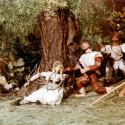
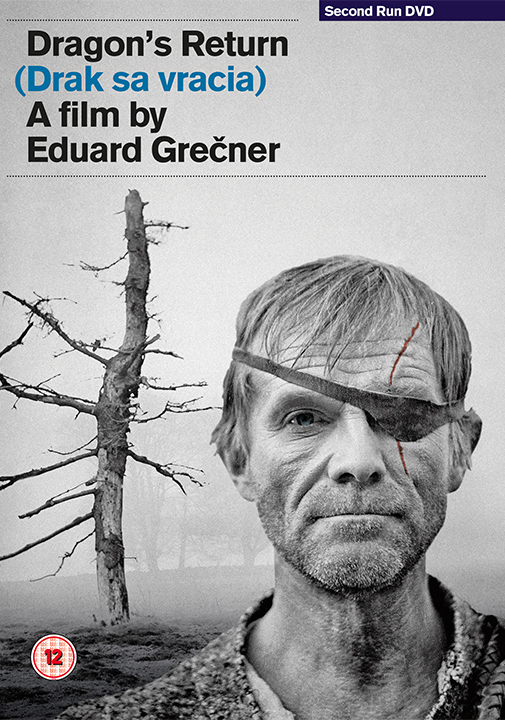 He had been working on this adaption of the novella by Slovak classic Dobroslav Chrobák for at least a decade before it was approved: the story is simple enough, telling of the return of a banished potter (Czech actor Radovan Lukavský playing the eponymous, rugged Dragon, pictured right) to his native village. His neighbours view his reappearance with foreboding (“dark days are coming”); we see in artful flashback memories of his past love for Eva (Emília Vášáryová), who later married Šimon (Gustáv Valach).
The hostility in the present is exacerbated by a drought which has put the village’s cattle herds in danger; Dragon sets out to save them, in the company of the suspicious Šimon, making for an epic mountain trek that certainly recalls the Western in style. The theme of the appearance of the solitary outsider in a community resounds with that genre too (Hames recalls The Searchers), but there’s a distinctly contemporary feel to this story of an individual being judged by the villagers’ “committee”, itself herd-like in its conformity. Grečner heightens that element by making his hero an artist – the pottery we see is a decorative element in itself – one of those who may “live alongside others, but lives alone all their lives”.
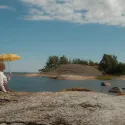
There’s as much grey as black and white in the cinematography, with grandiose panoramic views over the Tatras mountains matched by more stylised colour variations in scenes of village life. That rural element has always been close to the heart of Slovak culture, but elements that sometimes seem almost ethnographic nevertheless co-exist naturally with Grečner’s modernism.
The director was clearly influenced by the French nouvelle vague. More than ironic then, we learn in the accompanying booklet by Jonathan Owen, that it was one of that movement’s luminaries, Jean-Luc Godard no less (Grečner’s idol at the time, he admits), who was instrumental in breaking up the 1968 Pesaro film festival, which was due to have been the film’s first international outing, as part of the protests of ‘68. The reappearance of Dragon’s Return is a revelation, and this new high-definition restoration more than does it justice.