It’s a parental nightmare that’s virtually impossible to comprehend – a missing child. But however disturbing, that dilemma is not the chief concern of the Iranian writer/director Ashgar Farhadi’s latest drama. As ever, he’s interested in the psychological scars and relationship fault-lines that a crime or misdeed can expose.
Farhadi is a master at building tension from moral dilemmas, behavioural detail, awkward family relations that are complicated by the past, by secrets, by lies. He’s won two foreign language Oscars, for A Separation and The Salesman, both set in his own country. When he first ventured abroad, with the French-based The Past, he lost none of his ability to stretch a domestic scenario to a thriller’s tautness.
But despite terrific performances by Penélope Cruz and Javier Bardem, Everybody Knows loses its way in its rural Spanish setting. Farhadi has set a high bar for himself, and this one falls just a little short.
Laura (Cruz) has returned to the Spanish village in which grew up, for her younger sister’s marriage. She has her two children in tow – the teenage Irene and younger brother – while her Argentine husband Alejandro (Ricardo Darín) has remained in their home in Buenos Aires, supposedly for business.
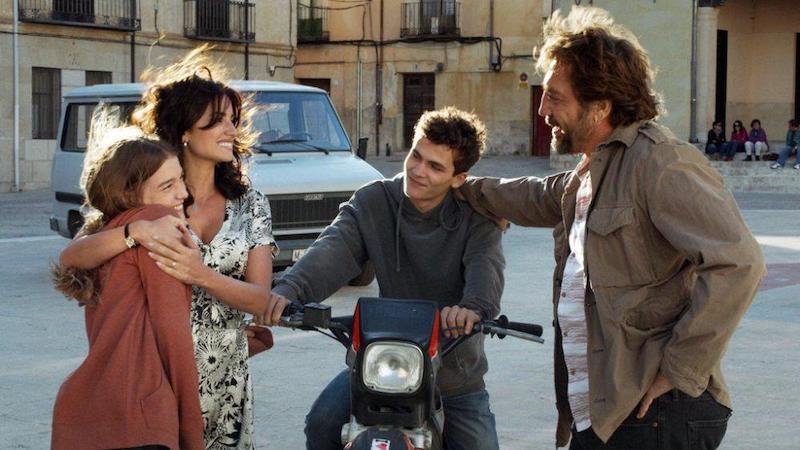 The film starts with an irritating blast of Spanish overkill. Laura and the kids are welcomed by their bewilderingly extended family – parents, siblings and in-laws, cousins, and friends who are so intimate that they could be mistaken for family, including the bear-like and ebullient vineyard owner Paco (Jarvier Bardem), who also happens to be Laura's old flame. It’s difficult to be sure of who’s who and what’s what in the melee. And when watching these people energetically prepare for the wedding, then dive full pelt into the festivities – with too much energy, too much volume, too much kitsch bonhomie – it’s quite unbearable.
I suspect that this is deliberate, at least in part, a tactic to distract all concerned – those on screen by the fun they’re having, we in the audience by the sheer sensory overload. And then, with the party in full swing, Farhadi springs his surprise.
The spoiler is unfortunate but necessary; in any case, Irene's eventual abduction has been highlighted by the very opening shot, of gloved hands arranging newspaper cuttings relating to an earlier kidnapping. Now, it’s the turn of Laura's family to go through the same hell.
The transition from a family gathering of Mamma Mia levels of high spirits to blind panic and despair is the film's standout sequence. As Laura and Paco launch themselves into the torrential rain to search for the girl, Cruz and Bardem (real-life partners and serial collaborators) are spectacularly good, she a rising tide of desperate emotion, he revealing the dependability and resolve beneath the party animal.
 Suddenly the film has become more than a confection; hereon, it’s both a mystery and a psychological thriller. Once suspicion has passed over the usual suspects targeted by prejudice (delinquent kids, grape pickers), it lands on those closest to home – fuelled by old grudges, rumours and conjecture, all twisted by the gulf between what everybody thinks they know about the past, and real secrets yet to be revealed. And as tempers fly, Irene’s life hangs in the balance.
There should be more than enough here for a rollicking ride and an interestingly fraught family drama. And frankly, I could watch Bardem all day when he’s in this sort of form – the actor utterly authentic and compelling as Paco ducks and dives and does everything he can to save the girl.
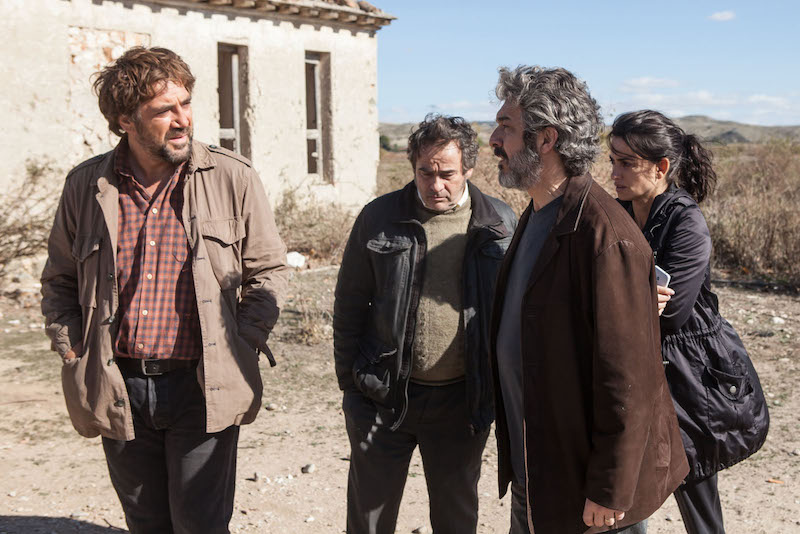
And yet Farhadi never quite gets it to gel. It takes a while to recover from the horrendous first half hour; the gripes about land ownership that see the family gang up against Paco don’t feel authentic; the important relationship between Paco and his wife Bea (Bárbara Lennie) is under-developed; despite Darín’s reliable turn (pictured above, right, with Bardem, Eduard Fernández and Cruz), his character's faith in God to sort out the ransom is simply annoying; and by the time Farhadi ends yet another of his films with a double barrel – a reveal, followed by an off-screen moral decision – there’s the sense that he’s painting by numbers.
Usually this director's nuanced storytelling justifies, or gives logical context to the sour taste of his endings and the cynicism of his world view. But the strong sense, here, that both Irene and the noble Paco deserve a different fate (and altogether different friends and family) suggests a failure to achieve a similarly satisfying denouement.