Silent movies are currently the rage of Tinseltown, so what better moment to brush up on one of the treasures of the pre-talkie era? Top movie-ologists now contend that FW Murnau's 1926 film of Faust is a neglected all-time great ("one of the most beautifully crafted films ever made," according to Theodore Huff in Sight & Sound). It's an opinion shared by Greek composer Aphrodite Raickopoulou, whose painstakingly wrought new score for the film was premiered at the Royal Festival Hall last night.
Performed by the Philharmonia Orchestra under conductor Benjamin Wallfisch, and featuring piano soloist Gabriela Montero, Raickopoulou's sweepingly symphonic writing amplified the dramatic turbulence of Murnau's movie with a passion that would surely have impressed the director himself. An audience bristling with Greek royalty and socialites responded with appropriate ecstasy (Murnau at work, pictured below).
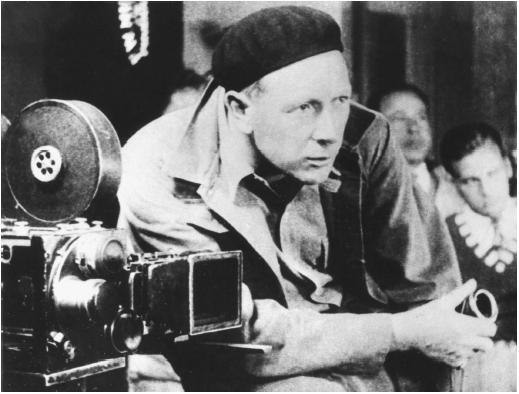 But first, there was an introduction by a dinner-suited Hugh Grant, who is not (he explained) an expert on German expressionist film-making, but is however a friend and fan of the composer. Grant's droll chat roved freely over Murnau's career in Germany and subsequently Hollywood, and Raickopoulou's interest in his work. Richard Curtis could hardly have scripted it better, with its self-effacing asides about his imperfect acting skills and a Faust-evoking joke about David Cameron's pact with Andy Coulson. A shame, perhaps, that he kept calling Murnau "Gurnau", though even that was an improvement on his real name, Plumpe. Nor did Grant forget to hail the excellence of the orchestra, "with the exception of Jill on cor anglais, who's a bit dodgy."
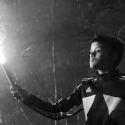
As the room darkened and the film commenced with a trio of apocalyptic horsemen galloping through a stormy sky, it was immediately clear that this would be not so much a movie, more of a pre-psychedelic trip. Mid-1920s special effects were "digital" only insofar as everything had to be painstakingly devised and constructed by hand, but even so it wasn't hard to see how Faust was considered a benchmark in lighting, camerawork, effects and design. The scene where Faust and Mephisto fly across a landscape of mountains, villages and countryside (achieved by putting the camera on a kind of rollercoaster) was somehow far more affecting than a similar feat performed using a bank of super-computers would have been, while the sequence where a towering devil envelops the little town below in his enormous black wings and sends black plague-clouds billowing over the streets and houses was stupefying (pictured below).
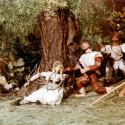
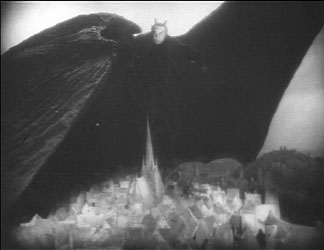 Raickopoulou's music mirrored the film's fantastical qualities with intensely-coloured string passages and some Wagner-esque brass, and wasn't afraid of a dollop of treacle for moments such as Faust's first romantic encounter with his beloved Gretchen or children dancing on the village green. Funereal piano and sombre violins greeted Faust's ill-judged decision to sign on Mephisto's dotted line.
The acting wasn't quite as we know it today, even from Hugh Grant. Emil Jannings's gurning, pantomimic Mephisto often brought farce where soul-piercing dread was required, while Gösta Ekman's Faust was too much like a young and fey Gene Wilder for comfort. Nonetheless, this was still film-making of boundary-busting ambition, and now it has a fine new score to go with it. All that's lacking is a big wad of funding to get some repeat performances on the road.
Watch trailer for Murnau's Faust