The classical-music industry loves dead icons; witness the endless reissuing and remarketing of recordings by Kathleen Ferrier and Jacqueline du Pré. Canadian pianist Glenn Gould died from a stroke at the age of 50 in 1982 and his seminal Bach discs have never been out of the catalogue since. Françis Giraud told Gould’s story on screen before in his 1993 film Thirty Two Short Films About Glenn Gould, an imaginative series of vignettes depicting scenes from Gould’s life.
Michèle Hozer and Peter Raymont’s new film is more conventional in being chronologically ordered and composed almost entirely of documentary footage and interviews, but it’s the rarity and candid nature of much of what is shown that makes it work. Gould was a film-maker’s dream, especially in his youth – improbably good looking and highly articulate, with a range of quirks and tics that still make compelling viewing. Wearing hat, scarf and gloves even in the height of summer, seated on a ridiculously low piano stool, he developed a highly individual playing style characterised by an incredible clarity of execution.
Gould was unable to stop himself singing along whilst playing, and sound engineers struggled unsuccessfully to prevent his crooning becoming a feature of his recordings. As one of Gould’s lifelong friends explains, "His mother wanted him to sing, and he just couldn’t stop doing it." He played the part of the tormented genius perfectly, and this film does succeed in showing us the more "normal" sides to Gould’s life – he did have close friends, fall in love, watch television and walk the dog.
Gould’s breakthrough came in 1955 when he recorded what was then an obscure work by Bach, the Goldberg Variations, which promptly became a bestseller. He toured widely, performed in the USSR (impressing a young Vladimir Ashkenazy) and famously disagreed with Leonard Bernstein over tempi in a Brahms concerto (which, as heard in the film, does not sound especially eccentric). In 1964 he abandoned live performances to concentrate on recordings, spending the rest of his life in and around Toronto. Retiring from performance didn’t mean disappearing from view, and Gould remained active and a prolific recording artist. Much of the material used in this film suggests steely self-control and determination.
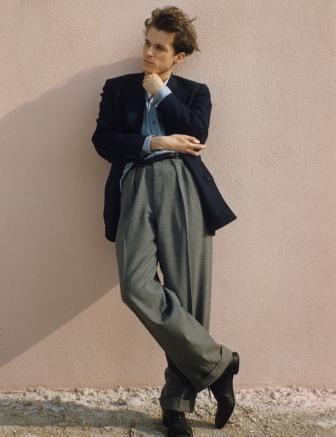 He must have been well aware that his glamorous image (pictured right) helped sell thousands of records, and there’s a revealing scene early on where a photographer asks him, "How do you feel about pictures?" to which Gould languidly replies "Must I?" But the ensuing stills are incredibly preening and self-aware. He could also be likeable, witty and charming, and the film’s most compelling subplot is that of Gould’s relationship with the artist Cornelia Foss, wife of composer Lukas Foss, who spent four years living with him. The recordings continued, usually made in the small hours in a concert hall in a Toronto department store. Gould’s excessive demands on his technical team are shown in an illuminating interview with his engineer Lorne Tulk, and it’s good to be reminded of how records were made in the pre-digital era, edits made with razor blades slicing through magnetic tape.
As the 1970s progressed, Gould’s hypochondria and eccentricities began to seem more worrying, and in one sequence he discusses his aversion to sunlight and how he prefers to drive around at night. Another acquaintance relates that, "He knew lots of people on the telephone. But that’s very different to having real friends." He developed a fondness for Petula Clark and made a series of influential radio documentaries. It’s sad to witness the passing of the exuberant 1950s Gould; in later years his obsessive desire for control involved scripting his own interview questions – a sad contrast to the chatty informality shown in the early extracts.
Cornelia Foss movingly explains how she ended up returning to her husband, and relates that Gould had told her that he expected to die at 50. Three-thousand mourners gathered at his funeral in Toronto, his reputation boosted by the release a few months before of a revelatory second Goldberg recording. It’s a fascinating life, skilfully and grippingly related without recourse to narration. The only false notes are the occasional stagey shots of a capped and coated Gould lookalike wandering along a beach or out of a hospital door, jarring with the wealth of revelatory genuine footage shown here.
Watch the trailer for Genius Within: The Inner Life of Glenn Gould
- Genius Within: The Inner Life of Glenn Gould opens on Friday in arthouse cinemas throughout the UK
- Find Glenn Gould on Amazon