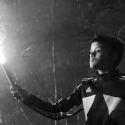
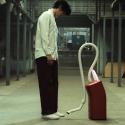
Miss Violence opens with an 11th birthday party whose brightly coloured balloons, pointed party hats and forced family jollity might seem unremarkable if a little girl hadn't chosen to stick Leonard Cohen's "Dance Me to the End of Love" on the stereo - not only Cohen at his most sinisterly sensual but a song inspired by the Holocaust. He wrote it after learning orchestras were a feature of some concentration camps, and that they were sometimes pressed into playing through brutality, so that their music became horribly anomalous accompaniments to punishments or violent death. Given the associations, the scene is ripe with dread - yet it still fails to prepare you for what's to come.
After being coerced into a family photo and waltzing with her beaming grandpa, the birthday girl Angeliki (Chloe Bolota, pictured below right with Themis Panou) calmly removes herself from the festivities and heads to the balcony where she mounts the railing, looks down the lens and smiles - before quite deliberately ending her own life. This look to the camera (ie. us) is crucial: a connection which, though fleeting, nevertheless compels us to take up her cause - to unpick this cruellest of mysteries.
This audacious opening sequence announces the film's confrontational yet carefully controlled style. The opening credits appear over Angeliki's tiny broken body as people gather round; viewed in an aerial shot the arrangement takes on an eerie beauty, and it's as if she's looking down on herself from above. We're being asked not only why such a young girl has done this, but why there's a strange serenity to her death.
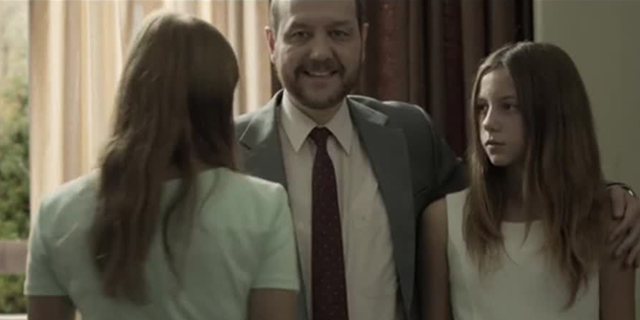
Avranas gets plenty of mileage out of the children's fearful faces
We get to know Angeliki's family in the aftermath of this life-shattering event with our suspicions already roused. What at first might appear to be people trying to manage their way through grief is bit by bit - in a series of what the director describes as "small explosions" - revealed as something significantly more disturbing. Alexandros Avranas' exacting directorial style is a perfect fit for the self-penned material - the stilted, precisely choreographed interactions, washed-out palette and (terrified) stillness of the performers point to a family living in fear.
The tyrant is gradually and chillingly revealed as the diminutive, apparently unassuming accountant grandfather (Themis Panou). His shut-in wife (Reni Pittaki) has long since taken to closing her eyes to what goes on around her, retreating to bed for long periods. Their eldest daughter, the adult Eleni (the wonderfully expressive Eleni Roussinou) - who is the mother of the dead child along with two younger children - seems drugged into submission, while her 14-year-old sister Myrto (Sissy Toumasi) is the lone voice of dissent.
 Miss Violence is the Greek writer-director's second feature. It follows the little seen Without - which despite nabbing multiple prizes at the Thessaloniki Film Festival in 2008 didn't even screen theatrically in Greece - and is itself an award-winner, most notably taking Best Director and Best Actor (for Panou) at the 2013 Venice Film Festival.
Although stylistically there's some crossover with some of the country's recent quirky outputs Miss Violence is less explicitly odd than, say, Dogtooth (with which it also shares subject matter) and Attenberg - and it certainly isn't funny. Avranas (who co-wrote the script with Kostas Peroulis) has stated that the film was inspired by the work of Pasolini, Haneke and Fassbinder, alongside the real suicide of an 11-year-old girl which happened while the director was living in Berlin, with the film his attempt at speculating as to why someone so young might feel compelled to do such a thing.
Avranas gets plenty of mileage out of the children's fearful faces, creating a twisted reality where every closed door is unpleasantly loaded. In its drip-fed misery and meticulously orchestrated discomfort Miss Violence paints a compelling picture of domestic terror. This is the horrifying, haunting story of the enemy within.