Her babyface spangled with tiny jewels and her lips painted fuschia, an adolescent with elaborately woven blonde hair lies on a silver velvet couch – round her neck and running onto her breast and down her right arm is a scarf of sticky blood as shiny as her blue vinyl (or cellophane) dress.
Like a W magazine photo spread conceived by Baudelaire and art-directed in electric colours by giallo maestro Dario Argento, the opening of The Neon Demon offers a foretaste of the plasticated grand guignolerie that by the end of Nicholas Winding Refn’s meretricious psychological horror movie has yielded both a feast and a bloodbath – in the precise senses of those words.
The actress served up as a necrophile’s delight is former eternal Hollywood tot Elle Fanning, whose china doll character is alive, in fact, and posing in a faux-Gothic shoot. A naïve but sly arriviste from Alabama, Jessie – 16, but looking 14 – is the flavour of the month in the Los Angeles fashion industry. To the chagrin of the seasoned and artificially maintained models Gigi (Bella Heathcote) and the more neurotic Sarah (Abbey Lee), who are already facing the scrapheap in their early twenties, Jessie’s natural look and virginal glow is the source of the magnetism instantly recognized by a cynical booking agent (Christina Hendricks), a vampiristic photographer (Desmond Harrington), and a salivating designer (Alessandro Nivola).
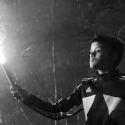
 Make-up artist Ruby (Jena Malone, pictured with Fanning, right), whose morgue day-job specialty is rejuvenating dead girls for cremation and burial, befriends Jessie to get into her bed. She is the evil stepmother and Gigi and Abbey are the beautiful ugly sisters to Jessie’s Cinderella. Keanu Reeves’s brutish motel manager is the potential Bluebeard in this extra-pervy Perrault scenario, while Jessie's would-be prince is Karl Grusman's smalltime photographer pal, whose belief that her beauty is of the inner kind rightfully earns the desiger's scorn.
Notwithstanding that The Neon Demon is a parable about ambition and hubris analogous to Darren Aronofsky’s Black Swan, its story is an excuse for kitschy visual grandeur. To complain that it prioritises style over substance is to miss the point: style is substance for Refn. A meticulous maker of charged pop-noir images, he followed the revered Drive (2011) with the despised Only God Forgives (2013), which posited him as a less obscene Scandi-American equivalent of the French provocateur Gaspar Noé (in Enter the Void mode). (Pictured below: Bella Heathcote, left, and Abbey Lee.)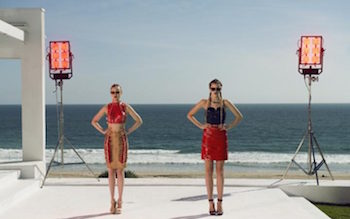 The Neon Demon is more Lynchian: Jessie echoes Naomi Watts’s cursed Hollywood starlet and lesbian love object in Mulholland Dr.; the mountain lion Jessie discovers in her seedy motel room, and which suggests her Id has been reawakened, is Refn’s direct equivalent of the monster discovered behind the diner in Lynch’s masterpiece. Yet the films’ similarities are superficial. The script written by Refn, Mary Laws, and English playwright Polly Stenham zings with quotable quotes about beauty’s currency in the current age of narcissism, but it musters nothing like Lynch’s (or for that matter Paul Schrader’s) psychosocial insight. Refn’s relentless aestheticism isn’t that original either: the glittery pollen clouds, a montage of neon triangles, blue and deep pink washes, and the stabs of synth on the soundtrack are so late-prog rock. Henri-Georges Clouzot’s proto-psychedelic glorification of Romy Schneider’s sensuality in his unfinished Inferno anticipated Refn’s fetishising of Fanning by 52 years.
The Neon Demon’s antecedents are, of course, older. The opening image and the film’s deceptively somnolent aura are rooted in the cult of decadent Victorian and Symbolist fin-de-siècle paintings of sexualised dead and sleeping woman and broken-backed nymphs, creations of an implicitly violent male gaze. That the predator who holds the greatest threat for Jessie is Malone’s quietly malign Ruby scarcely re-genders Refn’s gaze, which zeroes-in on the increasingly tyrannical brat – “I’m pretty and I can make money off ‘pretty’” – with vicious masculine intent.
Overleaf: watch the trailer for The Neon Demon