When cinema isn’t revering the greats of the art world, it’s usually debunking the superficiality and immorality of the power brokers of the business. On the one hand Eternity’s Gate, on the other, The Square.
The Burnt Orange Heresy falls into the latter category. Adapted from the novel by Charles Willeford, it relates the ruthless ends to which an art critic will go to keep his career afloat, while debating such broad stroke notions as truth, artistic integrity, the validity of criticism and its power – for good or ill – to shape people’s opinions.
It also happens to star Claes Bang, the errant art galley curator from The Square, whose slightly shifty good looks and too-easy charm make him a perfect embodiment of the art world’s less noble representatives. The result is nowhere near as effective as that phenomenal Swedish satire, but is a moderately diverting, appealingly cast art world caper cum noir.
Bang is James Figueras, first seen somewhere in Italy, giving a talk to a group of tourists in which he rather skilfully (and openly) twists their perceptions of the painting in front of them with outright lies about its origins – his double-handed aim being to both highlight and boast of the critic’s power to manipulate.
Among his audience is Berenice Hollis (Elizabeth Debicki). The pair have an instant and immediately enacted attraction. Alive to her new lover’s untrustworthiness, she makes a point of telling him next to nothing about herself. Nevertheless, he invites her to join him to the handsome Lake Como home of art collector Joseph Cassidy (Mick Jagger), where he’s been invited with the promise of work. 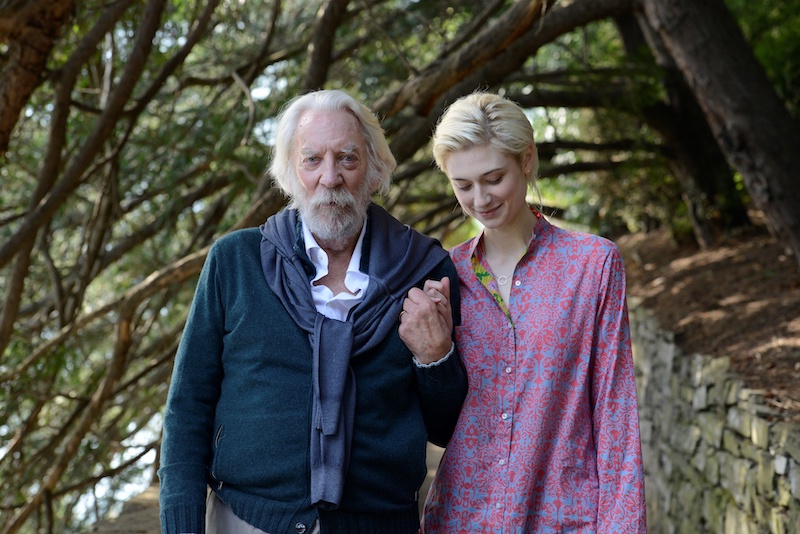 It turns out that Cassidy has as a permanent house guest the ageing and reclusive painter Jerome Debney (Donald Sutherland, pictured above with Debicki), famed for losing his entire output in studio fires – twice. Cassidy will facilitate an interview, for which he wants Figueras to use his persuasive powers to secure a painting. Let the courting of egos begin.
The set-up is intriguing, the locations gorgeous, the cast hugely watchable, with Bang and Debicki providing sexual sparks, Jagger an over-egged but queasily apt curio of a cameo, Sutherland a particular, sly delight as a possibly once-great artist (we have no way of knowing, since Debney’s greatest surviving work is aptly titled The Empty Frame) who will no longer play by the art world’s rules.
And yet once the pieces are in place the plotting loses its subtlety and control, director Giuseppe Capotondi allowing the film to be driven by his protagonist’s baser instincts. By the end there’s a touch of The Talented Mr Ripley in the lengths to which Figueras will go to secure the illusion of his success; while certainly dramatic, it feels rather empty.
This film does elicit two strong desires. One is to see the great Sutherland, who was awarded a career achievement Donostia Award by the Spanish festival, afforded another lead role or two, because he still commands the screen like few can; though Sutherland and Tommy Lee Jones didn't share scenes in the recent Ad Astra, I had the thought that it would be incredible to see the pair act together, for example, maybe in Waiting for Godot. The other is to revisit perhaps the definitive put-down of the art world, Orson Welles’s masterful F is for Fake.