If you’re hoping for an incisive look at Fifties American suburbia in this unappealing film, directed and co-written by George Clooney, you’ll be disappointed. It’s hardly worthy of the director of Good Night, and Good Luck, also set in the Fifties and co-written by Grant Heslov. It could have been much more satisfying if Clooney and Heslov had stuck with the original plan and explored the timely real-life story Suburbicon is partly based on – the racist riots sparked off by an African-American family moving into Levittown, an all-white suburb in Pennsylvania, in 1957. But instead, Clooney took an old Coen Brothers script that they’d sent him in 1999 and merged the two. Bad idea.
The main thread is the Coens' unfunny, Burn After Reading-esque dark comedy about Gardner Lodge, a nasty sales exec (Matt Damon) and the murder of his blonde, paralysed wife Rose (Julianne Moore). Her brunette twin sister Margaret (I wasn’t sure at first if the two were sisters or mother and daughter, which made things confusing) is also played by Moore. Two typically bumbling Coen brothers mobsters (Glenn Fleshler, recently in Billions and True Detective, and British actor Alex Hassell, acclaimed for his Henry V at the RSC in 2015) break into the Lodges' cookie-cutter suburban house in the middle of the night.
“Nicky,” Lodge tells his bewildered son (the impressive 11-year-old Noah Jupe, who played Hugh Laurie’s son in The Night Manager) “there are men in the house. They’re going to take what they want and leave.” Instead, they tie up and chloroform everyone. Rose dies in hospital a few days later; Margaret dyes her hair blonde and moves in with Gardner and Nicky. Creepy, yes, but none of the adult characters have any depth or consistency so we don't really care what happens to them.
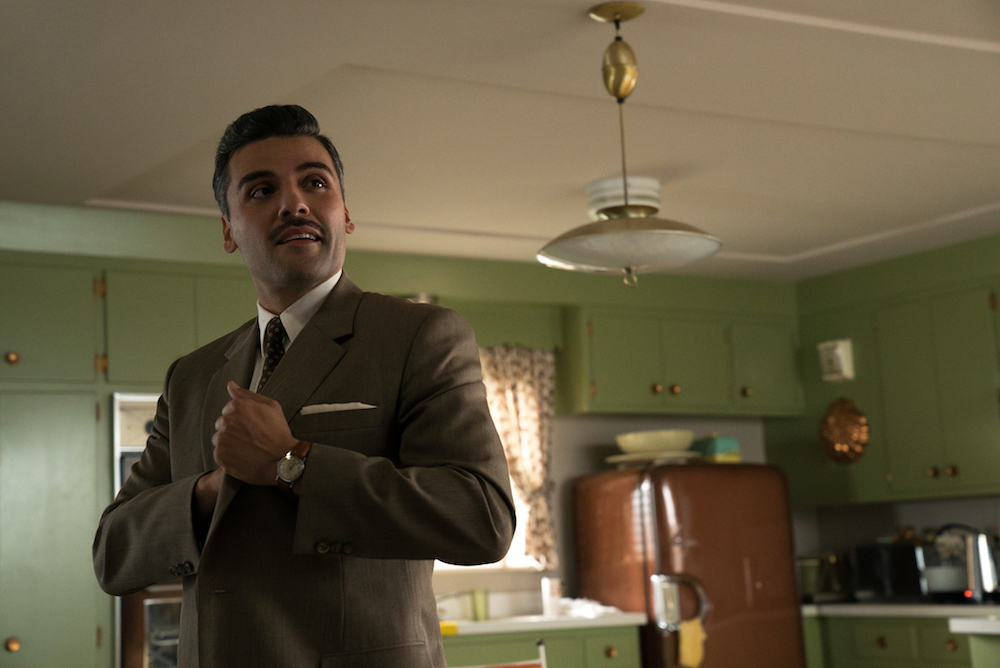
When Margaret and Gardner fail to identify the crims in the police line-up, young Nicky, the only family member with any moral compass apart from his buffoonish uncle Mitch (Gary Basaraba), begins to realise something’s not right. There are a few mildly funny lines: “Episcopalians are full of shit,” Mitch tells Nicky, trying to be comforting after his mother’s funeral. There’s an ongoing joke about Aruba, where Gardner and Margaret hope to go to ground once the insurance money comes in. “It’s a Dutch protectorate,” drones the dim Margaret. “I’ve never been to a protectorate before.” And things do pick up when Oscar Isaac (Inside Llewyn Davis and Ex Machina) steals the movie as a suspicious insurance claims investigator (pictured below). But all in all that’s slim pickings.
 Meanwhile, next door, a racist nightmare is unfolding: the white folks are trying to hound the Meyers family out of town. Fences are erected around their house and when Mrs Meyers (Karimah Westbrook) tries to buy a pint of milk, she’s told it costs $20 and she’d better shop elsewhere. When dusk falls, Suburbicon residents encircle the house. They bang drums, blow trumpets and and yell as well as setting fires and throwing stones – all based on shocking fact, and Clooney uses some documentary footage of the Levittown riots. But again the impact is lessened by the plot’s unreal, jarring feel. We never get to know the family – Mr Meyers (Leith M Burke) doesn’t even get a speaking part – though their son (Tony Espinosa) and Nicky manage to construct a fleshless, baseball-bonded friendship.
The best part is the meticulous period detail (Jim Bissell, a frequent Clooney collaborator, is production designer). Vintage Fifties appliances are everywhere, including a charismatic Zenith Flash-Magic TV with a wireless remote that shines like a torch when it changes channels. There are a lot of sickly greens and muted browns and a mass of wood panelling, as well as Fifties Oldsmobiles and VW Beetles. But a well placed KitchenAid mixer does not right the wrongs in this grating pastiche of the American dream.