Vesper is a piece of arty European sci-fi, filmed in the forests of Lithuania (homeland of co-director Kristina Buozyte) and set in a dystopian future conjured up by its French co-director Bruno Samper (a "digital experience designer"). The two collaborated in 2012 on Vanishing Waves, which was the first Lithuanian sci-fi film to play in the US, won awards on the festival circuit, and came with quite a lot of explicit erotica.
Ten years on, the directing duo have been working with a predominantly British cast to create an English-language film likely to appeal mostly to younger fantasy fans. My teenage son was convinced at the beginning that Vesper was based on a futuristic video game, but couldn’t quite place which one (it isn’t, but the visuals and series of challenges to overcome owe much to the genre). We are in a foggy, boggy landscape where ragged survivors of a catastrophe caused by genetic engineering struggle to find food and look with envy on those who live in the distant Citadels. Our heroine is Vesper (Raffiella Chapman), an androgynous 13-year-old trying to keep her father Darius (Richard Brake) alive as he languishes on a bed hooked up to hellish contraptions. There are tubes entering various orifices, an external organ throbbing menacingly in a transparent container. It’s all just a touch David Cronenberg.
Via a floating drone, Darius’ voice guides Vesper as she hunts for food in the woods. In the dark corners of their house, she experiments with biotech, trying to coax life from mutant seeds. There’s an absent mother who may have abandoned the family to join the wandering Pilgrims (hooded figures who appear in the landscape). And there’s a very sinister uncle, Jonas (superbly baleful work by Eddie Marsan, pictured below). He’s worked out how to do business with the inhabitants of the Citadels by trading in the blood of children. If Vesper wants to become a "breeder" in Jonas’ set up, he’ll make her and her sickly father "comfortable". 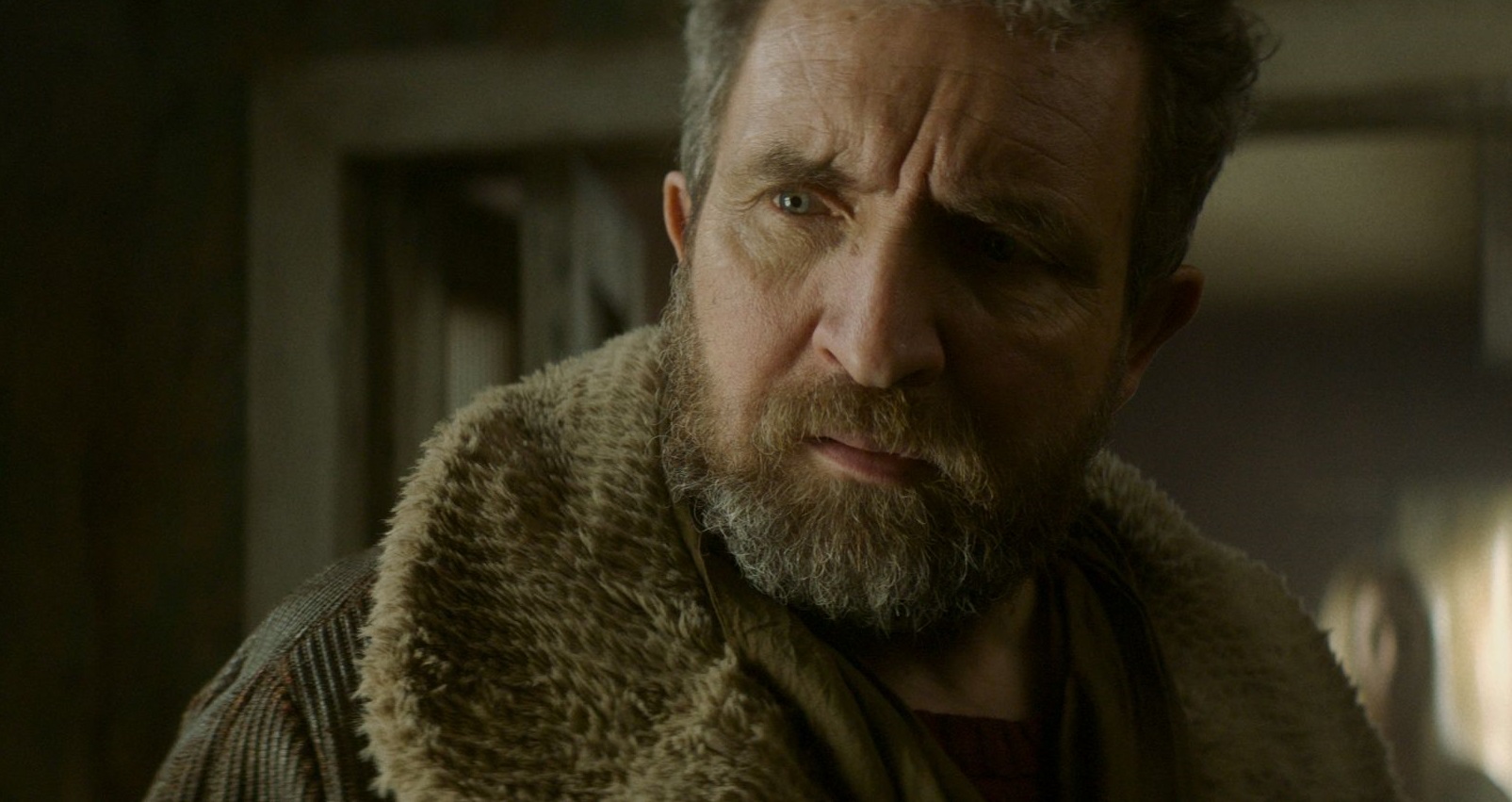 But Vesper has other ideas and when she stumbles across Camellia (Rosy McEwen), the survivor of a crashed flight between Citadels, she sees a potential route out. Camellia claims that her influential father will welcome them, but she is not quite all that she seems. The two girls spend a lot of time being ingenious and feisty, there are muddy chases and quite viscerally disturbing executions. The settings are reminiscent of Andrei Tarkovsky’s Stalker, John Hillcoat’s The Road and Alfonso Cuarón’s Children of Men, but with more body horror.
Nature has been violently disturbed and it’s affected not only plant life but also caused human mutations. In terms of art direction, it seems as if Buozyte and Samper have drawn on the paintings of Hieronymous Bosch and the imagery of HR Giger to create the unnerving world of Vesper. There’s some very inventive special effects work – both practical and CGI – which is particularly impressive considering its small budget. Cinematographer Feliksas Abrukauskas is a dab hand at Georges de La Tour lighting effects, which give the interior scenes a glaucous tinge.
Unfortunately, it appears that not quite as much attention and imagination was paid to the script as was given to the look of the film. The narrative is detail heavy but at times the dialogue is muddied. It’s hard to know if something got lost in translation along the way from the directors’ vision to the screen, but it makes it difficult to wholeheartedly recommend Vesper to anyone but die-hard fans of apocalyptic cinema. However the film’s strong visual style should act as an excellent calling card for the directors if they wanted to move into big budget sci-fi and fantasy.