

Emerald Fennell’s latest film begins with a sly joke. As the production company credits roll, the sound of distinctive creaking overlays them, increasing in frequency and intensity, and joined by male groans that reach a climax. She's at it again, we are being led to think, the gratuitous graphic sex.
Well, yes and no. When she cuts to the visuals of the scene we have been hearing, it’s a raucous public hanging, where, as an excitable youth informs the crowd, the rope wasn’t properly placed to break the man’s neck and his slow suffocation has produced “a stiffie” instead. (Close-up of man’s crotch.) Cue for the onlookers to engage in long snogs and unfeasible upright quickies. A nun’s close-up face sniffs in disapproval, clearly secretly fascinated. So yes, it’s sex everywhere as usual in a Fennell film, but with a megaphoned message too: beware, sex and death are bedfellows.
The nun, I rather suspect, is a place-holder for people like me, finding little to enjoy in the raw, often visceral sex Fennell likes to lard her scripts with (though I am not secretly fascinated by it). Here she excels in projecting the squelchiness of bodily-fluid-exchanging, with egg yolks and the kneading of bread dough supplying the soundtrack, and the sharp-toothed mouth of a fierce-looking fish in aspic standing in for an orifice – a vagina dentata? – into which a bored Catherine inserts her finger.
But the crowds who love a larky serving of sex’n’death can gorge themselves here as its two photogenic stars go at it: in carriages, gardens, hay lofts, occasionally in an actual house and, wherever possible, in the rain, with Emily Brontë’s febrile, doom-bound plot bearing down on them. Fennell, like most adaptors, has ignored the second half of the novel, which follows Catherine’s and Heathcliff’s children, but one half is enough, even if it does prevent the storyline from reaching the odd kind of resolution achieved in the novel.
The emphasis, as so often with Fennell, is on making an instant impact, ideally a shock at the warped fantasies she has concocted. Just as her Saltburn was posh family life recast as a repellent fever dream, this Wuthering Heights exists in a bizarre-looking half-world, half OTT luxury pad (the Lintons’ home, Thrushcross), half CGI landscapes that would be at home in Game of Thrones, where jagged jet-black rock formations poke up like sets of a buried dragon’s teeth. The empty landscape is appropriately misty, except for the grand 18th century Thrushcross estate and a lone tall-steepled church that seems to have been plonked down there randomly by a spaceship.
We are on the moors, but then again, we are not. The Earnshaw home is a stark black-timbered number with a section that looks like a chimneyed crematorium; somewhere, never specified, there is a wall made of white breeze-blocks where a pig is noisily slaughtered. The main living accommodation, though, could have stepped out of a Vermeer painting, with black and white tiled floors and handsome furniture in candle-lit wood-panelled rooms.
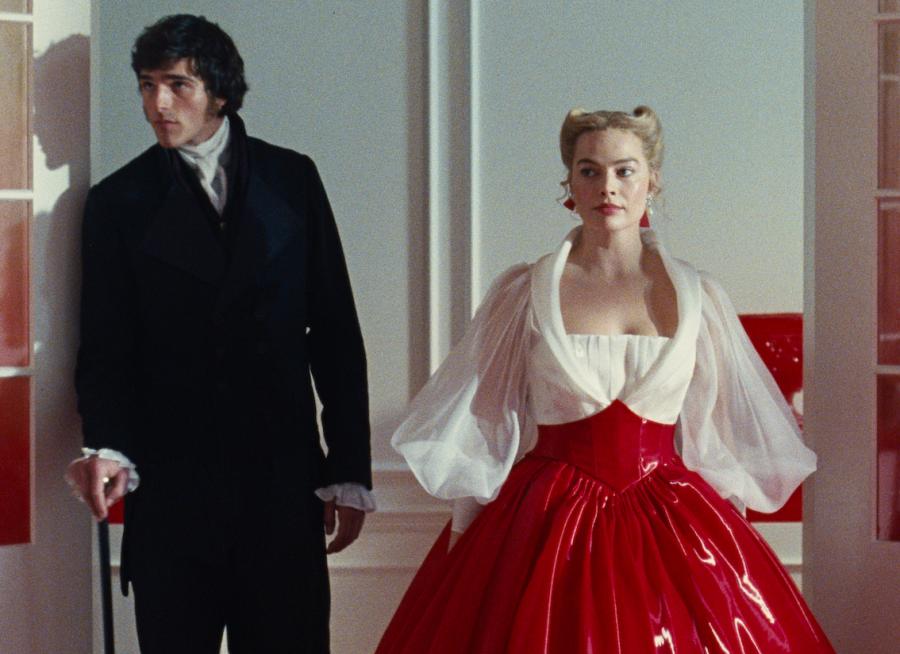
Thrushcross has apparently time-travelled to the area from a glossy magazine shoot, its main living space given a floor made from what looks like scarlet glass, with matching blood-red urns and a strange sculpted fireplace where multiple hands made of white clay pour down from the ceiling and over the mantelpiece. In Catherine’s bedroom, salmon pink – with one freckle – ousts red and black for once, but her gilded four-poster with its giant crown decoration is something Jeff Koons would be proud to own.
Jacqueline Durran's costuming for Catherine is from the mood-board for that same magazine shoot, an 18th century fantasy of big-panniered skirts and low-cut bodices, set off with elaborate hairstyles and the kind of statement jewellery Fennell’s dad helped make famous, all outsize pearl pendants, gothic gewgaws and crucifix shapes. Her dress materials are anachronistic, to say the least, with an emphasis on shiny synthetics and plastics (pictured above). I was confused by the embroidered motifs on one of her shawls – a scattering of dark-coloured leaves? But all became clear when she fell ill and the leeches were brought in.
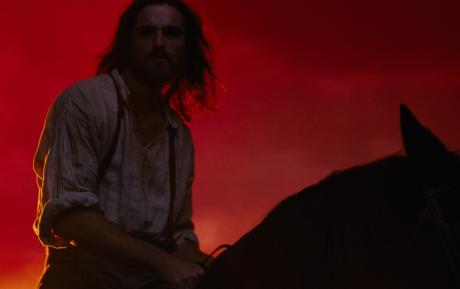
Almost lost under all this elaborate styling are the cast. The two leads go for simulations of a period romcom couple, all love-to-hate-you posturing, she clipped and constantly in a sulk, he predictably brooding and so clench-jawed he can hardly speak, though as they are the leads they get to keep their perfect white teeth (Jacob Elordi’s Heathcliff is given a silver falsie when he loses one). Naturally, Elordi will be posed silhouetted on horseback against a lurid sunset.
Martin Clunes as Mr Earnshaw at least goes full rotten English dentalwork as his alcoholism takes over. He is evidently having a ball in the role, one part bonhomie to five parts vicious bully. Also enjoying herself is Alison Oliver as Isabella, billed as Edgar Linton’s “ward” here, not his sister, a swotty, proper young lady whom we first meet regaling Edgar (Shazad Latif) with a blow-by-blow account of the plot of Romeo and Juliet, a rare scene whose humour lands well. When Heathcliff treats her with casual cruelty, her latent masochism is triggered and her oddness turns toxic.
But the famous main characters are two-dimensional cartoon characters (it’s tempting to say, a mock-gothic Barbie and Ken with real genitalia), driven on by the film’s bizarrely split vision. Are they in a legendary tragic story of undying love? Sort of. Is this a knockabout bit of kitsch, complete with lush Charli XCX balladry, a black comedy vibe and a puerile desire to shock? Hell, yes.
Kitsch doesn’t sit well with tragedy, though, because it is a closed system that's there to be looked at, not understood, and definitely not to be empathised with. So it’s no good protesting that the film is nothing like the book, as I would guess it never set out to be. (Try Andrea Arnold’s raw no-budget version for an honest attempt at adaptation that doesn’t infringe the Trades Description Act.) Fennell’s is sui generis but, as such, a misfire.








Add comment