

After his pop at Berlusconi, The Caiman, and cheeky peek inside the papal selection process, We Have a Pope, beloved Italian director Nanni Moretti returns to the melancholy territory of his Palme d'Or winner The Son's Room for his sombre, predominantly subtle latest. Inspired by the death of his own mother Agata in 2010, Mia Madre is a pared-down drama, coloured by genuine grief, peppered with and enlivened by moments of farce.
film reviews
Adam Sweeting

I don't usually suffer from chattering teeth and attacks of vertigo while watching a movie, but as this panorama of Himalayan disaster reached its climax I began to fear that I might need paramedics and an emergency evacuation. Everest might not top the all-time charts in terms of plot development or character psychology, but as an immersive account of a horrific chain of real-life events, it reaches – I nearly said "summits" – its objectives with distressing potency.
Kieron Tyler

Tangerines has a simple premise which is executed straightforwardly. Yet it proves affecting to a degree seemingly out of proportion to the proposition behind the film. A man living in a war zone finds that the conflict has, literally, come to his door. He takes in an injured survivor from each of the opposing sides and, as they come back to health, steers them to confront and accept each other’s humanity. Where there was neither, tolerance and respect are cultivated.
Kieron Tyler

When a lead character is warned that “it’s easier to be scrutinised in a small town”, it’s instantly clear they are not going to take the advice, keep their head down and make sure they don’t attract attention. In South Korean director July Jung’s first full-length feature, police chief Young-nam inevitably makes her presence felt soon after her arrival from Seoul in the southern coastal region of Yeosu.
Graham Fuller

Pedro Costa’s Horse Money begins with a silent montage of Jacob Riis’s grim photographs of late 19th-century Manhattan slum dwellers, some of them former slaves or their offspring. One photo shows a bowler-hatted young black man sitting athwart a barrel; beside him stands a white woman with a filthy face. The former looks like he had enough wits to survive the squalour for a while, the latter looks doomed.
Matt Wolf

When Immanuel Kant, the existentialists, and Antonioni's Zabriskie Point all get referenced right from the start, there can be no doubt that Irrational Man is on its way toward achieving the "total heaviosity" that its writer-director Woody Allen famously lampooned in Annie Hall.
David Kettle

It’s a strong word, misery. It makes you think of unremitting sorrow, a darkness it’s difficult to see a way out of, unforgiving conditions that make life well-nigh unbearable. A fertile backdrop for a career in stand-up comedy, you might assume. But despite the promise of his film’s title, it’s a subject that veteran US actor and comedian Kevin Pollak hardly dares to touch in his bright, breezy but frustratingly lightweight debut feature.
Tom Birchenough

It’s somehow unsettling that, while the physical resemblance between Willem Dafoe and Italian writer and filmmaker Pier Paolo Pasolini is remarkable to the point of being almost uncanny, Abel Ferrara’s Pasolini almost consciously avoids elucidating the character of its hero in any traditional sense.
Jasper Rees

Gangland London has never really worked for British directors. The warped poetry and seedy glamour of the American Mafia were the making of Coppola and Scorsese. You don’t get a lot of that down Bethnal Green way. Just knuckle dusters and glottal stops. But what happens if an American has a go at the Krays instead?
Jasper Rees

The Bourne trilogy riffed on the idea of an undercover CIA operative who is so thoroughly brainwashed he no longer knows who he is. American Ultra mines that same scenario for laughs. Where Matt Damon looked the part, the weedy Jesse Eisenberg is very far from central casting. Indeed, nothing in his career so far has suggested that he could punch his way out of a paper bag.
That includes the film’s opening scenes, which position Mike as a geeky stoner working the till at a convenience store in the fictional Liman, West Virginia. His girlfriend Phoebe (Kristen Stewart) is the competent one who rescues the omelette from burning, owns quite a nice Subaru and fields his constant apologies. Then one night he gets mugged by two armed thugs. Without an idea how, he dispatches both in a trice and is soon banged up by the sheriff. More killers arrive and this time Mike needs a little longer to do them in.
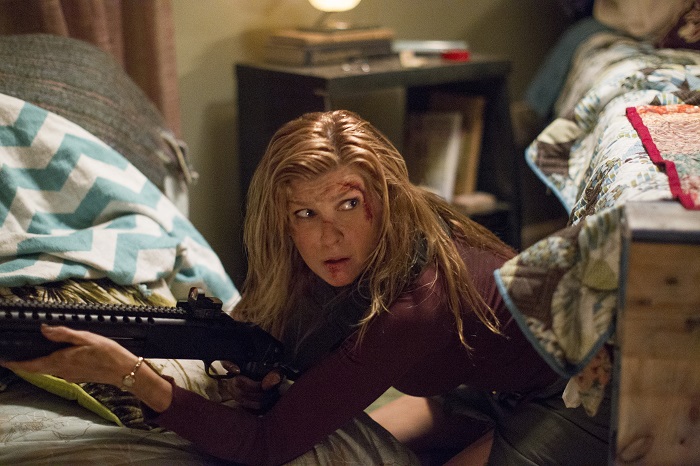 Meanwhile at CIA headquarters a turf spat has broken out between Mike’s former handler Lasseter (Connie Britton, pictured) and her preppy younger boss Yates (Topher Grace), who has decided to flex his muscles by wiping out her sleeper agent, the only success of a programme to train up mental patients as government assassins.
The script by Max Landis has a twist or two along the way, including a nice reveal about Phoebe that gives Stewart more to do than look on admiringly as Eisenberg lays waste to all-comers. “You’re his girlfriend, his mom, his maid and now you’re his lawyer?” says the cop when she advises him under arrest. Maybe that’s not all she is.
The film crescendos into a festival of splatty, splurgy cartoon violence: director Nima Nourizadeh has been hard at study of action genre tropes. Gore has not been this glorified in a comedy since James Gunn’s Super, in which a loser cast himself as a horribly vengeful superhero.
Are the laughs good enough to keep pace with all the punctured flesh? More or less. The joke of Mike’s incomprehension holds up reasonably well (“Is that a lyric?” he asks when greeted by a bafflingly coded message from Lasseter). Before he has accepted his destiny as a ruthless killer, Mike frets neurotically that he may be a robot. The best laughs are at the expense of the CIA, though there’s nothing to match the sheer bliss of Robert de Niro outwitting the Agency in Midnight Run. Eisenberg and Stewart are likeable, and there are fun cameos for John Leguizamo as a paranoid drug dealer who thinks he’s black and Bill Pullman as a national security capo. The film seems all set to cue up a sequel, but instead compresses it into the closing minutes. By then, the joke has done its job and run its course.
Overleaf: 'Piss My Pants' – watch a clip from American Ultra