Ives’ The Unanswered Question remained unanswered when the BBC Philharmonic and John Storgårds performed it in the Bridgewater Hall in January, but on this occasion, with Thomas Adès, it was followed by Kurtág’s even briefer The Answered Unanswered Question.
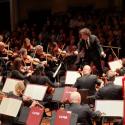
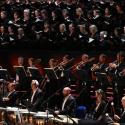
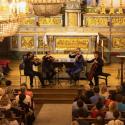
Spatial effects were very much part of the first half of the concert (I say “half”, but there were about 20 minutes of actual music; the rest was spent in platform re-arrangements), beginning with the 118-year-old Charles Ives piece, for which the solo trumpet was positioned in Stygian gloom on the organ bench at the centre of the auditorium’s choir area, the four flutes were front-of-stage near Thomas Adès, and the strings were high up in the hall’s audience seating on each side. Surround sound, you could say, for us listeners – there were not very many, though those who came were extremely enthusiastic. Adès co-ordinated these far-flung elements with great skill, and the balance and fleeting bitonal blend of the flutes’ with the strings’ sound was at times quite uncanny in its effect. So far, so very good, and if you hear it on the radio next week do try to imagine the scene.
Kurtág’s four-minute “answer” to Ives, from 1989, is anything but a final one. There are echoes of The Unanswered Question in the sonority of string tone (two cellos, the Hallé’s Rachel Helleur-Simcock and Simon Turner, centre-stage while the two violins specified were unlit in the Choir Circle area again, along with the celesta that ends the work with three brief chords), but the whole piece is full of hesitations, its main effect being one of layers of sound, and intervals in the texture, gradually coming closer together. It’s an intriguing comment on an enigmatic statement.
The much longer Kurtág work on offer was his Double Concerto, and this was probably the reason that the two previous ones were staged as they were, since it requires there to be two chamber orchestras, each containing a multiplicity of percussion, along with its piano and cello soloists, all spread around the auditorium. We talk of immersive experiences these days, and though it was still more a matter of “surrounded” than “immersed” for the listeners – the wind and strings groups being up in the vacant audience side seating on each side of the hall, while the soloists, percussion and harps were to left and right of the conductor down on-stage – it was certainly an experience. Whether it will come out as stereophonic on the radio is another matter, the Bridgewater Hall acoustics having so much side reflection anyway.
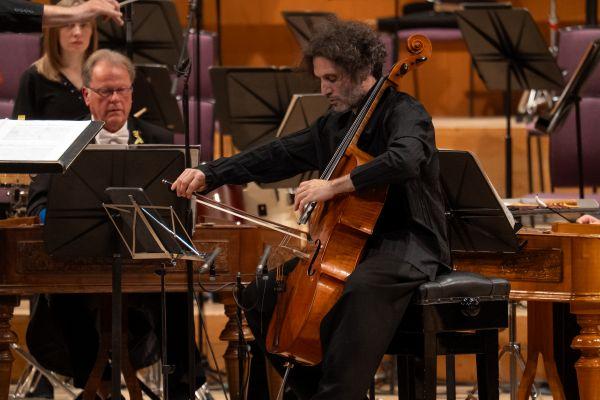
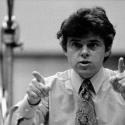
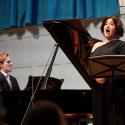
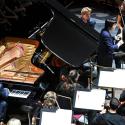
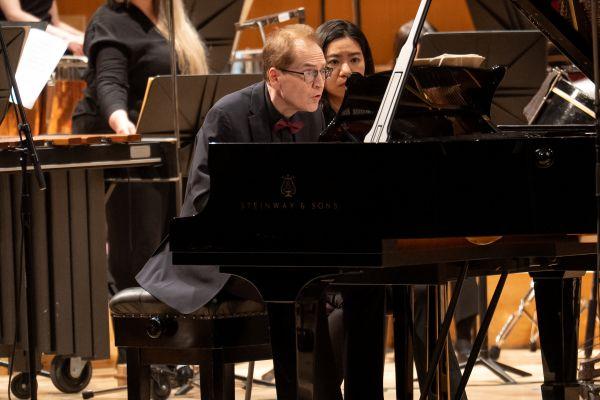
I don’t recall hearing anything quite so (intentionally) dismal and miserable as this for quite some time, its rhythmic impetus notwithstanding, at times almost like a wake to follow The Rite of Spring (the recurrent pounding drumbeats seeming to be deliberately reminiscent of that). But humanity shines in the role of the cello soloist, who is engaged in something of a losing battle with the rest of the score, and has to do some live scordatura (re-tuning of a string) in the process. Nicolas Altstaedt (pictured above) was in complete control of this and in the final slow section sang mournfully through to its despairing climax (a solo trumpet tries to bring him noble resignation, but he’s having none of it and responds with only more misery), before the striking fade-away ending as the piano soloist (Dénés Várjon, pictured below) plays repeated chords, a bit like the choral ending of The Planets Suite, against a bass drum heartbeat that finally stutters and stops. It’s the cello’s role that makes the piece, or at least it did on this occasion, though the piano soloist has his virtuosic contribution to make.
Thomas Adès’ own Lieux retrouvés, coming with the platform re-arranged to a more usual orchestral configuration, was like a good deed in a naughty world after that. It’s his own version for cello and chamber orchestra, made 10 years ago, of what was originally a cello sonata with piano, written in 2009. There are four movements, entitled "Les eaux", "La montagne", "Les champs" and "La ville" respectively (The waters, The mountain, The fields and The town – all “Places revisited”), and the music is nothing if not evocative.
The opening imagery of floating cello melody over rippling harp accompaniment is simply sweet and mellow to begin with, though (as the saying goes) complications ensue. After its abrupt finish, that’s followed by a pizzicato (at first) uphill tramp for the solo cello, though energy increases and horn and trumpet solos are added to the wind-laden and ever more frantic texture and another abrupt stop. If that was the summit, the mountain top experience is what follows, featuring a lovely soaring interval for soloist and orchestra, disappearing into the distance… before a jolly mickey-take of a return to towny life, mentioning the downward four-note arpeggio fanfare of Offenbach’s famous Can-can, though concluding somewhat weirdly.
Audience reaction is always interesting, and I liked that of one member close to me, who found humour in almost all the unusual musical effects heard to this point, and positively chortled at that one. I admired her honesty.
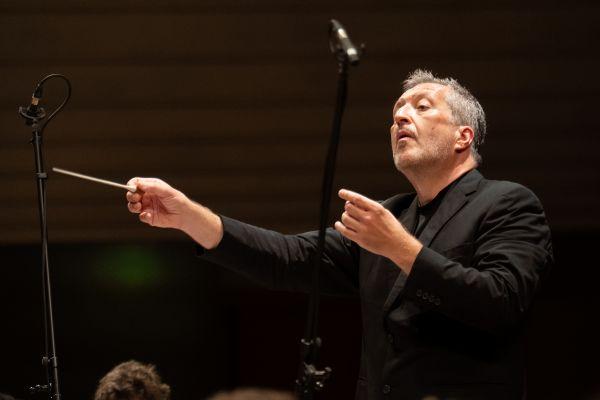
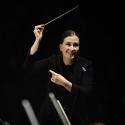
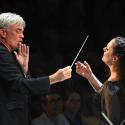
The concert concluded back in the early 20th century (pretty well contemporary with the Ives piece), with Debussy’s orchestral Images. There was a full orchestral compliment for this, with its quadruple woodwind, two harps and six percussionists, and its pictures in music (often seen as essentially Impressionist) were vivid, Adès’ direction (pictured above) never losing underlying rhythmic motive power despite Debussy’s interruptions and dreamy fantasies. “Gigues” (which bashes away at the Geordie tune of The Keel Row but adds the plaintive tone of the oboe d’amore – beautifully played by Virginia Shaw) built to a nervous climax with a spooky ending. “Ibéria” stood out for the liveliness of its Spanish dance rhythms, with a lovely sense of open-air fiesta about it and in its more intimate middle section was sensuous and gorgeously detailed, with Laurence Rogers’ horn solo a highlight. The slightly-drunk brass band we hear at the end was magnificent. And “Ronde de printemps”, under Adès’ control, was skilfully built in tension and energy to its end – in all, a fine exposition of a colourful and complex score.
- To be broadcast on Radio 3 on 30 April
- More classical reviews on theartsdesk