

Serendipity smiled on a lunchtime event you'd have been happy to hear any time, anywhere in the world. Edward Gardner's typically engaging short introduction told us that Royal Academy of Music string students were facing exams in a fortnight, so the brief was to find a programme predominantly for wind and brass. Quite apart from the fact that here were two amazing young soloists, RAM postgraduates, up to the mark of each work, the concertos in question were both created in 1924, both had divided double-bass parts - now that really was a coincidence - and (this bit I'm adding) Gardner had just conducted a stunning performance of Berg's Wozzeck, completed in 1922 and premiered in 1925.
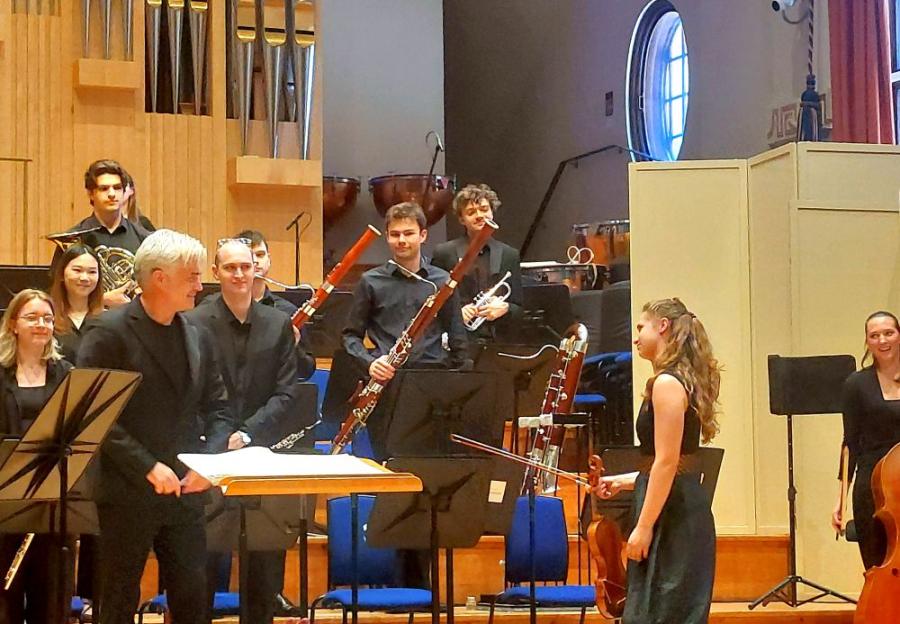
As in his way with Berg's spider-web of sound, Gardner brought out themes and lines in the Concerto for Violin and Wind Instruments, arguably Weill's thorniest masterpiece, and the young players met the challenge superbly (though there was never any chance of missing Sasha Canter's brazen trumpet or Faith Stonehewer's xylophone duet with the soloist in the "Notturno"). Charlotte Saluste-Bridoux (pictured below with Gardner and Academy Symphony Orchestra players), first of the afternoon's revelations, had the score in front of her but didn't seem to need it; she visibly lived every moment, every mood in Weill's concertante fantasy, which needs both close work with colleagues and a virtuosity that dazzles at times.
Glamorous in red, Lithuanian-born, Purcell School-educated Milda Daunoraitė held similar focus, and kept the same tabs on her fellow players. Nothing less than total toccata precision will do for Stravinsky's very different style in the main sections of the Concerto for Piano and Wind Instruments' outer movements ("Bach with smallpox, Prokofiev rudely judged it; the heavier textures might lead one to call it Bach with elephantiasis, but that's probably a compliment). Daunoraitė never missed a beat, even when Stravinsky does (those hiccups!). The typical mask-off poignancy of the Largo was beautifully judged, too, with outstanding cor anglais work from Jessica Ellis. The final dash to the finishing post, always surprising, was as dazzling as the rest. Could either concerto have been better played? I can only answer with an emphatic "no". The musical future is bright indeed.
- Ryan Bancroft conducts the Academy Symphony Orchestra on 25 June at the RAM and 26 June at the Aldeburgh Festival
- More classical music reviews on theartsdesk


