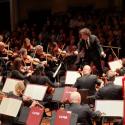
The Hallé Orchestra is still in many ways the well honed, burnished instrument created by Sir Mark Elder over his near quarter-century as its music director, and his calm authority over it was apparent in almost every note of this, his second Bridgewater Hall appearance in the present season.
Radio 3 listeners – the concert was broadcast live – will have been aware as much as those in the auditorium of the qualities of its playing under its now Conductor Emeritus: incisive articulation, intelligently balanced and unified ensemble, sweet and passionate string playing, rapier-thrust brass interjection, confident woodwind, bounding rhythmic impetus.
All that was apparent from the first few bars of Glinka’s Ruslan and Ludmilla overture – an exhilarating way to begin a concert if ever there was one and played throughout with appropriate swagger, energy, crispness and eloquent solo voices. It’s often been a mainstay of a “Russian” popular programme over the years, but what followed was more intriguing. Two early 20th century pieces by Russian-born composers – Stravinsky and Rachmaninov – took us into less familiar territory.
The Song of the Nightingale (Le Chant du Rossignol) is what Stravinsky called a symphonic poem, based on material he originally conceived for an opera but eventually mapped out in light of his success in composing for Diaghilev’s ballet company (he said at first he didn’t like the way it was turned into a dance work by Léonide Massine but approved a later choreography by Balanchine). You can hear echoes of Petrushka and even The Rite of Spring as it tells the story of a Chinese emperor who summons a nightingale to sing to him, so beautiful is its voice, but then decides that a mechanical imitation is really just as good. The real nightingale flies away, but when the emperor falls ill it returns to save him from death.
It’s a lovely vehicle for orchestral solo playing, and in this performance received outstanding treatment from Claire Wickes’ flute, the oboes of Stéphane Rancourt and Virginia Shaw and the trumpet of Gareth Small (the latter gentle and eloquent as he uttered the melody of what in the opera would have been the consolatory “Fisherman’s Song”, twice over). Hallé leader Emily Davis also contributed a tender solo as the role of the nightingale is shared with the violin in the later part of the music. It may seem now to be pre-eminently written as in ballet scene style, with a busy opening emperor’s court scene like Petrushka’s Shrovetide Fair and some sections that simply enjoy insistent rhythms, but it has its striking moments (such as the one that precedes the sound of the mechanical nightingale, which is almost a precursor to Bernard Herrman’s shower scene in Psycho). The whole was delivered with imagination and vivid musical colour.

Rachmaninov had completed his seductively Romantic Second Piano Concerto when he composed his cantata for baritone, chorus and orchestra entitled Spring. The title itself is a bit of a misnomer, as the poem he set (by Nikolai Nekrasov) has a two-word name, more literally translated on the concert hall’s suspended digital screen as “The Green Sound” and explained by its writer as “the name people give to the awakening of nature in spring”. It, too, tells a story, of a peasant whose wife has been unfaithful and who decides during wintertime to kill her but is awakened in spring to acceptance, love and forgiveness.
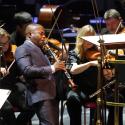
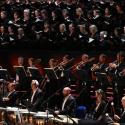
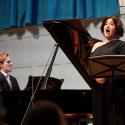
It’s a dramatic piece (though there are some similarities to the language of the Brief Encounter concerto in the music that comes with the dawn of spring, and even nature-painting of the kind we might associate with 20th-century English “pastoral” style), and was given a vivid solo interpretation by the Lithuanian soloist Kostas Smoriginas (pictured above). His bass-baritone has the qualities of bitterness and ultimate warmth the character embodies (it was written for Chaliapin), and Elder used the orchestra skilfully as the foil to his role, with an excitingly operatic acceleration at the point where he’s introduced. But the chorus has an equally important part to play here, and the Hallé Choir – pictured below – played its full part and rose to two thrilling climaxes with energy and a beautifully balanced sound (much credit to choral director Matthew Hamilton).

The second part of the concert was in the cheerful company of Tchaikovsky, as heard in his Symphony No. 2. It’s got a nickname based on its use of Ukrainian folk tunes, and the sections that aren’t derived from them seem to inhabit the same world. Structurally it needs a firm hand to give it shape (there’s plenty of stop-start in the opening movement, and the last one bashes away at a traditional dance melody to a very great extent) – it had that in Elder’s direction, and the horn solos from Laurence Rogers and the striking string articulation in those outer movements were the icing on the cake. Sir Mark caught a fine balance of sarcasm and fun in the second movement’s march tune, and the third contrasted crisp outer sections with a gentler folksiness in the middle.