

Station to Station documents the transcontinental American rail trip taken by a group of musicians, visual artists, and performers in 2013. Local artists and marching bands also contributed to the series of "happenings", often enhanced by light shows and pretty effects, which included rock concerts staged at each of the 10 designated stops on the westward journey. Organised by the artist Doug Aitken, the marathon must have brought the contributors and audiences much pleasure. His film of it is underwhelming.
film reviews
Adam Sweeting

In 1998, Ian McKellen starred in Bill Condon's Gods and Monsters, an account of the final days of the ailing and tormented film director James Whale. Echoes of it are discernable here, where Condon has recruited an older McKellen for a carefully-crafted depiction of the imaginary dotage of Arthur Conan Doyle's great fictional detective. Aged 93, the doddering sleuth struggles to reassemble the jumbled jigsaw of his memories and hence solve his final case, which turns out to be himself.
Condon has based his film on Mitch Cullin's novel A Slight Trick of the Mind, and the narrative whisks us back to 1947 and a melancholy rural England still trying to drag itself from the wreckage of World War Two. We first meet Holmes in a railway carriage as its steam locomotive chugs through garden-of-England Sussex countryside, the view occasionally scarred by the rusting wing of a Luftwaffe aircraft sticking out of a field. There's no sense of an enemy triumphantly vanquished, more of regret for something lost forever. Holmes's gruff assertion to a schoolboy passenger that what he thinks is a bee is in fact a wasp not only establishes him as a bit of an old grouch, but also previews a recurring apiaristic theme.
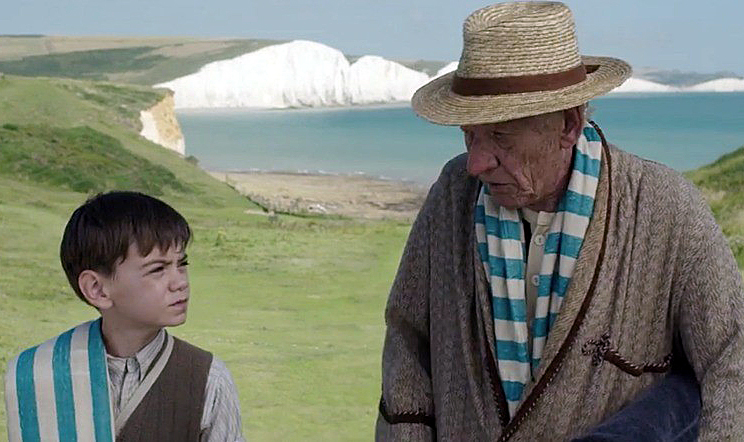 Having long ago called time on his career as a "consulting detective", Holmes has retreated to his rambling old house a stone's throw from the sea, where he tends his beehives and racks his brains for recollections of his glory days. His only companions are his tetchy, unhappy housekeeper Mrs Munro (Laura Linney) and her son Roger (Milo Parker, pictured above with McKellen), the latter a fan of the Holmes mythology who also bonds with the old man through a shared fascination with bees. His once scalpel-sharp mind is growing foggy, and Holmes's friendly local doctor (Roger Allam) asks him to make a dot in his diary every time he can't remember a name. As the story progresses, the dots gather like a black snowstorm. McKellen, equally persuasive as the dapper, pleased-with-himself Holmes in his prime and the fearful old man he has become, can expect some gongs heading his way.
Condon's dominant theme is memory, not just the way Holmes's faulty one chops up the past into fragments and non-sequiturs, but the way memories can be distorted or manufactured. On a trip to Japan, to track down the supposedly memory-enhancing prickly ash tree (prompting a disturbing visit to the ruins of Hiroshima), Holmes has to explain to a local fan that he never wore a deerstalker or smoked a pipe, but these were just inventions of a book illustrator. Holmes reflects sadly on his brother Mycroft, Mrs Hudson and Dr Watson, all long gone now, but he still hasn't quite forgiven the latter for his penny-dreadfulesque fictionalisations of Holmes's great cases.
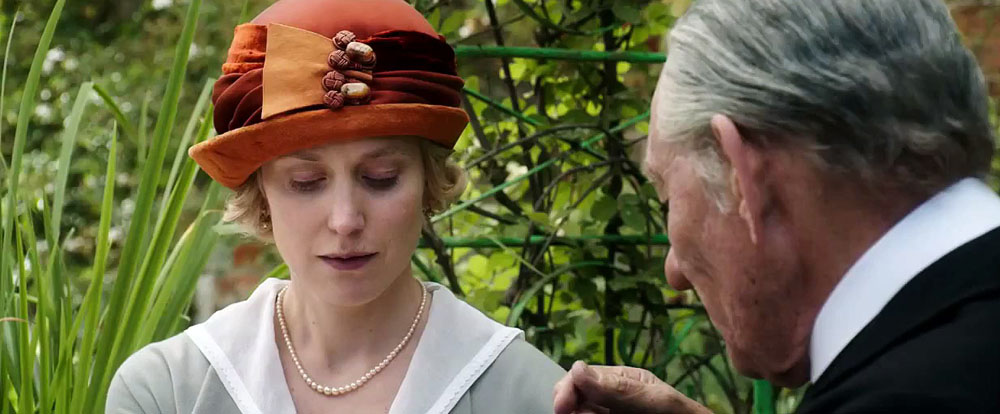 It's the final one, The Case of the Grey Glove, that has been preying on Holmes's mind. Condon has some fun with a scene where Holmes goes to the cinema to be appalled by a melodramatic film treatment, The Lady in Grey, with Frances Barber in the title role. Meanwhile, Holmes has been laboriously trying to write his own definitive version of events, in which he investigated the failing marriage of Thomas and Ann Kelmot (Patrick Kennedy and Hattie Morahan, pictured above with McKellen). Suffice to say that we learn why the case prompted Holmes to call time on his detective work, and its tragic overtones shine a piercing and poignant light into the soul of the erstwhile doyen of Baker Street. When Holmes comments that "I've been alone all my life, with the compensations of the intellect," it makes you ponder an interior Holmes that Dr Watson cheerfully ignored. And when that intellect begins to fail, what is left?
Though Condon is chiefly concerned with a crumbling, misfiring Holmes, the denouement permits a belated flash of the old deductive powers, and it helps Holmes to make the human connection that has eluded him for so long. Despite its stately pace and determination not to do anything rash – it's the antithesis of the hyperactive clever-dickery of the Cumberbatch Holmes – Mr Holmes is a quiet triumph whose ripples will keep washing over you long after you've left the cinema.
Overleaf: watch the trailer for Mr Holmes
Demetrios Matheou

A group of gunmen are roaming the Argentine rainforest jungle, terrorising local farmers in order to obtain the rights to their land. One farmer follows an ancient custom, praying to spirits to send a saviour. When a young stranger strolls bare-chested and barefoot out of the jungle, the farmer assumes his prayer has been answered.
ellin.stein

Some people are irritated by Entourage’s superficial depiction of Hollywood as a bro fantasy world, but this is like condemning a soufflé for not being a roast chicken. For those like myself who enjoyed Entourage the television series, Entourage the movie will be very much the kind of thing they like, since it is essentially a feature-length version of the long-running HBO/Sky Atlantic show; non-enthusiasts, however, may find it shallow, shambolic, sexist, and smug (if you feel this perfectly describes Top Gear, you probably fall into the latter category).
Like the film iterations of Sex in the City, the movie is primarily a reunion for characters and fans and the similarities don’t end there. Both are a celebration of the city as a glamorous arena of infinite possibilities centered around a group of four friends, in this case pretty boy Vincent Chase (Adrian Grenier) and his three homies from Queens (New York’s version of Croydon). They come along for the ride as Vincent rises to Hollywood stardom, keeping him grounded when he hits the big time, picking him up from the setbacks, and always having his back as they negotiate life in the fast lane.
The ostensible story is just an armature on which to hang entertaining social comedy and insider jokes
Just as there are no long subway journeys, grim fifth floor walk-ups, or homeless in the New York of SATC, so traffic-clogged freeways, sprawling suburbs, and gangbangers do not trouble Entourage’s LA. Instead, both shows take place in a bubble of fabulous residences, super-trendy nightspots, and fashionable neighbourhoods. And just as SATC’s girls are drowning in designer shoes and clothes, Entourage’s boys have an endless supply of exotic cars and babelicious hotties on tap.
The film’s story follows the basic arc of an Entourage season – Vincent strikes off in a new creative direction, a gamble that may pay off or result in ruination. Since fast-talking, mercurial agent Ari Gold – Jeremy Piven (pictured below), far more at home here than as genial Midwesterner (!) Mr Selfridge – is now the head of the studio backing Vincent’s expensive directorial debut, his neck is also on the line.
The pressure ramps up when the Texan oil magnate who is largely bankrolling the studio insists on his obnoxious film grad son (The Sixth Sense’s Haley Joel Osment, all grown up) having creative oversight. This allows the movie to cock a snoot at those backwards (homophobic, environmentally unsound) rubes in flyover country who actually buy the tickets that keep the whole enterprise afloat.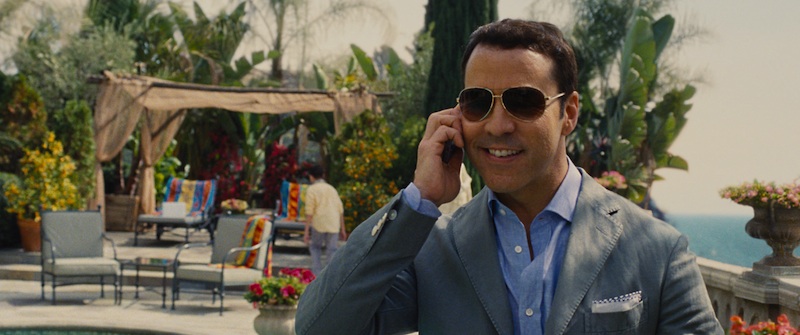 As always, the ostensible story is just an armature on which to hang entertaining social comedy and insider jokes that perfectly capture Hollywood’s combination of lethal aggression and laidbackness. The insider-y feel is reinforced by over 30 cameo appearances by various celebrities portraying themselves. Some (like Kelsey Grammer, Pharrell Williams, and Queens-raised Mark Wahlberg, one of the show’s originators whose adventures allegedly inspired the series) are more recognisable than others (namely various US sports stars and industry moguls).
But while no one is going to accuse Entourage of being a hard-hitting critique, writer-director Doug Ellin does permit two aspects of harsh reality to intrude. One is a constant awareness of how even power players like Ari and Vincent are a single misjudgment away from failure, and how rapid and unforgiving the fall from grace can be.
The other is the eternal struggle of Vincent’s more talented, less cute actor brother, Johnny Drama (a well-judged performance by Kevin Dillon, real-life brother of the very good-looking Matt), forever relegated to having his nose pressed up against the glass of success by a combination of self-sabotage and bad luck. A scene where Drama auditions for a small role captures the endless humiliations heaped upon the 95% of industry hopefuls who, unlike Vincent, never make it into the charmed circle.
Middle-aged women like Mrs Ari (as she’s called in the credits) are permitted if perfectly toned and expensively dressed
Also outside the Entourage universe are: old men, unless famous or very rich and powerful, like Ari’s boss played by Alan Dale or the actual Warren Buffett (another cameo); fat chicks; and old chicks. Middle-aged women like Mrs Ari (as she’s called in the credits) are permitted if perfectly toned and expensively dressed.
This is a man’s world, so, as in The Sopranos or True Detective, those babelicious hotties are often found wearing not a lot, either dancing in the background or writhing on a bed. But at least Entourage has a moment where two of them turn the tables, calling one of the boys out on his Hollywood player attitude and asserting their right to be treated as more than just a disposable shag.
And if Vincent’s object of desire is one Emily Ratajkowski (apparently famous enough as a Sports Illustrated Swimsuit Issue model and featured dancer in Robin Thicke’s controversial Blurred Lines video to portray herself), at least his driver and former go-fer Turtle, now a successful tequila magnate, pines for actual Olympic Judo champion Ronda Rousey, also playing herself, a woman who makes SAS squaddies look like Sarah Jessica Parker.
If you’re expecting a penetrating, caustic look at the entertainment industry’s many shortcomings, you’re going to be disappointed. But if you’re prepared to sit back and enjoy the limo ride, Entourage is enjoyable on its own terms as entertaining, breezy escapism.
Overleaf: watch the trailer for Entourage
Kieron Tyler

A twist on the battle between the sexes and the romance which blooms after the dust has settled, Les Combattants pitches the reticent Arnaud into the path of the intimidating Madelaine. While the outcome is never in doubt, true love is only achieved after navigating a few bumps in the road, most of which result from Madelaine’s feelings that she and the world in general are at war with each other.
Matt Wolf

So many plays and musicals are adapted from films (Bend it Like Beckham is up next) that it comes as something of a throwback to find a film that takes as its source an acclaimed musical play. The sheer fact that there is a movie of London Road is doubly extraordinary when one considers that the widely acclaimed theatre production from 2011 was anomalous even as a stage show, let alone transposed to the screen. A piece of verbatim theatre conceived very much without take-home numbers but scored to the jagged, often discordant music of the composer Adam Cork, London Road seemed to want to shift the landscape of what the musical theatre could look and sound like. So the happy surprise, from this corner at least, is that the film version is even better.
The writer Alecky Blythe took her tape recorder into the homes of the inhabitants of the Ipswich street that has given the show and now the film its title and was at the epicentre of the shock waves sent out nationally in 2006 when a forklift truck-driver by the name of Steve Wright and from that very road was found guilty of the murder of five prostitutes.
 Weaving a skilfully layered mosaic of reaction and response that ranges from sorrow to outrage, paranoia through to something approaching glee (one chap derides the murdered women as "foul-mouthed slags"), Blythe along with Cork and under the ever-watchful eye of Norris offer a portrait of a community under siege that is seen by the end to begin to heal: hanging baskets full of flowers are co-opted for their full metaphoric weight and then some.
Onstage, in fact, the symbolic heft of the floral abundance was itself a bit, um, florid, and there was scant escaping the impression that we were watching a well-drilled team of actors pretending to be characters and a community that they were not. The performances, however technically accomplished, felt as if they were on the outside looking in, and it was difficult not to detect a whiff of condescension surrounding the enterprise, however inadvertent that surely was. (I remember pondering what Mike Leigh might have done with much the same material.)
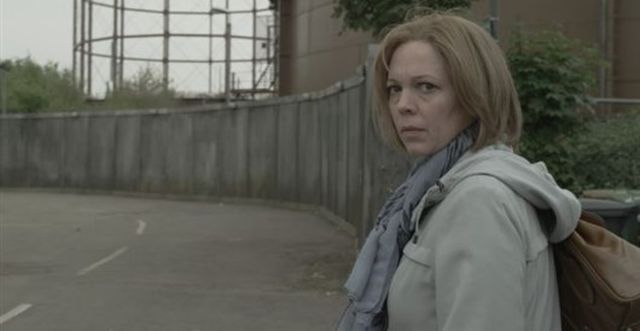
Well, what a difference a shift in genres can make. Making full use of the panoramic possibilities that film allows, Norris has widened out his perspective to up the emotional stakes while also deepening one's sense of an enclave that risks erosion from within faced with the prospect of a murderer in your midst. Norris's prowling camera teases us from the start with the repeated sight of an apparently solitary man, Dodge (Paul Thornley), who acts as a lightning rod for the gathering alarm that is seen to take over the citizenry as a whole. As before, our way into the narrative is via chatty single mum Julie (Olivia Colman, pictured above), whose gradually evident lack of empathy leads to the single most startling line in the piece – a remark, present as well onstage, that is best discovered for oneself.
 Colman is one of several starry additions to the ensemble that performed the play at the National, who have themselves been retained for the movie but sometimes in a smaller role. Lending putative box office wattage is Tom Hardy (pictured left) in a sturdy seven-minute turn as a know-all cabbie quick to emphasise that just because he has made a study of serial killers doesn't mean he is one. And, in an intriguing demotion of sorts that nonetheless plays to her strengths, the Olivier-nominated stage Julie, Kate Fleetwood, here is seen as the hooded representative of the working girls whose lives have been put at risk, her ever-furtive gaze of a piece with the suspicion that looks to be growing far more quickly (at least at first) than any of those necessarily symbolic baskets.
Working with an A-list cinematographer in Danny Cohen (Les Misérables), Norris lends a desaturated visual cool to proceedings whose holiday-time occurrences make for some chilling vignettes all their own: the eerie plastic Santa seen in the stage production reappears here, and there's a startling moment – mordantly funny in tone – during "It Could be Him" (one of the song titles) when mannequins in a men's clothing store become objects of suspicion and scorn.
This director's confidence behind the camera exponentially amplified since his wildly OTT debut film Broken three years ago, London Road could be subtitled Restored or Made Whole in its climactic implication that those involved find a way forward, albeit at a grievous price: "it took [the prostitutes'] lives for them to help us," as is made clear. And through it all is Cork's insistent, sometimes jarring, always-arresting soundscape that trades in conventional musical theatre uplift for something more quietly forensic, Cork glimpsed near the end as a pianist who catches the Fleetwood character's eye some while after he and his colleagues have caught us in this rewarding film's grip.
Overleaf: watch the trailer for London Road
Jasper Rees

Jurassic World opens on a close-up. The smooth creamy surface of an egg is shattered by a claw attacking it vexatiously from within. In no time at all a scaly little critter is peeping out at us. It took a mite longer for the latest in the Jurassic Park franchise to hatch. The last film was 14 years ago and this fourth instalment seems to have been on the development slate almost ever since. Now that it's here at last, what’s new?
Thomas H. Green

What Wes Orshoski’s new documentary points out, above everything, is how much pop success relies on an ordered narrative and an easily understood package. First-wave British punk band The Damned, on the other hand, wrote as many great songs as their peers, but their career has been a mess of random creativity, changing line-ups and dreadful business decisions. There is a telling moment where Rat Scabies, the original drummer, weeps as he recalls the one occasion the band had all their ducks in a line. With a major label deal, solid American management, and 1985’s chart-friendly Phantasmagoria album under their belt, they had returned to a plush studio to record the follow-up. “But we didn’t have the will to play,” he says, wiping tears from his eyes. It is almost as if chaos is what they thrived on.
Orshoski’s previous documentary was the likeable and subtly revealing Lemmy, about Motorhead’s perma-rock’n’roll frontman. With Don’t You Wish That We Were Dead he has taken on a much more convoluted tale, riddled with interweaving details and alternate versions that must have been nigh-on-impossible to marshal. He acquits himself admirably. Not least, there’s the fact that Rat Scabies, kicked out in 1995, and Captain Sensible, who remains in the band, have bitterly fallen out, something both return to uncomfortably throughout, especially a scene in which the former, wandering through an open market, falls into a bitter, vitriolic ramble, marinated in self-pity.
The Damned’s original line-up coalesced around the guitar skills and songwriting of Brian James. They were the first UK punk band to release a single (“New Rose”, October 1976), the first to have an album out (Damned Damned Damned, February 1977) and the first to tour the US (giving birth to the West Coast's version of punk). What’s made clear, however, is that while the Sex Pistols and The Clash were busy defining themselves to the wider public, The Damned were on one long juvenile bender, crawling along hotel balcony ledges to shit in each other’s beds, and the like. This line-up was the first of many to implode but a host of talking heads, from minor punk figures such as TV Smith (The Adverts) and Charlie Harper (UK Subs) to bigger fish, such as Duff McKagan (Guns’n’Roses) and Chrissie Hynde (The Pretenders), make clear that The Damned offered jokey levity at a time when all was nihilism and year zero militancy. The film zings with their snappy, irrevererent humour, especially Sensible's. “You’re never going to have a good political discussion with Jerry Lee Lewis,” is the comparison Dead Kennedys singer Jello Biafra uses to explain their appeal.
It’s a convoluted biography, grounded in old footage alongside film of the band performing around the world in recent years, from Tokyo to Reading, eating endless pizzas backstage. Sensible comes over as a sharply intelligent, naïf mischief-maker while singer Dave Vanian is an enigma, very private, dryly humorous and intriguingly unknowable. Both of them look far younger than they have any right to. Their music blossomed in the late Seventies and early Eighties, exploring psychedelia – more on their Syd Barrett/LSD obsession would have been interesting. They even had proper chart hits, but the film gives a sense that everyone involved in The Damned is awaiting recognition, as well as financial recompense for an ongoing career full of great music. In that sense this is an unfinished story, made just as The Damned’s 40th anniversary approaches. Where many music documentaries have a similar dynamic arc – rise, fall, rise again – Don’t You Wish That We Were Dead is a fascinating, rambling saga that emanates a rich, sometimes morose, sense of what it's really like to have a whole life defined by the oh-so-brief explosion that was punk rock.
Overleaf: Watch the trailer for The Damned: Don't You Wish That We Were Dead
Kieron Tyler

Any suggestion that the companion piece to director Joshua Oppenheimer’s The Act of Killing, his disturbing documentary on the state-supported mass killings undertaken for Indonesia’s Suharto regime, could actually be a more troubling film might seem surprising. The Act of Killing was extremely unnerving. The Look of Silence is even more distressing, even more frightening. Inong, a death-squad leader interviewed in the new film, chillingly says, “if we didn’t drink human blood, we would go crazy.”
Tom Birchenough

As its title might suggest, Christian Schwochow’s West (Westen) takes us back to the time of Germany divided. It's almost a chamber piece, catching the very particular experiences of a woman and her young son who leave East Berlin and end up in a refugee centre in the city’s American sector, where they’re forced to reappraise their expectations of what their new life in the West will be.