Over 1974 to 1978 Graham Collier issued five albums on his own imprint Mosaic. There was another in 1985 and eight releases on Mosaic by other musicians, but for its first four years the imprint was dominated by the British jazz composer, bassist and bandleader’s own work. In the same period, three books Collier had written came out. There was Jazz – A Students' and Teachers' Guide, published by Cambridge University Press, Compositional Devices, published by America’s Berklee College and Cleo and John, about Laine and Dankworth. Collier was busy.
He had graduated from Berklee in 1963 and went on, in 1987, to found the first jazz course at The Royal Academy of Music. He died in 2011. While his path can be seen as a series of bullet points – his life and work was gone into by the 2018 biography Mosaics - The Life and Works of Graham Collier – this line of attack makes it hard to get a handle on the essence of Graham Collier. Was he one thing? Another? Or all or some?
 What is certain is that mainstream record labels had not kept hold of him. From 1967 to 1971, there were albums on Deram, Fontana and Philips but he did not settle with one label. It was the same with the musicians he played with. There was Graham Collier and the Collective, Graham Collier Music, The Graham Collier Septet, The Graham Collier Sextet and more. Everything, it seemed, was about exploring and understanding.
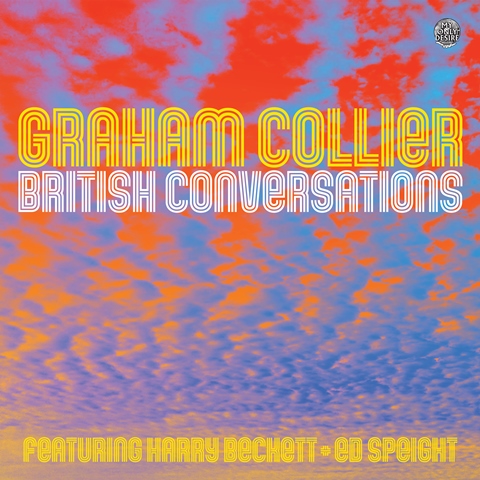
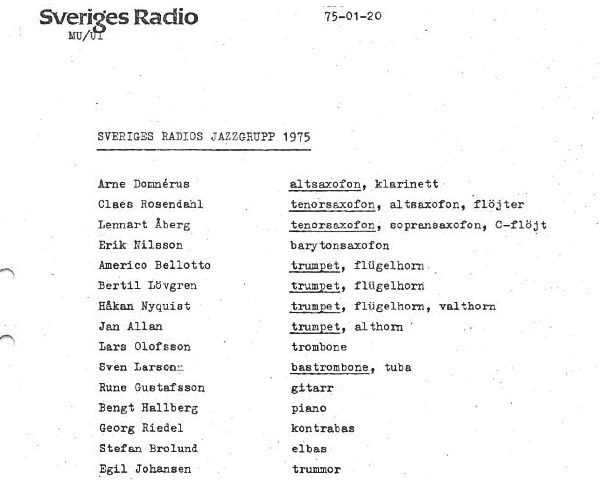
Entering this whirl is British Conversations, a release dedicated to a never-before issued recording from Stockholm’s Kulturhuset, taped on 27 February 1975. Firmly bracketed within the period when Collier was running Mosaic, what’s heard is a 49-minute suite titled British Conversations which was commissioned by Sveriges Radio. Collier conducts, and his regular collaborators Harry Beckett (trumpet, flugelhorn) and Ed Speight (guitar) play with 15 players from The Swedish Radio Jazz Group (the players are listed below left). British Conversations has five sections. The recording is studio quality and the sole indication this is a live recording is the applause heard at the end.
 Manifestly, this is music where the performance was preceded by forethought, planning and rehearsal. In his accompanying essay, Duncan Heining (the author of Mosaics - The Life and Works of Graham Collier) says that on top of what was issued on record, Collier undertook at least 60 continental European commissions. There’s a lot of lost work out there. For British Conversations, Heining says the contract stipulated 10 hours of rehearsal and a full dress rehearsal before the live broadcast. Collier is quoted on the repetition and the introduction of new melodies in the second section (“Clear Moon”) and noting that, overall, “beneath all the fragmentation a fairly straightforward melody is trying to get out.”
British Conversations ends with “Mackerel Sky”, its most tense section. Ed Speight steps on his fuzz pedal and employs sustain, nudging himself towards Jeff Beck territory. The contrast between this and the bands ebbing, flowing, percussive rendering of a series of refrains adds to the tension.
While it looks to the weather, British Conversations is more about signifiers of what might be in the offing: the sections are titled “Red Sky in the Morning”, “Clear Moon”, “Halo Round the Sun”, “Red Sky at Night” and “Mackerel Sky”. Rather than specifics, it's concerned with what signs imply. Analogously, this release of a previously unheard, fully formed work by Graham Collier is about what it says about him in this period; what it implies. While little is clear-cut with Collier, British Conversations confirms that nothing can be taken on its own, that something was always just out of reach. Now, this assured music enhances the narrative. Nonetheless, further pieces of the complex Graham Collier jig-saw are still needed to understand the full extent of the picture.
- Next week: Three CDs of The Sun Shines Here - The Roots Of Indie Pop 1980-1984
- More reissue reviews on theartsdesk
- Kieron Tyler’s website