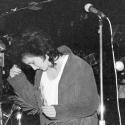
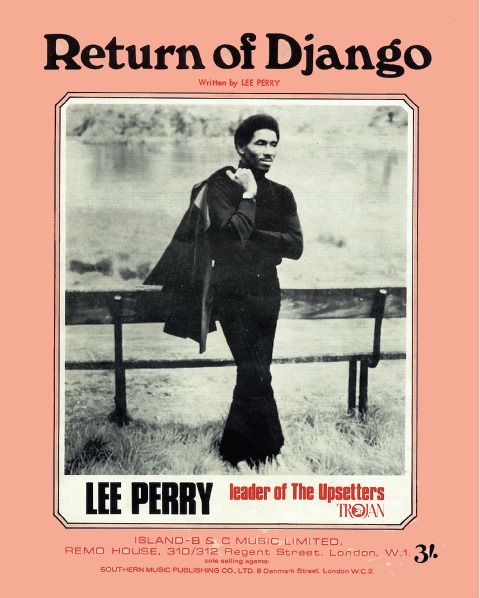
After the March 1969 UK release of the “Return of Django” single, prospective performers of the song could buy it transcribed as sheet music. On the record, the credit was “Upsetters.” For the sheet music, with its photo of a single person, the credit was “Lee Perry, leader of The Upsetters” (pictured below left). Close to a year on from becoming an independent operator, Perry was already singled-out as the music’s principal aspect. A Phil Spector analogue.
Of course, in Perry’s native Jamaica, the sound-system circuit meant those at the controls were as much a focus – and sometimes more so – than the singers or bands. Duke Reid, Clement ‘Sir Coxson’ Dodd and Joe Gibbs – all of whom the pre-independent Perry (1936-2021) had worked for – were names as recognisable as Stranger Cole and Delroy Wilson, who Perry had written for, or Prince Buster and Clancy Eccles, who Perry had co-produced with.
 Perry was unsatisfied with his work being used without credit and with underpayment or not being paid at all, so in 1968 he set himself up as an independent operator; playing, producing, songwriting and running his own label. Naming his first label “Upset” pointedly reflected his feelings about the situation he had been in. His appearance on the sheet music was in keeping with this choice to follow a solo path. Self-determination was his future. And, being the man he was, cult and more-than-cult status followed. Naturally, it also helped that he was a musical innovator and fully on-top-of and central to the changes in Jamaica’s music.
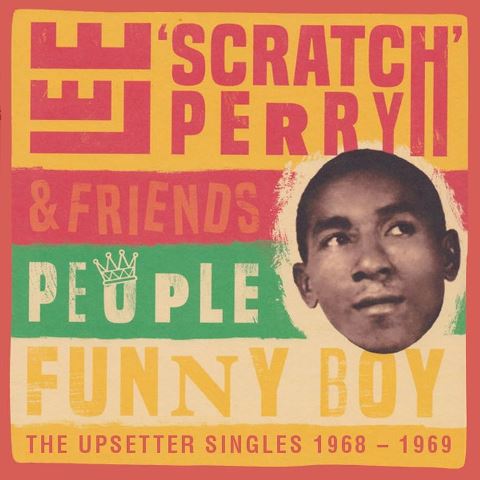
Across two discs, People Funny Boy: The Upsetter Singles 1968-1969 collects 53 tracks from Perry’s earliest years as an independent. While "Return of Django" is the best-known track, this is the most wide-screen picture to date of Perry's 1968 and 1969. The greatest number of tracks so far from these two years are brought together, and sequenced as close as possible to the order of release (no one will ever be able to figure out an exact sequence). There is master-tape sound quality. The booklet’s essay is by Perry’s biographer David Katz. The set comes in old-fashioned jewel case.
In his early years as an independent, Perry was competing with those he had worked for and with, and also had to make records which would bring a return – he needed to make singles which would be popular and hopefully sell. To a degree, his sustainability was aided by licensing deals with UK labels Doctor Bird, Punch and Trojan. Then, in Spring 1969, his own UK imprint Upsetter was up and running (in Jamaica, Upset was renamed Upsetter). Perry was not thinking of Jamaica as his sole market.
 People Funny Boy – its title taken from one Perry’s earliest independent A-sides – includes a raft of accessible tracks which could or did find a wide audience: Val Bennett & The Upset All Stars’ version of “Stranger on the Shore,” Burt Walters’ smooth “Honey Love,” The Righteous Flames’ ooh-la-la “Mini Dress,” The Mellotones’ tender “Dry up Your Tears,” The Bleechers proto-reggae “Check Him Out” amongst them.
Alongside these are less commercially minded cuts. Burt Walters’ “Evol Yenoh” takes the vocal track of “Honey Love,” and plays it backwards over the backing track. There is “Mad House,” credited on its label to Lee Perry, where the songwriter-producer attempts to recreate the soundtrack of the titular institution. The bizarre “Eight for Eight” is a 1968 Upsetters' instrumental which prefigures dub while also dipping its toes into easy listening. A curious mix. The Soul Twins’ “Pound Get a Blow” has a reverberant organ part which sounds as if a Leslie speaker was revolving very fast but is doubtless the result of some very fast stabbing at the keyboard.
There is ample evidence that even at this early stage of his life as an all-in-one music biz independent, Perry balanced commercial necessities with his non-conformist tendencies. However, the latter are framed within the overarching need to do business. An unbroken string of unconventional releases would not have given him a future. The hugely enjoyable and diligent People Funny Boy: The Upsetter Singles 1968-1969 fascinates because this is what it is about: the balance between making records which were designed to sell and releasing sides which were purely about sonic exploration. In time, Lee Perry would tip the balance in favour of the latter.
- Next week: 1960s beat-boom hopefuls Sean Buckley & The Breadcrumbs
- More reissue reviews on theartsdesk
- Kieron Tyler’s website