

The sense of occasion around flamenco guitarist Paco de Lucía’s return to London was palpable. The Royal Festival Hall was heaving. Queues at the bars before the show and during the interval were three or four deep. Spanish was everywhere. And that was good to hear. Paco de Lucía is a hero in his country as much for interesting political reasons as he is for purely musical ones. London-based compatriot fans were not going to miss this.
De Lucía emerged as a golden solo talent at the end of the 1960s from the many flamenco competitions that kept the art alive when the garbage put on for tourists on the costas nearly finished it off. By the mid-1970s, his partnership with one of the greatest singers to have come from any folk idiom, El Camarón de la Isla, was well established.
Volatile, gifted with fire, Camarón - a gypsy - got snagged on drugs and was dead by the age of 41. De Lucía, a genius on the guitar and arguably, still, the best player of the instrument in the world - and, as it happens, a non-gypsy (or “payo”) - is steadier, a real worker, constantly searching. And it was his innovations in the sombre, dark, unnotated forms of flamenco - embracing jazz-rock and funk - which coincided with a new national freedom. Franco died in 1975. De Lucía’s most important record, Almoraima, came out in 1976. The brilliant, border-busting sounds of his flamenco and the musicians he surrounded himself with was a lambent, rhythmically thrilling soundtrack for the end of Spanish fascism.
This, to sound a brief personal note, is when it hit me - in 1980, to be precise, when I first heard, on holiday in Valencia, the opening bars of the beguiling “Entre Dos Aguas” (Between Two Waters), a rumba-based anthem of de Lucía’s from 1973. I’ve been hooked ever since. He played in London several times in the 1980s (without Camarón: his drug dependency had begun to wear the guitarist down), but these shows could be curiously frustrating. De Lucía is a generous collaborator and was at this time, live, best known for his sextet, which included two of his brothers. The concerts were always a fantastic sonic experience, but I, for one, always ached to hear Paco just play solo.
For hour after hour after hour. His technique, combined with a rare gift for melody - and melody in itself is rare in flamenco - along with the extraordinary strength and speed of his playing, has long been simply one of the miracles of contemporary music. Before this concert, I was rabbiting on to some colleagues over post-work drinks about the likely state of his fingers. I hadn’t heard him play live since the late 1990s (he was on good but not barnstorming form), and now in his sixties, I wondered whether he could still astonish.
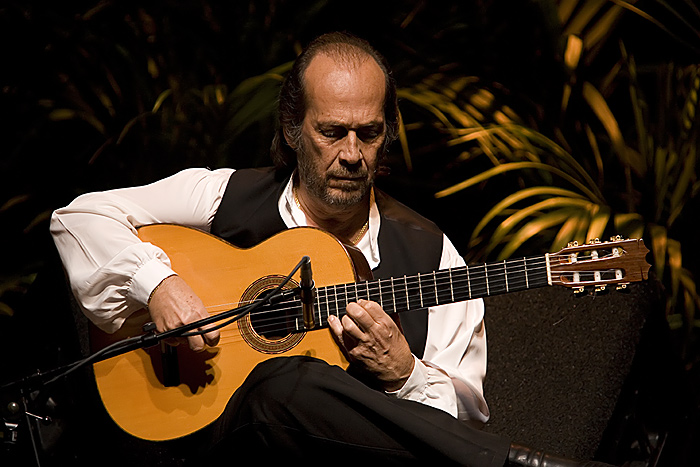 He did. De Lucía (pictured right) opened with a short solo set, containing familiar runs (falsetas) and patterns, but initially sounded a little tentative: it still made me cry. No worries whatsoever about the fingers: that familiar grasp of the neck, four solid fingers shaping still radical chords over the frets, right hand flexing over the sound hole with that ferocious alzapua of the thumb which is what gives flamenco guitar its unique percussiveness... His dynamism hasn’t diminished a jot with age.
He was joined by seven others: bassist, percussionist, keyboardist, second guitarist, two singers and, in black, a male dancer (no great shakes but his workouts gave Paco a break). Gorgeous music came from the band: the opening colombiana from Castro Marín (1981), the melting tribute to de Lucía’s wife Casilda from Siroco (1987), the crackling bulería “Soniquete” which opens Zyryab (1990) - and of course, towards the end, “Entre Dos Aguas”. Cue audience eruption.
Bassist, second guitarist, percussionist and keyboardist, playing many of Paco’s own lines, and some vocals, on harmonica all had solo slots. The singers, used judiciously, were volcanic. But at the centre of everything was this stocky Andalusian, balding and facially quite grizzled, playing his old and new flamenco, with all its fusions, twists and turns, as if it were the freshest thing ever to have come from Spain.
It is. Paco de Lucía is his country’s musical Picasso. He doesn’t know how to stop. I fully expect him to be on the same form in 10 years’ time. Until then, this will remain London’s impeccable, soul-shaking flamenco event of the year.
- The London Jazz Festival runs until 21 November
- Find Paco de Lucía on Amazon






Add comment