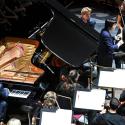
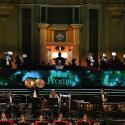
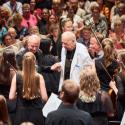
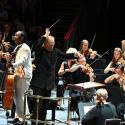
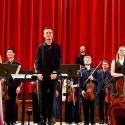
"Madness! Madness! Everywhere madness!" The unsung words of cobbler-philosopher Hans Sachs in the third-act prelude to Wagner's Die Meistersinger might seem like an odd opening manifesto for the Berlin Philharmonic Orchestra's annual May Day ceremonial concert this morning, hosted this year by Oxford in the gorgeous venue where the Berliners had last played under Karajan a very long time ago. But there was method in it. Whether or not Oxford's traditional May Day eve revels last night had any drunken brawl as threatening as the one which set Sachs meditating on human folly there was certainly a bacchanalian atmosphere outside the Sheldonian - and even more to be found inside.
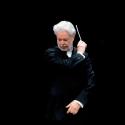
As concert-goers arrived, Morris men were gathered at the pub opposite; a student with dyed hair drunkenly wished us a merry morning, and all seemed right with the world. Never for long, as Daniel Barenboim of all conductors knows only too well, but all the more reason for him to send the orchestra thundering towards the final optimism of Brahms's First Symphony, leaving us jelly-limbed and open-mouthed.
I've never heard anything quite like it. Bows flew, strings sounded as if they might have snapped; even the orchestra was taken aback by the Dionysiac frenzy Barenboim had pulled out of the bag at the last minute. It wasn't up to that point the most radical of interpretations: all earth and fire, little air and water, Barenboim didn't always make the phrases fly. For that you'd have to go back to the Abbado era in Berlin, or Jurowski's drastic rethink at last year's Proms.
 Yet the sound of it had to be heard to be believed. That was clear from the first opening consolation of horns in the Wagner prelude. Later little flecks of colour - gurgling woodwind, a couple of bars of deeply significant clarinet phrases in an otherwise string-laden slow movement - gilded the nut-brown colour of Elgar's Cello Concerto. You couldn't get away with a lazy entry in the revealing acoustics of the Sheldonian Theatre, and yet the BPO never felt cramped here; their sound is innately rather than explicitly forceful.
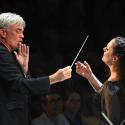
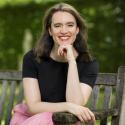
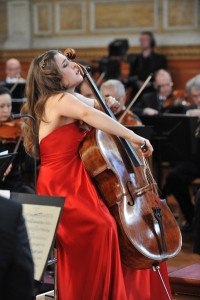
There was an added, unspoken frisson in seeing a vivacious young cellist play the melancholy old man of the Elgar under Barenboim's direction. To begin with, I thought Alisa Weilerstein (pictured right) would be as passionately extrovert as Jacqueline Du Pré - a legendary interpretation, of course, but by no means the whole introspective story. Yet she reined in for the great Adagio, working in close collaboration with her ever-sensitive orchestral colleagues to make every settling on a home key a little miracle.
At first the Brahms symphony felt rather more externalised; it took the searing oboe work of co-principal Jonathan Kelly to bring the necessary tears to the eyes. Nice, too, to see Daishin Kashimoto's co-front-desker pat his knee in warm congratulation of his soaring solo at the end of the slow movement. Barenboim did find a lightness in the intermezzo-like sequel, but at first seemed to be driving too hard in the finale as the clouds parted for the horn solo and the big string tune in the finale.
From the development onwards, the intensity went up and onwards to that final dithyramb. Hardened critics were shaking; and I certainly haven't heard the orchestra play this well live since Abbado's Brahms Third at the Proms. Go figure. The only pity of it was that while many European countries broadcast the event live on television and radio today, the BBC has it on hold for future transmission. Am I surprised?
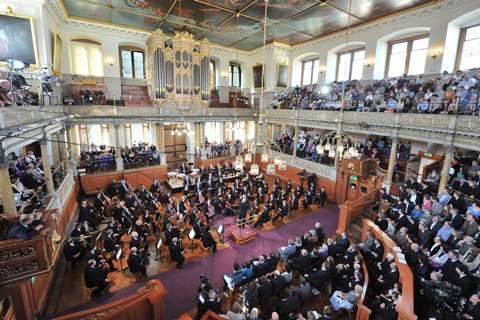
I've never heard anything quite like it. Bows flew, strings sounded as if they might have snapped; even the orchestra was taken aback by the Dionysiac frenzy Barenboim had pulled out of the bag at the last minute. It wasn't up to that point the most radical of interpretations: all earth and fire, little air and water, Barenboim didn't always make the phrases fly. For that you'd have to go back to the Abbado era in Berlin, or Jurowski's drastic rethink at last year's Proms.
Yet the sound of it had to be heard to be believed. That was clear from the first opening consolation of horns in the Wagner prelude. Later little flecks of colour - gurgling woodwind, a couple of bars of deeply significant clarinet phrases in an otherwise string-laden slow movement - gilded the nut-brown colour of Elgar's Cello Concerto. You couldn't get away with a lazy entry in the revealing acoustics of the Sheldonian Theatre, and yet the BPO never felt cramped here; their sound is innately rather than explicitly forceful.There was an added, unspoken frisson in seeing a vivacious young cellist play the melancholy old man of the Elgar under Barenboim's direction. To begin with, I thought Alisa Weilerstein (pictured right) would be as passionately extrovert as Jacqueline Du Pré - a legendary interpretation, of course, but by no means the whole introspective story. Yet she reined in for the great Adagio, working in close collaboration with her ever-sensitive orchestral colleagues to make every settling on a home key a little miracle.
At first the Brahms symphony felt rather more externalised; it took the searing oboe work of co-principal Jonathan Kelly to bring the necessary tears to the eyes. Nice, too, to see Daishin Kashimoto's co-front-desker pat his knee in warm congratulation of his soaring solo at the end of the slow movement. Barenboim did find a lightness in the intermezzo-like sequel, but at first seemed to be driving too hard in the finale as the clouds parted for the horn solo and the big string tune in the finale.
From the development onwards, the intensity went up and onwards to that final dithyramb. Hardened critics were shaking; and I certainly haven't heard the orchestra play this well live since Abbado's Brahms Third at the Proms. Go figure. The only pity of it was that while many European countries broadcast the event live on television and radio today, the BBC has it on hold for future transmission. Am I surprised?
- Visit the Berlin Philharmonic website
- Watch this performance on Medici TV