An aura of mystique surrounds Tinariwen. The members of this group’s shifting line-up are from the Tuareg people, nomadic Berbers of the North African desert regions, and several have taken part in armed Tuareg rebellions in the past. This air of mystery is enhanced by their garb – flowing robes and extravagant headdresses that mask most of the face (though singer/guitarist Ibrahim Ag Alhabib keeps his head – and his fabulous frizz of hair – uncovered). Their music, too, has a mystical quality, its repeated refrains acquiring a cumulative hypnotic potency.
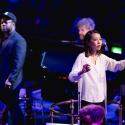
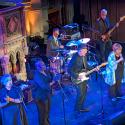
All this was in evidence at this one-off gig at Koko in Camden, where the band kept a packed, attentive audience – already warmed up by the intriguingly chosen support act, the very English folk singer Eliza Carthy – enthralled for 90-odd minutes. This was a slow-burning set, beginning with the thrum of an acoustic guitar, a delicately plucked electric bass, the gentle slap of a tindé drum, the chanting voices of the all-male line-up. Slowly, almost imperceptibly, as the evening progressed, the excitement levels rose: the volume increased incrementally, the band’s limbs loosened, the percussionist occasionally released a crackling rattle, an electric guitar squawled, so that by the end Tinariwen were unleashing a powerful surge of sound.
I couldn’t hope to name any of the songs they played, for the simple reason that Tinariwen’s music is essentially (and I don’t mean this in a bad way) the same song reconfigured and rearranged over and over again. On their latest album, Tassili, there’s a more acoustic flavour to the music, but essentially at its core it retains, as did most of the songs in this show, the shape and the structure of the Tinariwen template: a droning chord on an electric guitar (on several tunes tonight, the rhythm guitarist played just one chord throughout); a hand-drummed rhythm that resembles the rolling, swaying movement of a man riding a camel; a meandering bass; guitars that similarly weave around the drone note; and a simple vocal refrain, sung mostly in unison, with the quivering quarter-tones that are typical of the region.
It evoked night-time desert scenes with a flickering campfire, small cups of mint tea and a sky bristling with stars
The effect of all this was several-fold. First, for me it evoked night-time desert scenes with a flickering campfire, small cups of mint tea and a sky bristling with stars. Second, it induced a sort of trance-like state in which the mind meandered, sometimes meditatively, sometimes randomly, to be brought back to reality by a sudden snap of drums or the howl of a guitar. Also, too, it was music that had vivid echoes and re-echoes of a spectrum of Western music: for instance, the Velvet Underground (that droning guitar), the American folk music of Diana Jones (listen to her “Cold Grey Ground” and then anything by Tinariwen), Led Zeppelin, Bert Jansch, Neil Young and Robert Johnson.
It’s not terribly complicated stuff, but its appeal lies in the power of repetition – a force that’s been used in all manner of music, from Philip Glass to Kraftwerk to disco. These are not “songs” as such, with beginnings, middles or endings, but loops, grooves, that ebb and flow in power and intensity.
Tinariwen’s former fighting men have long since renounced the gun in favour of the guitar, which is probably wise given the associations between some of the Tuareg rebels and one of their former sponsors, Colonel Gaddafi. At this show, a flag supporting the Libyan liberation was waved and ended up draped across a microphone stand on stage, while elsewhere in the audience a flag was waved for neighbouring Algeria. Throughout, the six men of Tinariwen were mostly impassive, expressing their thanks in French or halting English, but otherwise remaining wrapped in their aura of enigmaticism.