

This was the Prom I’d earmarked as the most unmissable event out of this year’s 76. Starry attraction was the century-overdue UK premiere of maverick-mystic Dane Rued Langgaard’s Music of the Spheres, born for this of all venues. But the meshing of microscopic Ligeti with big stalwarts of the core repertoire, the marriage of legendary Danish choral singers with the country’s best orchestra and the presence of two live wires, violinist Henning Kraggerud and conductor Thomas Dausgaard, promised other fresh perspectives. Did they deliver? Truly, madly, deeply.
This was the Prom I’d earmarked as the most unmissable event out of this year’s 76. Starry attraction was the century-overdue UK premiere of maverick-mystic Dane Rued Langgaard’s Music of the Spheres, born for this of all venues. But the meshing of microscopic Ligeti with big stalwarts of the core repertoire, the marriage of legendary Danish choral singers with the country’s best orchestra and the presence of two live wires, violinist Henning Kraggerud and conductor Thomas Dausgaard, promised other fresh perspectives. Did they deliver? Truly, madly, deeply.
It's strange how the inclusion of that oddball Hungarian master Gyorgy Ligeti usually brings out the best in concert programming. Those of us lucky to be there will never forget the way Vladimir Jurowski segued straight from the cloud-clusters of Atmosphères into the opening bassoon solo of Stravinsky's Rite of Spring, or how Atmosphères subsequently billowed in the Albert Hall at the start of Jonathan Nott's Prom last year with the Gustav Mahler Youth Orchestra. Dausgaard's first coup was to let the burnished professional voices of the Danish National Vocal Ensemble steal upon the senses, to lead them from the soaring polyphony of the young Ligeti's Night to his welkin-ringing Morning and then to bring in first violins immediately with the opening bars of Tchaikovsky's Violin Concerto.
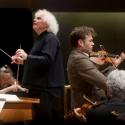
This first of the three parts Roger Wright has boldly incorporated into his recent Proms seasons flashed by in less time than many performances of the concerto alone. That was subject to a seemingly improvisatory whizz through Tchaikovsky's cornucopia of song from Kraggerud. Just when you thought he was going to rush it, he'd unbend a phrase, play with a melodic line in the most unpredictable way, and Dausgaard's orchestra was right there with him even in the maddest dashes.
The first movement, its lengthy recap usually redundant but not so here thanks to Kraggerud's fantastics, would have deserved the Proms audience's insistent applause, but Dausgaard authoritatively held the last chord and took another plunge, into the melancholy central Canzonetta, and latecomers who'd missed the 7pm start had to shuffle in and sit where they could. Here the woodwind, especially the free-and-easy principal clarinettist Olli Leppäniemi, were equal stars, and led us with a magical chorale into a fast and furious folk-finale. Vivacissimo indeed, and for a second night at the Proms we were treated to a master violinist in an encore, this time Kraggerud's own homage to the more soulful realm of fellow Norwegian Ole Bull, the Paganini of the North.
Part Two brought the extra-terrestrial slice we'd all been waiting for, again prefaced by dizzying choral Ligeti - this time the more disorienting Lux aeterna "as heard in 2001" (what apt but unusual music Kubrick chose for his psychedelic extravaganza, and what a cult kick he gave it). Where to begin with the confounding space odyssey of Langgaard's Music of the Spheres?
The prolific Dane was only 25 when he completed it in 1918, and as Calum MacDonald points out in his illuminating programme note, "much of it sounds as if he had hopped on a time machine and heard some of the leading avant-garde trends of the 1960s and 1970s". Indeed, when Ligeti first saw the score in 1968, he exclaimed that he was a "Langgaard imitator" without having known it.
Yet the 21 sections - think the panorama-finale of Mahler's Second Symphony and you get a hint of what to expect - find some kind of weird unity in an unexpected diversity: what's the healthier, folksy side of Nielsen, conspicuously absent from his fellow Danes' programme, doing at the heart of the piece? How does Langgaard make just a couple of descending chords so memorable? These are the kind of essential hooks - you can't always call them melodies - essential to any great work of art, largely missing from the previous evening's drift of lesser late romantics.
And the Albert Hall is the only place to relish Langgaard's spatial effects - the soprano (Inger Dam-Jansen, radiant from afar) and chamber forces showering down Straussian manna from above, the all-stops-out organ, the "glissando piano" washing around the spaces, the widescreen thunder of four sets of timpani. Here Dausgaard was able to show that he could turn his usually febrile spirit to timeless contemplation, and if at the mid-point of the 36-minute impressions we wondered where Langgaard could go, the ever-onward closing sequences took us higher and further than we'd imagined possible.
Any sane concert would have left it at that. But, no, the Danes wanted to show us after a second interval what could be done in a near-contemporary masterpiece that does choose, unlike Langgaard, to stitch and develop God's mosaic pieces, as Sibelius once put it. His Fifth Symphony is so difficult to pace. Earlier this year I seemed to be in a minority in finding that the widely praised Osmo Vänskä, halting and highlighting unnecessary details, missed completely the crucial first-movement climax Sibelius took four years, and three versions, to perfect. Dausgaard hit the mark, quivering nervously along the way but surmounting the peak all the more heroically.
In the oddest of intermezzos, Danish brass and pizzicato strings highlighted the gulf between the human song that wants to emerge and the implacable tread of time. And the finale, though it threatened to implode from all that volatility, again reached its goal via truly awesome dissonances, the trumpets bringing vividly to life the cries of Sibelius's beloved wild swans before leading us towards the still-shocking masses and voids of the last chords and gaps. And I could hardly believe my ears when Dausgaard conducted as encore my favourite Sibelius miniature, the tripping, less-than-a-minute clarinets-and-strings arrangement of "Where the bee sucks" from the composer's late, great Tempest music. Danish prankster Lumbye's Champagne Galop - not J Strauss arranged by Shostakovich as I originally misguessed - allowed the DNSO xylophonist a virtuoso turn (it was his presence that made me plump for Shostakovich's hand), and brought an already ecstatic full house down. Bring back this team, please, for more Sibelius, Nielsen and Langgaard symphonies.



Add comment