

“Too fat, too miserable, too pinched” for love and life, the Brontë sisters famously made a kingdom out of their dingy rectory home in rural Yorkshire. Denied not just a room but an existence of their own, these three Victorian spinsters found authority and expression in novels the world would have them unfit to read, let alone write. It’s an attractive legend, one that leans over the shoulders of Jane Eyre, of Cathy, Heathcliff and Helen Graham, reflecting their virgin-born passions back with all the greater intensity. Reversing this process, Polly Teale’s Brontë invites us instead to linger on the sisters themselves, refracting their lives through the words and deeds of their fictional creations.
Originally staged in 2005, Shared Experience’s production is the third in a Brontë trilogy created by Teale. What started with a straightforward stage adaptation of Jane Eyre (albeit with typical Shared Experience physicality) took a more meta-literary turn with After Mrs Rochester, before going back to where it all began in the biographical Brontë.
It should be said upfront – as the author herself does in a programme note – that biographical facts are no more of a restriction on Brontë than original texts are to any of Shared Experience’s adaptations. The goal here is one of emotional fidelity, manipulating facts, chronology and dramatic unity to serve this process. The result is, in that most damning of faint praises, accomplished. The mechanisms are all exposed to view: fictional doubles duly echo and deny their creators; traumatic events find themselves transposed and transformed on the page; the return of the repressed takes physical form. Admire it though I did, I remained unmoved and never unmoored from the theatrical practicalities of it all.
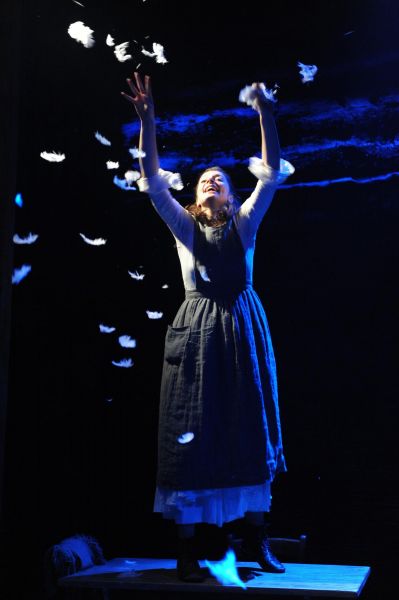 Tone is a problem in Nancy Meckler’s revised production (returning the original actresses to their roles). In trying to trace the Gothic brutality of Wuthering Heights back to Haworth, Meckler insists on excess and anger until no character simply walks across the room or turns away, but instead is flung bodily into furniture, or dashes in a frenzy from place to place. It’s all rather highly strung, a drama of fits and starts where everything is always bursting out or chafing against, charged without the fulfilment of satisfying narrative release. The deaths of Anne and Emily are perfunctory affairs, while Charlotte’s courtship and marriage is played for comedy.
As the rigid, dominating Charlotte, Kristin Atherton compels and repulses in equal measure. Stalked by Bertha Mason (Frances McNamee, pictured right also playing Cathy), she struggles plausibly with her physical and moral instincts, offering an anchoring point for Elizabeth Crarer’s delicately underplayed Emily and Flora Nicholson’s pliant Anne. The family dynamic is at its most vivid in the scenes of adulthood, but childhood flashbacks offer the glorious visuals of youthful adventure tales: brother and sister voyage on the kitchen table, heavy skirts becoming billowing waves, breaking in a froth of white petticoats. The Tricycle’s generous stage space for once hinders matters however, giving little sense of a claustrophobic frame against which to bounce these visual imaginings.
In a scene of Teale’s imagining we watch the impressionable Charlotte in conversation with a professor at school. Railing at her overwrought prose, he demands something new of her, a description that shocks the reader into new understanding. It is this unexpectedness, this theatrical jolt, that Brontë itself currently lacks. Attacking long-besieged territory with an arsenal of blunt symbols (is there really need for Bertha to writhe and convulse at every opportunity for us to grasp the madwoman/sexualised woman elision?) Teale and Meckler cannot hope to startle. Jane Eyre has already been seduced by everyone from Orson Welles to Michael Fassbender, the door to the attic of repressed Victorian womanhood long since flung wide and the windows wiped clean; to reinstate these conditions is too artificial a process to coexist with emotional authenticity. Brontë reduces Anne’s novels to “context” for the real classics written by her sisters. It’s a supporting role the play itself risks performing.









Add comment